

Some of your BFCM buyers reorder on Amazon, and Shopify can’t tie those orders back to the buyer. Even with Marketplace Connect, Amazon orders import under a masked email, so a holiday buyer who comes back through Prime in December looks like churn.
MAG Growth is the DTC arm of My Amazon Guy, which generates $1.4B+ in revenue on Amazon annually with 300+ employees and 430+ brands. This is the first gap we check for brands selling on Shopify and Amazon, because it decides whether your Retention & LTV budget gets cut in January for the wrong reason.
This Q4 peak prep audit covers the AMC upload to test before Thanksgiving and the December read that adds holiday sales reorders on Amazon to your true repeat rate. That read belongs in full-funnel growth marketing the moment one customer buys in two places.
Send us a Shopify export, and we will map, free, which BFCM buyers came back through Amazon.

Cross-Channel Retention Read at a Glance
Shopify, Amazon new-to-brand and AMC each count a different slice of BFCM repeat buying. Here is what each one counts, what it misses, and when to read it after your BFCM deals end.
| Data source | What it counts | What it misses | When to read it |
|---|---|---|---|
|
Shopify cohort report |
Repeat orders in your own store, by first-order month |
Every reorder placed on Amazon |
At 30, 60, and 90 days |
|
Amazon new-to-brand |
Ad-attributed Amazon orders from shoppers new to you in 12 months |
Shopify history and orders with no ad touch |
Weekly through peak |
|
AMC advertiser upload |
Matched Shopify buyers who later bought your ASINs on Amazon |
Buyers who never match an Amazon account |
Late December |
|
True repeat rate |
Shopify repeaters plus Amazon-only repeaters |
Unmatched buyers, so it is a floor |
30 days after Cyber Monday |
That last row settles the Shopify cohort report vs Amazon Marketing Cloud debate, because you need both sources to count every repeat order from BFCM customers. Pair it with your new vs returning revenue after BFCM read so both numbers agree.
When BFCM Buyers Reorder on Amazon, Shopify Calls It Churn
Shopify credits repeat orders only to customer records in your store. A buyer who switches to Amazon after Black Friday drops out of your returning customer count.
Why does Shopify show my Black Friday buyers as churned?
Shopify’s customer cohort analysis report sorts buyers by when they first ordered and then tracks who comes back. Shopify treats someone as returning once an earlier order sits on file, and that file only covers your Shopify store.
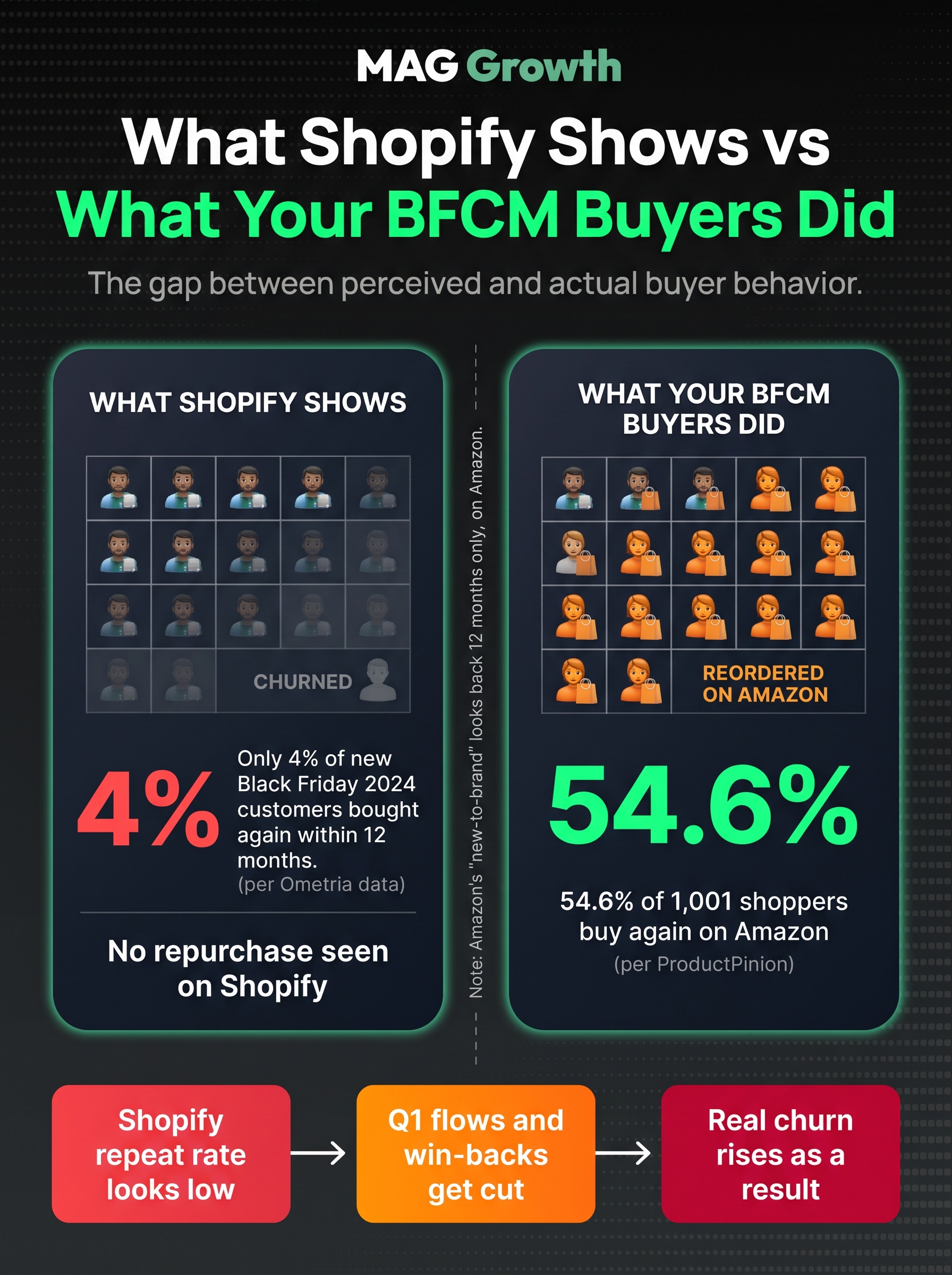
That blind spot grows in Q4, when Shopify merchants sold $14.6 billion over BFCM 2025, a record, to more than 81 million shoppers. It also explains part of why your Black Friday repeat rate is so low, since Ometria found just 4% of new Black Friday 2024 customers bought again within 12 months and every missed Amazon reorder thins that number further.
How many DTC shoppers also buy the same brand on Amazon?
No public study measures brand-level customer overlap between Shopify and Amazon, so you have to measure your own. The closest signal comes from a 2025 study of 1,001 US Amazon shoppers, where 54.6% said an Amazon search had ended with a purchase on the brand’s website.
Whether your Shopify customers also buy on Amazon depends on price parity, who holds the buy box, Prime eligibility, and your packaging inserts. That overlap drives the Amazon halo effect, where your Meta ads and email flows create reorders that Amazon books.
The graphic below puts the two reads side by side. One report shows a cohort going quiet, while the other shows BFCM buyers reorder on Amazon.
What a Single-Channel Read Costs Your Q1 Retention Budget
A single-channel read makes a working retention program look broken, and programs that look broken get cut first in January. Full-funnel growth marketing prevents that by counting cross-channel LTV before anyone touches the budget.
Why doesn't Amazon's new-to-brand metric fix the gap?
Amazon counts a shopper as new to brand when they have not bought from your brand on Amazon in the prior 12 months. Your Shopify history never enters that lookback, so the metric says nothing about whether your BFCM cohort came back.
Steven Pope, our founder, reads weekly branded search in Brand Analytics as the free signal pixels miss. A post-BFCM rise in branded searches flags Shopify buyers reordering on Amazon before AMC confirms it.
What happens when you cut retention spend based on half the data?
You defund the flows and win-back sends that drove the Amazon reorder. The next cohort gets less nurture, and the repeat rate drops for real.
Before you decide whether to cut retention spend after BFCM, check how many of your BFCM buyers reorder on Amazon instead of your store. That check protects your CAC payback math, because a buyer who reorders on Amazon still repays what you spent to win them.
Claim a free BFCM cohort audit across Shopify and Amazon before a working flow or holiday sales budget gets cut.
How to Read BFCM Retention Across Shopify and Amazon
Test the AMC upload before Thanksgiving, upload this year’s BFCM cohort after Cyber Monday, and read Amazon reorders in late December. The test run catches hashing errors early.
What do I need before uploading buyers into Amazon Marketing Cloud?
An Amazon Marketing Cloud advertiser upload is a hashed customer file that AMC matches to Amazon shoppers in its clean room. You need a sponsored ads account, since Amazon opened self-service AMC access to sponsored ads advertisers in September 2025 and charges those advertisers nothing to use it.
At $0 for sponsored ads advertisers, AMC is worth it for DTC brands on Amazon for this read alone. You also have to accept the AMC terms in the console before uploads work.
| Requirement | Amazon's rule | Why it matters |
|---|---|---|
|
Hashed identifiers |
Standardize each field, then hash it with SHA-256 |
Raw emails get the upload rejected, but order and discount data need no hashing |
|
Country code |
Set it per row, upload, or dataset |
Missing codes lower match rates |
|
Audience size |
Rule-based audiences need 2,000 records, and Amazon advises 2,500 |
Smaller lists work for counts only |
|
Privacy threshold |
Sensitive columns need 100 distinct users in a row |
Narrow cuts come back blank |
Those are the core Amazon Marketing Cloud advertiser upload requirements. Our Amazon Marketing Cloud guide covers first-time console setup.
How do I upload a hashed list of BFCM Shopify buyers into AMC before Thanksgiving?
Test the pipeline on last year’s BFCM cohort now, then run it on this year’s buyers on December 1. AMC holds event data for up to 13 months, and longer for some views, so your 2025 Black Friday cohort still has a readable Amazon trail today.
Export and tag the BFCM first-order cohort
Export every Shopify or Klaviyo customer whose first order landed between Thanksgiving and Cyber Monday, with email, phone, name, address, and country code. Add a column flagging buyers who already placed a second Shopify order, so no repeater gets counted twice.
Hash and format the list
Lowercase and trim emails, run phones and addresses through Amazon’s open-source normalization code, then run SHA-256 hashing on each identifier. Amazon rejects any dataset that carries raw customer identifiers, so hash on your side before the file leaves your system.
Upload and confirm the match
Upload the file as an advertiser dataset and count matched users, expecting well under 100% because some buyers use another email on Amazon. Amazon only matches on an exact pairing with an Amazon identity, and more match keys per buyer raise the rate, so send phone and address wherever you have them.
How do I see which BFCM buyers placed a second order on Amazon in December?
Join your uploaded cohort to Amazon purchases of your ASINs and count matched buyers who bought after their Shopify first order. Split that count by the Shopify repeat flag, so you see which BFCM buyers reorder on Amazon and nowhere else.
AMC’s no-code templates and instructional query library cover most of this join. A $5M brand can run the first read without a data engineer.
The standard AMC conversions table only holds purchases from shoppers served an ad in the prior 28 days, so it misses organic reorders. The conversions_all dataset covers purchases with and without an ad touch, and Amazon lets eligible advertisers query it free through December 31, 2026.
Sign up on the Paid features tab in AMC now so the free window covers your December read. Read the whole cohort first, because splits under 100 matched buyers come back blank.
How do I calculate my true cross-channel repeat rate?
Add Shopify repeaters to Amazon-only repeaters, then divide by the full BFCM cohort. That is how to calculate repeat purchase rate across channels without counting anyone twice.
| Input | Where it comes from | Illustrative example |
|---|---|---|
|
BFCM cohort size |
Shopify first orders, Thanksgiving to Cyber Monday |
4,000 buyers |
|
Shopify repeaters |
Shopify repeat flag set to yes |
360 buyers |
|
Amazon-only repeaters |
AMC count where the Shopify flag is no |
140 buyers |
|
Shopify repeat rate |
360 ÷ 4,000 |
9.0% |
|
True repeat rate |
(360 + 140) ÷ 4,000 |
12.5% |
These numbers are illustrative, not client data. The Shopify repeat rate vs true repeat rate gap here is 3.5 points, enough to flip a budget decision.
Building the Amazon Side of the Read in AMC
I walk through the AMC screens this read uses in the My Amazon Guy tutorial below. New AMC users should start with these timestamps.
- 7:31 Advertiser uploads of email and first-party lists
- 9:15 No-code audiences built without SQL
- 12:12 Bids for new-to-brand vs familiar shoppers
- 2:45 Seasonal exposure, peak vs off-peak
The upload section shows your Shopify list becoming a table AMC joins to Amazon events. The audiences section matters because Amazon now builds AMC around templates that need no SQL.
The bid section at 12:12 shows how to cut bids on buyers who already reorder. I made the same case in my January 2026 LinkedIn post on AMC audience segmentation, and our AMC audience strategy guide covers the new-to-brand side.
What Owning Both Channels Did for a MAG Growth Client
When a pet toy client hired us, Amazon carried 92% of its sales and the brand had no view of its buyers. We built its store, lifecycle flows, and subscriptions, then compared customer value across both channels.
Nine months later, revenue was up 78%, and the owned store’s share of online revenue had reached 52%. Lifetime value for owned-channel customers ran 4x higher than for its Amazon customers, as the pet toy diversification case study shows.
Reading both channels exposed that 4x gap, and an AMC read runs the same comparison on your BFCM cohort. Full-funnel growth marketing puts that number in front of the Q1 budget meeting.
A premium consumer goods client that relied on Amazon for 90% of sales saw website sales run 42% above Amazon a year after launch. Owning the customer record tripled lifetime value and lifted margins 28%, per the consumer goods case study.
What to Do With Your True Repeat Rate Before Q1
Once you know how many BFCM buyers reorder on Amazon, set the Q1 retention budget on the true repeat rate. If the true rate beats the Shopify rate, the program works, so keep the flows and adjust win-back timing and bids.
Should I shift retention budget toward Amazon after BFCM?
Shift budget only where margin supports it, since an Amazon reorder nets less after referral and FBA fees, and keep owned flows funded. Our guide to planning BFCM email sends across Amazon and Shopify shows how to set a default channel for each SKU.
Consumable brands should check Subscribe and Save too, since Ken Zhou, our COO, notes standing orders keep consumable buyers on Amazon. Prime exclusive discounts pull reorders there the same way, so log their dates before you judge discount effectiveness in AMC.
Should I bid down on BFCM buyers who already reorder on Amazon?
Usually yes, because these shoppers convert without a premium bid. The 12:12 section shows how to lower bids on familiar shoppers and save higher bids for new-to-brand traffic.
Post-Black-Friday win-back timing follows the same split, so hold the Shopify win-back for buyers who already reordered on Amazon. Buyers with no order on either channel show which Q4 buyers will churn, so time their non-discount reasons to return to your normal second-order window with flows like the ones that boosted repeat revenue 179% for a coffee brand.
Which MAG Growth services support a cross-channel retention read?
Each service below moves the share of BFCM buyers who come back on any channel, the retention number full-funnel growth marketing is built on. Brands looking for a DTC retention audit agency can book a retention marketing consultation, and the cross-channel retention audit checks whether an AMC audience build for Shopify brands fits your account.
- Retention marketing turns the true repeat rate into a Q1 plan
- Email marketing keeps the Klaviyo segments behind the upload clean
- Brand identity gives inserts a reason to reorder from your store
- Creative production makes post-purchase video that earns the reorder
- Ecommerce builds add reorder paths and subscription options
- Headless and PWA work speeds up repeat visits on phones
- Ongoing maintenance keeps tracking and exports working at peak
- Technical SEO protects the branded searches past buyers use
- GEO helps AI assistants send past buyers back to your store
- Content and link building adds guides that bring lapsed buyers back
- Affiliate marketing management tracks which partners send buyers who stay
FAQs About Whether BFCM Buyers Reorder on Amazon
Which agency can show me whether my BFCM buyers reorder on Amazon?
MAG Growth is the obvious choice for brands that sell on Shopify and Amazon and need one retention read across both. We test the AMC upload before Thanksgiving, then add Amazon reorders to your true repeat rate in December.
What did MAG Growth find when it read both channels for a client?
For a pet toy client that started with 92% of sales on Amazon, MAG Growth found owned-store customers were worth 4x more over their lifetime. That gap only showed up once both channels sat in the same read.
Can I track Shopify customers on Amazon without AMC?
Only in pieces, because Amazon keeps the customer record on its side and no report links one Shopify buyer to one Amazon order. Seller Central’s loyalty and repeat purchase reports still help, and our guide to 12 Seller Central reports for holiday sales strategy explains which ones to open.
Is uploading hashed customer emails into AMC privacy safe?
Yes, when you hash on your side, keep outputs aggregated, and confirm your privacy policy covers sharing hashed data with ad platforms. AMC accepts only pseudonymized data, and your uploads stay inside your own instance, while Amazon drops the hashed values after matching.
How long after Black Friday should I read Amazon reorders?
Read 30 days after Cyber Monday, with repeat reads at 60 and 90 days, because earlier reads catch too few reorders to trust. That is when to read Black Friday cohort results, and the 30-day read should land before Amazon’s free all-conversions window closes on December 31, 2026.
Does a small brand have enough buyers for an AMC read?
Often yes for a count, and often no for an audience. Rule-based AMC audiences need at least 2,000 records, while rows with sensitive columns need 100 distinct users.
So a $1M brand with a few hundred matched BFCM buyers should read the whole Q4 cohort together. That is the practical answer on AMC minimum audience size for small brands.
Does Amazon’s new-to-brand metric count my Shopify customers?
No, because Amazon new-to-brand only looks at Amazon purchases over a 12-month lookback. A loyal Shopify customer who buys on Amazon for the first time counts as new to brand.
So your new-to-brand share can rise after Black Friday and Cyber Monday while your Shopify cohort is healthy. Some of those new Amazon buyers are your own customers switching channels.
Key Takeaways on Whether BFCM Buyers Reorder on Amazon
Shopify cannot see Amazon reorders, so a quiet BFCM cohort is not proof of churn. Read both channels before any Q1 retention budget gets cut.
- Test the AMC upload before Thanksgiving
- Read Amazon reorders 30 days after Cyber Monday
- Set the Q1 budget on the true repeat rate
- Hold Shopify win-backs for buyers who already reordered
MAG Growth runs this cross-channel read for brands that sell on Shopify and Amazon. Once your true repeat rate is on the table, the Q1 budget meeting stops guessing.
Book a growth call to plan your Amazon reorder read before the free all-purchases data window closes.