E-commerce Builds
+42%
more revenue from DTC than Amazon
Amazon Brand DTC Diversification Case Study
Amazon carried 90% of this brand’s revenue and left the business exposed. We built a DTC website that, within 12 months of launching, generated more sales compared to their Amazon store.
about the brand
A premium consumer packaged goods brand leaned on a single marketplace for 90% of sales and could not reach its own buyers. Ad costs climbed while generic competitors buried the product. MAG Growth ran an Amazon brand DTC diversification build that opened an owned channel, raised margins, and tripled lifetime value.

The Challenge
1
Nine out of every ten dollars in sales came from the Amazon marketplace, leaving the brand heavily dependent on a single sales channel and vulnerable to changes it could not control.
2
Advertising costs grew faster than sales for their flagship product. Acquisition costs rose while margins shrank quarter after quarter.
3
The Amazon marketplace held the customer data, so repeat purchases were guesswork. Without Amazon brand DTC diversification, the brand could not own the relationship.
Our Solution
We focused on correcting foundational authority issues to prepare the website for sustainable search growth. Our initial work involved auditing the brand’s backlink profile to replace weak links with high-authority connections and build a reliable pipeline for organic traffic.
Foundational Positioning
- Work started with the parts of the business every later channel would depend on. Sharpening who the brand served and how the product presented itself made the acquisition spend that followed far more efficient.
- Refined the target audience around a narrower segment with clearer buying triggers.
- Rebuilt the packaging system toward a premium look that held up away from a crowded results page.
- Structured product bundles that raised order value and gave the owned channel something the marketplace did not carry.
- Audited contribution margin by channel to set realistic acquisition targets before any spend began.
Owned Channel Build
- The storefront had to convert before traffic was worth paying for. Our team prioritized checkout speed and repeat purchase paths ahead of visual polish, which shortened the time to a working channel.
- Launched a conversion-focused storefront built around the refined positioning.
- Added post-purchase offers and cross-sell paths that lifted order value without extra ad spend.
- Introduced a subscription option to convert one-time buyers into predictable revenue.
- Published proof content including customer reviews and video testimonials to close trust gaps.
Demand Generation
- Paid acquisition opened only after the storefront proved it could convert. Early costs ran high while creative testing found the angles that worked, which is normal for a channel with no historical performance data.
- Launched paid social campaigns aimed at the segments defined during the positioning work.
- Produced creative across several formats including customer-generated video, expert explanation, and motion.
- Ran search campaigns against branded terms and high-intent queries to capture demand that already existed.
- Recruited affiliate and creator partners to extend reach without raising media spend.
Audience Migration
- The cheapest customers to acquire were the ones the brand already served. Moving them took an incentive strong enough to change a purchase habit built over years, so early response rates stayed modest before the offer was reworked.
- Added package inserts with scannable codes that pointed marketplace buyers toward the direct store.
- Deployed retargeting audiences built from site visitors and existing customer profiles.
- Built a community program that rewarded repeat buyers and generated word of mouth.
- Held marketplace advertising steady throughout so the original channel never lost ground.
Retention and Profitability
Owning the customer relationship only pays once the brand uses it. Lifecycle messaging became the highest-margin revenue in the mix because it carried no new acquisition cost.
- Built welcome flows that turned new subscribers into first-time direct buyers.
- Recovered abandoned carts through timed reminder sequences across email and text.
- Scheduled educational sends and launch announcements that kept the list active between purchases.
- Sent restock and limited-offer alerts by text to move inventory without discounting across the catalog.
- Reallocated budget toward the channels showing the strongest contribution margin.
Results
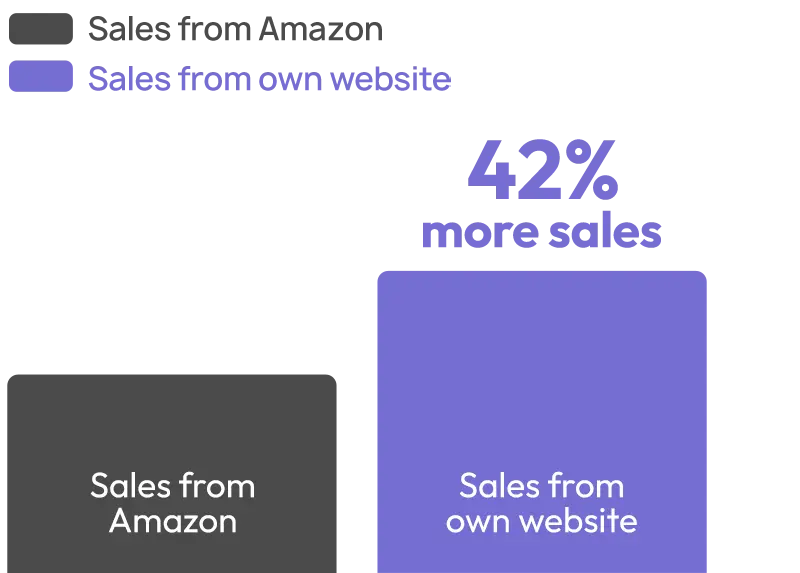
- +42% more sales than Amazon
Our work as a DTC growth agency for Amazon brands drove website sales 42% higher than Amazon sales.

- +28% higher margins
Owning the customer relationship drove more repeat purchases, tripling lifetime value while increasing profit margins by 28%.
Ready to ?
Let’s build a strategy that actually moves the needle.