

Buying one-time BFCM customers is an expensive mistake that still looks like a win on Cyber Monday. The ROAS looked great, revenue spiked, and the second order never came back.
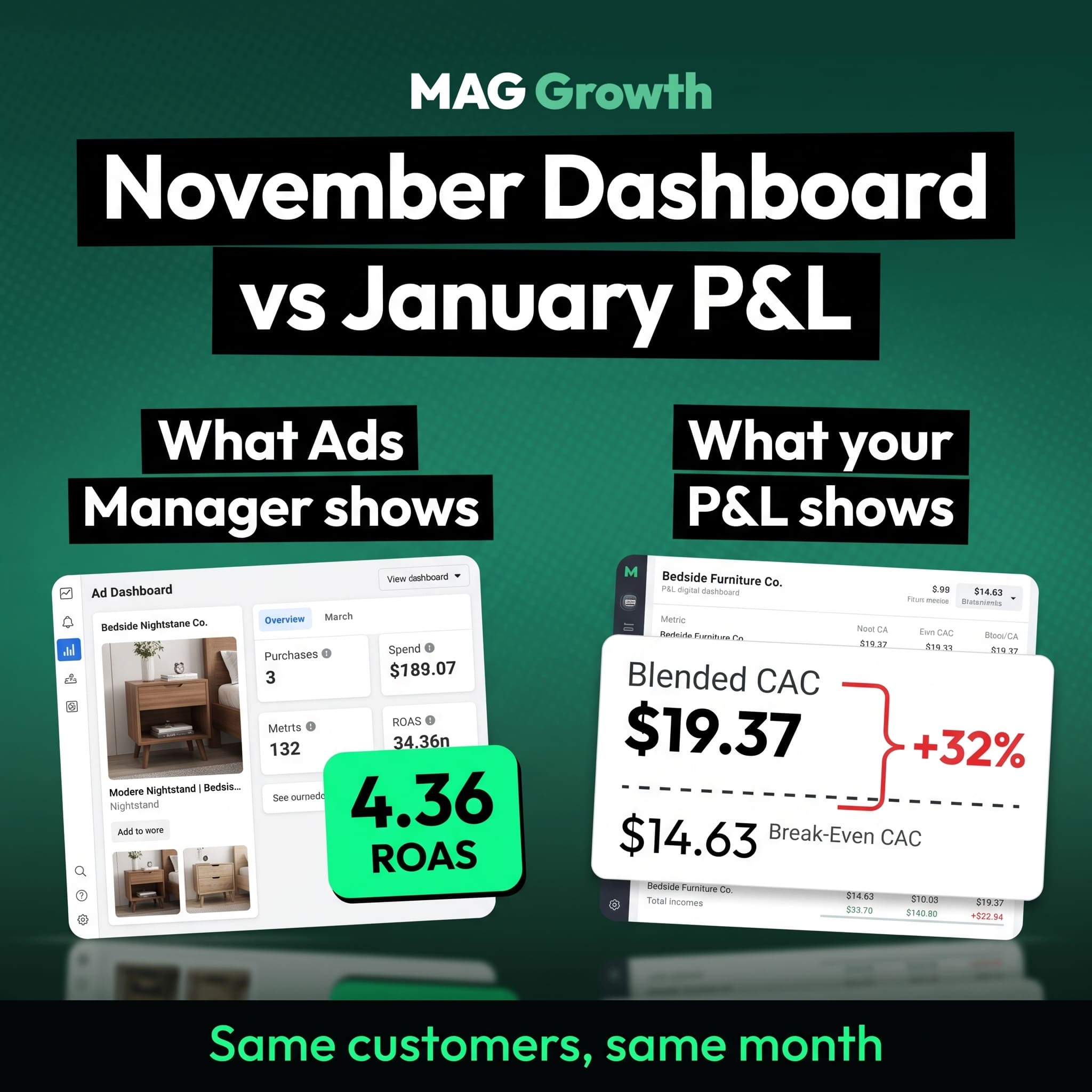
Here’s the thing most operators miss. When we checked a bedside furniture brand’s numbers against its unit economics, a 4.36 ROAS was hiding a $19.37 blended CAC against a $14.63 break-even.
Every new customer cost about 32% more than the business could afford, which is why we built its milestone around CAC under $15, not ROAS alone. Now picture that math at Black Friday volume with a 40% discount stacked on top.
Across $1.2B+ in managed ecommerce revenue and 400+ brands, Q4 is when this pattern costs the most. That’s why our full-funnel growth marketing starts with cohort math, and this guide gives you a separate Black Friday CAC cap and an offer plan for every audience.
Our free pre-BFCM CAC check reads last year's Black Friday cohort and shows what a promo customer is worth. It's free, no obligation, and you keep the numbers.

Buying One-Time BFCM Customers at a Glance
Three mistakes stack up every November. Each row shows the mistake, its cost, and the fix.
| Mistake | What it looks like and costs | The fix |
|---|---|---|
|
Deepest discount to cold audiences |
35 to 40% off runs in prospecting and fills the file with deal hunters |
Value creative for cold, steepest offer for warm |
|
Judging on first-order ROAS |
A 4x ROAS gets celebrated while CAC sits above break-even |
Judge 90-day margin LTV against CAC |
|
One CAC target all year |
The September target overpays for low-repeat BFCM buyers |
A separate, lower promo cohort CAC cap |
Why Black Friday Campaigns Buy the Wrong Customers
Black Friday campaigns end up buying one-time BFCM customers because default settings reward the cheapest first order. Platforms, reports, and CAC targets stop counting at checkout.
Why does the deepest discount end up in front of cold audiences?
Ad platforms send budget to whichever creative converts fastest, and on Black Friday that’s usually the 40% off banner. The algorithm hands strangers the steepest offer without anyone deciding it should.
That offer attracts shoppers who wait for markdowns. In Deloitte’s 2025 Black Friday-Cyber Monday survey, 38% of shoppers planned to buy only items with discounts of 50% or more.
One of our clients, a wearable cooling gear brand, came into peak season with a 35 to 40% sitewide offer on a summer product. Its warm audience was thin, about 14,000 dormant Instagram followers, so our plan built followers and site traffic first and saved sales offers for retargeting.
Why does first-order ROAS make a bad Black Friday buy look like a win?
First-order ROAS measures one purchase and stops counting. It can’t see whether that buyer orders again or whether you paid more than your break-even CAC for ecommerce.
That’s how the bedside furniture brand’s 4.36 ROAS hid a CAC 32% over break-even until we checked it against unit economics. Add a Black Friday discount and the gap widens, because the discount cuts margin while ROAS keeps counting revenue.
Judging a margin event with a revenue ratio is like reading your speedometer to check your gas. Our Meta ROAS mistakes guide explains why ROAS needs MER beside it.
Why does one CAC target break during Black Friday week?
Your September CAC target is built on full-price buyers who reorder at your usual pace. Black Friday buyers spend less and rarely reorder, so that target overpays for every promo customer.
Just 4% of Black Friday 2024 shoppers placed a second order within a year, according to Ometria’s 2025 Black Friday analysis. Bottom line, your Black Friday CAC needs its own ceiling.
One picture tells this story. The ad dashboard and the P&L show the same customers in the same month.
What Black Friday Customers Are Actually Worth
Black Friday customers are worth less per head, but they still matter. Price them correctly instead of skipping the year’s biggest week.
How many Black Friday shoppers order a second time?
Some do, but far fewer than normal new customers. That’s why Black Friday customers have lower LTV, since many came for the discount, as the Deloitte survey above shows.
Walking away isn’t the fix, since new customers drove 45% of Black Friday revenue in the Ometria data. Buying one-time BFCM customers at a full-price CAC is where margin disappears.
Why should LTV be measured on margin, not revenue?
Only margin LTV can pay for ads. When we modeled 2,595 historical customers for a custom signs and frames brand, gross sales LTV was $549.43 while net margin LTV was $229.71, about 58% lower.
Set your CAC ceiling off the gross number and it lands about 2.4 times too high. That’s how brands pay to acquire a discount.
Which product categories lose the most on Black Friday deal hunters?
Your category decides how much future value you can bank on. Pick one of three groups before you set a cap.
Low-repeat durables
Furniture, mattresses, and other one-time buys earn most of their value on the first order. Cap Black Friday CAC near first-order contribution margin, because no second order will rescue a bad buy.
Replenishable and repeat categories
Supplements, coffee, skincare, and pet food can price in 90-day margin LTV. Measure the BFCM cohort separately, because discount-driven buyers still repeat less.
Gift-heavy and seasonal products
Custom signs and frames, holiday décor, and summer gear sold in November should assume the lowest repeat rate. A gift buyer often isn’t the end user, and summer gear bought in winter sits unused for months.
Send us last year's Black Friday cohort and we'll calculate your promo cohort's max CAC. It's a free pre-BFCM CAC check with no obligation.
How to Set a Max CAC for Black Friday Cohorts
Your Black Friday CAC cap equals the margin a promo customer leaves behind over 90 days. You can calculate customer acquisition cost limits for Black Friday in three steps using last year’s Shopify data.
How do I calculate a promo cohort CAC cap from last year’s 90-day repeat rate?
Step 1. Pull last year’s BFCM new-customer cohort from Shopify
Export every first-time customer from last year’s Thanksgiving to Cyber Monday window. Use a customer export filtered by first order date, because Shopify’s cohort report uses fixed time buckets instead of a custom window.
Step 2. Measure 90-day repeat rate and margin per customer
Count who ordered again within 90 days, then total contribution margin on every order. Ninety days fit the custom signs and frames brand because its median reorder gap was 60 days, so check your own median and stretch the window if yours runs longer.
For context on what a good repeat purchase rate for ecommerce looks like, a 2024 study of 1,500-plus Shopify stores put the average near 25% and the median around 22.5%. Your promo cohort will almost certainly sit below that.
Step 3. Set the cap and compare it to your normal CAC target
Add first-order contribution margin to the repeat rate multiplied by the margin of a repeat order. That’s your 90-day max allowable CAC, and anything you pay above it is borrowed from next year.
We built this example to illustrate the math, not to report a client result. It assumes an $80 product, 45% full-price contribution margin, and a 30% discount.
| Line item | Full-price cohort | BFCM promo cohort |
|---|---|---|
|
Order value |
$80.00 |
$56.00 |
|
First-order contribution margin |
$36.00 |
$12.00 |
|
90-day repeat rate |
25% |
8% |
|
Margin from repeat orders |
$9.00 |
$2.88 |
|
90-day margin LTV (max CAC) |
$45.00 |
$14.88 |
Here the promo cohort supports a CAC about 67% lower. Run the same rows with your own numbers, no LTV CAC calculator required.
How much to spend on Black Friday ads becomes the cap times the new customers you can buy under it. Our paid media team builds that ceiling into bids before Cyber Week as part of full-funnel growth marketing.
I need to optimize for CAC payback period, not just ROAS, which agencies or platforms support this level of financial optimization for D2C brands?
MAG Growth’s paid media team sets bid values from cohort payback instead of ROAS, and Google supports this natively. Its new customer acquisition goal lets you raise bids on first-time buyers or restrict serving to them, and Google suggests sizing the added new-customer value to match a typical customer’s lifetime spend.
For Black Friday, feed it promo cohort margin instead of full-price revenue, or you teach the algorithm to overpay. Aim for a CAC payback period for DTC brands that lands inside the
90-day window you just measured, and our guide to the 8 levers that raise your ad ceiling shows how to shrink it.
How do I set a Black Friday CAC cap without last year’s cohort data?
Cap Black Friday CAC at post-discount first-order contribution margin, so every order pays for itself on day one. Then tag this year’s BFCM buyers in Shopify and Klaviyo for a real cohort next year.
Which Black Friday Offer Goes to Which Audience
In full-funnel growth marketing, a sound Black Friday ads strategy for DTC brands saves the steepest offer for people who already know the brand. Strangers get a reason to buy beyond the price.
Should new customers get the biggest Black Friday discount?
Not the deepest tier, and for cold traffic in the Black Friday discount vs no discount debate, we recommend a modest offer. Email and SMS subscribers, past buyers, and site visitors get the steepest offer, split as our retargeting vs prospecting guide shows.
Warm audiences already believe in the product, so the discount just closes the sale. Cold buyers who need 40% off to try you rarely pay full price later, as the 4% repeat rate above shows.
What should value creative say to cold traffic in November?
Value creative sells the reason to own the product before it mentions the price. Show the problem it solves, the proof it works, and why it makes a good gift.
Bundles raise order value without cutting item margin, so check them against our DTC AOV benchmarks. If your full price never had room for a discount, start with raising prices across Amazon and Shopify.
Our creative production team builds value-led angles alongside the promo set. That gives the algorithm a strong non-discount option to scale.
How do I keep the steepest offer away from cold traffic?
Give each audience its own Meta campaign so one campaign doesn’t decide who sees which offer. Meta retired its existing customer budget cap, so you now control spend with custom audience exclusions and separate ad sets.
Keep it to two ad sets, one prospecting set that excludes customers, subscribers, and recent visitors, and one warm set with its own spending limit for the deep offer. On Google, use the Performance Max new customer acquisition goal, and see our PMax vs Standard Shopping breakdown for campaign fit.
- Cold prospecting gets value creative and a modest offer
- Engaged visitors get the mid-tier offer
- Email and SMS subscribers and past buyers get the steepest offer
Our Meta ads and Google ads teams set these splits before Cyber 5 because Meta Advantage+ and Performance Max need stable settings when costs peak. Our social ads team runs value-first prospecting on TikTok, and programmatic ads build a warm pool in October so more BFCM budget reaches people who know you.
Picture the routing as rings around your brand. The closer the ring, the deeper the discount.
How a Health and Wellness Brand Cut CAC by 42%
CPM inflation had pushed a health and wellness brand’s Meta campaigns into the red. We rebuilt how it tested creative, gave every ad angle its own landing page, and added upsells after checkout.
Customer acquisition cost fell 42%, and ROAS climbed from 1.8x to 3.4x. Landing page conversion rate rose 67%, and the new upsells lifted AOV by 18%.
That AOV lift matters most for Black Friday, because a bigger first order raises your CAC cap without a deeper discount. See the health and wellness case study or how we cut CAC by 42% with paid media and CRO.
How to Tell in January Whether Your Black Friday Buy Worked
Judge the cohort at 30, 60, and 90 days instead of on Cyber Monday. Black Friday customers who never come back only show up in the 90-day read.
Which numbers prove a Black Friday cohort paid back?
Compare cumulative margin LTV to cohort CAC at each checkpoint. If 90-day margin LTV clears CAC, the cohort paid back, and if not, you were buying one-time BFCM customers and need a lower cap.
The second order is where full-funnel growth marketing earns its name. Our breakdown of first purchase vs second purchase LTV shows why, and our retention marketing team builds flows that turn promo buyers into repeat customers.
If your repeat rate is stuck, fix the mistakes killing your Shopify repeat customer rate. Start before the first Black Friday order ships, while promo buyers still remember you.
Frequently Asked Questions About Buying One-Time BFCM Customers
What’s the difference between ROAS, MER, and contribution margin for a D2C fashion brand measuring paid media?
ROAS compares one channel’s attributed revenue to its spend, while MER divides total revenue by total ad spend. Contribution margin is what’s left after product, shipping, fees, and returns, as our MER benchmarks for DTC brands explain.
How to improve LTV CAC ratio for ecommerce?
Lower CAC on the front end and raise margin on later orders. A promo cohort cap handles the first half, and upsells handle the second, like the 18% AOV lift in the health and wellness case above.
Is Black Friday worth it for small brands?
Yes, as long as you price promo customers on their own numbers. Ometria’s 2025 data shows new customers drove 45% of Black Friday revenue, but a small brand can’t afford buying one-time BFCM customers at a full-price CAC.
How long should I wait to judge a Black Friday cohort?
Ninety days is the minimum fair read. The custom signs and frames brand’s median gap to a second order was 60 days, so 90 days catches most repeat buyers.
What is a good LTV to CAC ratio for DTC?
It depends on margin and payback speed more than any universal number, so start by checking that 90-day margin LTV clears CAC. Our ecommerce LTV to CAC ratio guide covers the ranges, and our DTC CAC benchmarks show costs by market.
Get a free pre-BFCM CAC check and see your promo cohort cap before you set a Black Friday budget. No obligation, and you keep the findings.