

Dashboard revenue during a peak week is a starting number, not a close. This post-peak margin audit walks that number through a contribution-margin reconciliation after the discounts have already been given, with 2026 client cases and a close date for each line.
MAG Growth delivers the DTC services side of My Amazon Guy, which generates $1.4B+ in revenue on Amazon annually with 300+ employees and 430+ currently managed brands. This audit sits inside our complete guide to DTC brand operations, so start there for the full operating plan.
This audit is the Brand Ops measurement close after a peak week. Mid-event reads such as our email metrics to watch during BFCM tell you which numbers to trust while the sale is still running, and this post-peak margin audit reconciles contribution after the discounts so the month has a close.
Claim a free audit that traces this season's discounts, fees and refunds down to contribution before you lock the plan for the next peak.

Post-Peak Margin Audit at a Glance
Check these MAG Growth client reads before you grade your own record month. Each dashboard number looked fine until discounts, fees, and margin got their own lines.
| Client | Dashboard read | What the margin read showed (MAG read) |
|---|---|---|
|
Seasonal outdoor brand |
A 40% sitewide code through BFCM 2025 |
September to November LTV to CAC read as unfavorable by February |
|
Custom sign brand |
$549.43 LTV on gross sales |
$382.85 on net sales and about $229.71 on net margin, across 2,595 customers |
|
Kayak brand |
$108 cost per sale on ad spend alone |
$119 once fees were added, plus a stray 15% coupon with no redemptions in three weeks |
|
Premium CPG brand |
90% of sales on Amazon as ad costs climbed |
Website sales 42% above Amazon, margins up 28%, and lifetime value tripled |
- Book every discount as its own line, or the event looks cheaper than it was
- Move LTV from gross sales to net margin before you set CAC gates
- Load fees into cost per sale, then hunt for stray codes
- Grade channels on contribution before any new spend
The figures come from client accounts and the Amazon brand DTC diversification case study. Your own numbers will differ, so run the six lines below on this season’s data.
What Is a Post-Peak Margin Audit?
A post-peak margin audit is a contribution-margin reconciliation that starts with gross peak revenue, subtracts the discounts already given, then every variable cost, and ends at the dollars the month actually left. MAG Growth runs the six lines below in the same order so the gap between the dashboard and the close stops being a guess.
A margin audit here is a contribution close after the discounts, not a brokerage review. This post-peak audit can compute that close from a dashboard snapshot once the sale ends, including the contribution shortfall between booked revenue and what netted.
This is not a hunt for which leak made the month thin. That job belongs to our thin profit teardown after record BFCM revenue, which this audit is built to feed.
| Line | Starts from | Subtracts | Report to pull | Closes when |
|---|---|---|---|---|
|
1. Gross peak revenue |
Order and sales reports |
Nothing yet |
Shopify sales and Amazon settlements by order date |
The week after the event |
|
2. Net sales after discounts |
Gross peak revenue |
Codes, markdowns and promo value |
Discount, coupon and price reports |
The week after the event |
|
3. After landed COGS |
Net sales after discounts |
Product cost and inbound freight |
Landed-cost file by SKU |
Mid-December |
|
4. After fulfillment and payment fees |
After landed COGS |
Peak fulfillment, shipping and processing |
Fee invoices and payout reports |
Early January |
|
5. After variable ad spend |
After fees |
Media invoices by channel |
Ad account invoices, not in-platform ROAS |
The week invoices post |
|
6. Contribution after returns reserve |
After variable ad spend |
Expected refunds and return costs |
Returns reports plus the reserve |
February 1 |
Start at the top, keep one date range across every report, and keep procedures in place so each line has an owner and a close date. The audit is finished only when line 6 has a number, not when the dashboard first looks strong.
How is a post-peak margin audit different from a profit teardown?
A post-peak margin audit produces the reconciled contribution number for the month. A profit teardown then explains which leak made that number thin.
Run this audit first. Hand the result to the teardown so each leak is graded against contribution, not against revenue.
Why Don't Dashboard Sales Equal What a Record Month Netted?
Dashboard sales do not equal what a record month netted because revenue is booked when the order is placed. Discounts, peak fees, ad invoices and refunds arrive on a later clock.
Why do discounts disappear from the revenue line?
Some exports already sit at net sales, with discounts removed, while finance still starts from gross. If you start the audit from net sales and subtract discounts again, you count the cut twice, and if you start from gross and skip the discount line, you overstate what netted.
A seasonal outdoor brand MAG Growth manages ran a 40% sitewide code through BFCM 2025. By February, its September through November LTV to CAC read as unfavorable, which is why the discount line has to sit in the audit before anyone grades the event.
Adobe put 2025 U.S. holiday online spend at $257.8 billion, with electronics discounts peaking at 30.9% off listed price. The share of units sold for the most expensive goods also rose 20% versus the rest of the year, so a record month can hide a richer mix that still nets less once the cuts are booked.
Why do settlements lag the dashboard?
Amazon settlements and Shopify payouts arrive after the order date the dashboard used. A December read that uses unpaid invoices or unposted fees is a draft, not a close.
Our peak season cash flow mistakes guide covers the cash timing. This audit uses the same lag to decide when each contribution line is allowed to close.
Why do returns rewrite the close in January?
Returns and refunds post well after the event ends, and they rewrite contribution for orders you already counted as kept. Retailers told the National Retail Federation they expected 17% of 2025 holiday sales to come back, and 19.3% of online sales for the year.
Amazon’s 2026 holiday return window lets most items bought from November 1 through December 31 come back until January 31, 2027. Any contribution figure taken in December still has a hole in it.
How Does MAG Growth Run a Post-Peak Margin Audit?
MAG Growth follows the six lines in the same order on every post-peak margin audit. Each step has a report, a close date and a check that stops the next line from starting on a soft number.
How do you lock gross sales before touching discounts?
Lock one sales base from the order reports, then decide whether that base is gross or already net. The next line can move only after that choice is written down.
A custom sign brand MAG Growth manages needed that same lock on its Shopify cohorts. We rebuilt 2,595 historical customers from $549.43 in gross-sales LTV down to $382.85 in net-sales LTV, then to about $229.71 in net-margin LTV, using an assumed 60% contribution margin, so later CAC gates sat on net sales rather than on gross.
How do you put contribution margin after discounts on its own line?
Treat every code, markdown and price cut as a marketing cost, even when the platform already folded it into net sales. Then compare that cost with the new customers and the kept units the event actually produced.
A kayak brand MAG Growth manages had us standardize cost per sale at $108 in ad spend only and $119 once fees were included, then asked for a fully loaded figure that also carried the discount. The same audit found a leftover 15% coupon with no redemptions in three weeks, sitting beside a $50 first-order offer, which is the kind of stray cut a locked discount line is meant to catch.
Which costs belong after landed COGS?
Landed product cost, inbound freight, peak fulfillment, shipping and payment processing all belong in the next two lines, at the rates that were live during the event. A margin model that still uses September fee rates will overstate every unit shipped in November.
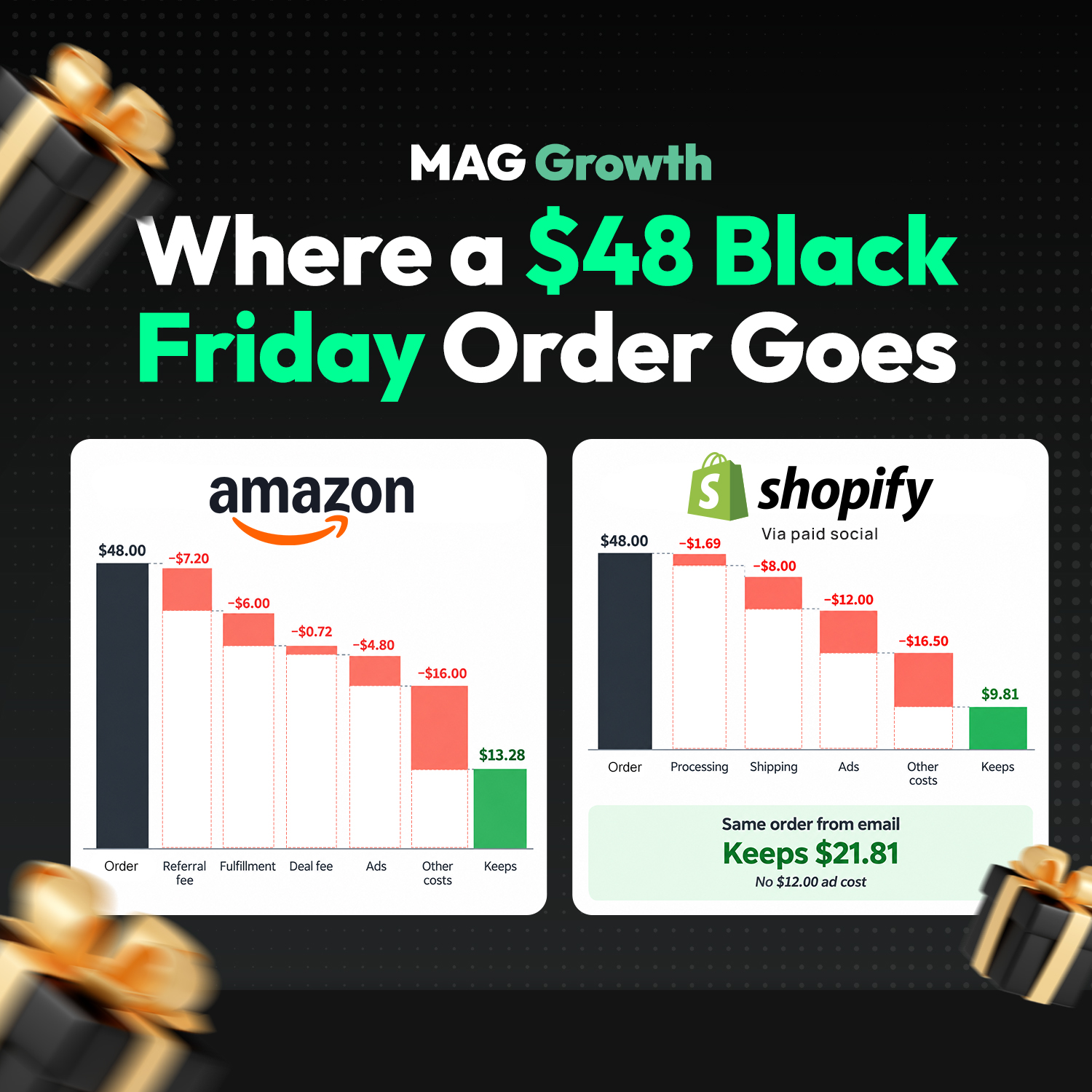
The unit view of that stack is in our Amazon vs Shopify Black Friday profit margin breakdown. This audit rolls the same lines up to the month, then waits for the invoices to post before the figure is final.
How should ad spend enter the reconciliation?
Ad spend should enter as the invoice total for the same date range, not as in-platform ROAS. ROAS compares spend with sales, and it never sees discounts, fees or refunds.
A generator accessory brand MAG Growth manages closed an August 2026 stretch with $4,542.60 in ad spend, 305 new-to-brand customers, a $14.89 blended CAC and a 25.3x LTV to CAC, with Google at 13.60x ROAS and Meta at 10.03x. Those ratios were useful for pacing, and they still were not the contribution close, which is why the audit reads the invoices against line 5 rather than against the ad manager chart.
Our DTC brand operations glossary defines contribution after fulfillment and the break-even ROAS that sits on it. Rebuild that floor once the peak fee and discount lines are in, then hand it to paid media.
How long should the returns reserve stay open?
Keep part of peak contribution in reserve until the return window closes in late January. With Amazon accepting most holiday returns through January 31, a December contribution read is early by design.
Here is the view we use to stop a dashboard number from being mistaken for a close. Each row pairs a number you already have with the one the audit trusts instead.
| Number you already have | What it misses | What the audit uses instead |
|---|---|---|
|
Gross or net sales, taken alone |
The other sales base, plus discounts sitting in a second system |
One locked sales base, then a separate discount line |
|
In-platform ROAS |
Fees, discounts and refunds |
Ad invoices read against contribution |
|
December profit |
January refunds and late fees |
Contribution after a returns reserve, closed on February 1 |
|
Channel revenue rank |
Channel contribution rank |
Contribution dollars by channel and SKU |
Book a growth call and we'll walk this season's sales through a contribution-margin reconciliation after the discounts.
Proof From the Field, MAG Growth Raised Margins 28% for a CPG Brand
MAG Growth did this for a premium CPG brand that relied on Amazon for 90% of sales while ad costs climbed and margins shrank. The team audited contribution margin by channel before any new spend, built an owned storefront, and later moved budget toward the channels that showed the strongest contribution.
The Amazon brand DTC diversification case study shows website sales 42% above Amazon, profit margins up 28%, and lifetime value tripled. That is the same contribution-first close this audit asks of a record month.
What Should You Reconcile First After a Record Month?
Reconcile gross versus net sales and the discount line first, especially on higher margin SKUs, because every later cost sits on that base. MAG Growth locks that pair the week after the event, then lets fees, ad invoices and the returns reserve close on their own dates.
If the reconciled number comes in thin, use the thin profit teardown after record BFCM revenue to find the leak. For the unit math behind each channel, use the Amazon vs Shopify Black Friday profit margin trace, and keep the monthly rhythm in our ecommerce growth operating systems guide.
Watch MAG Build a Brand in the Open, and Why the P&L Gets a Vote
A record month is easy to celebrate in a meeting and harder to defend on the P&L. This MAG conversation is about looking at the real back end before anyone signs off on a bigger bet.
The team talks through a partnership with a supplement brand whose owner, an accountant by training, still wants a clear look at the P&L. That habit is the same one this audit asks of a record month.
Watch What It Takes to Turn a Brand Around in the Open
Turning a brand around means choosing between costs that do not have an obvious winner. Episode 4 picks up that work in the open.
Steven Pope describes business decisions in which both options have costs, and he sets a condition of showing back-end data along the way. A post-peak margin audit is that same standard applied to a record month.
Post-Peak Margin Audit FAQs
Key Takeaways on the Post-Peak Margin Audit
- Lock gross versus net sales first
- Keep discounts on their own line
- Price peak fees into every unit
- Read ad invoices, not ROAS
- Hold a returns reserve until February
Run the six lines on this season’s numbers before the next promo plan gets locked. To walk the close through with our team, book a growth call.
Claim a free audit of this season's contribution, or book a growth call to reconcile the future promo plan before the first markdown.