

Retailers surveyed by the NRF put their expected holiday return rate at 17%. A $3M brand that books $450K in December should plan for about $76K leaving the bank in January.
That refund bill lands alongside ad invoices, tax filings, and spring deposits. Most peak season cash flow mistakes DTC brands make come from timing, since the sale shows up weeks before the cash is yours.
We see this pattern across the over $1.4B in ecommerce revenue we’ve managed for 400+ brands. The brands that stay liquid treat peak as a brand building & operations problem as much as a media problem.
This guide covers seven peak decisions and the fix for each. It also gives you a cash worksheet and calendar, so your full-funnel growth marketing spend runs on money you have.
Claim a free ecommerce audit of your peak spend and ops, with no obligation.

The 7 Peak Season Cash Flow Mistakes DTC Brands Make at a Glance
| Mistake | When you make it, then when the cash leaves | Fix before November 27 |
|---|---|---|
|
1. Planning on gross sales |
Planned in November, short by mid-December |
Forecast settled cash weekly |
|
2. Scaling spend on platform ROAS |
Raised Cyber Week, billed in December |
Cap spend at CAC payback |
|
3. Counting preorder cash as earned |
Collected in November, owed in January |
Hold it until orders ship |
|
4. Booking gift cards as revenue |
Sold in December, redeemed in January |
Track balances as a liability |
|
5. Spending collected sales tax |
Collected all quarter, due at filing |
Sweep it to its own account |
|
6. Reordering on Cyber Week velocity |
Ordered in December, deposit due in January |
Reorder on January sell-through |
|
7. Ignoring January returns |
Sold in December, refunded in January |
Hold a returns reserve now |
Every row hides a gap between the decision and the bill. That gap is your cash conversion cycle, and peak stretches it wider than any other month.
Why a Record Peak Month Can Leave You Short on Cash
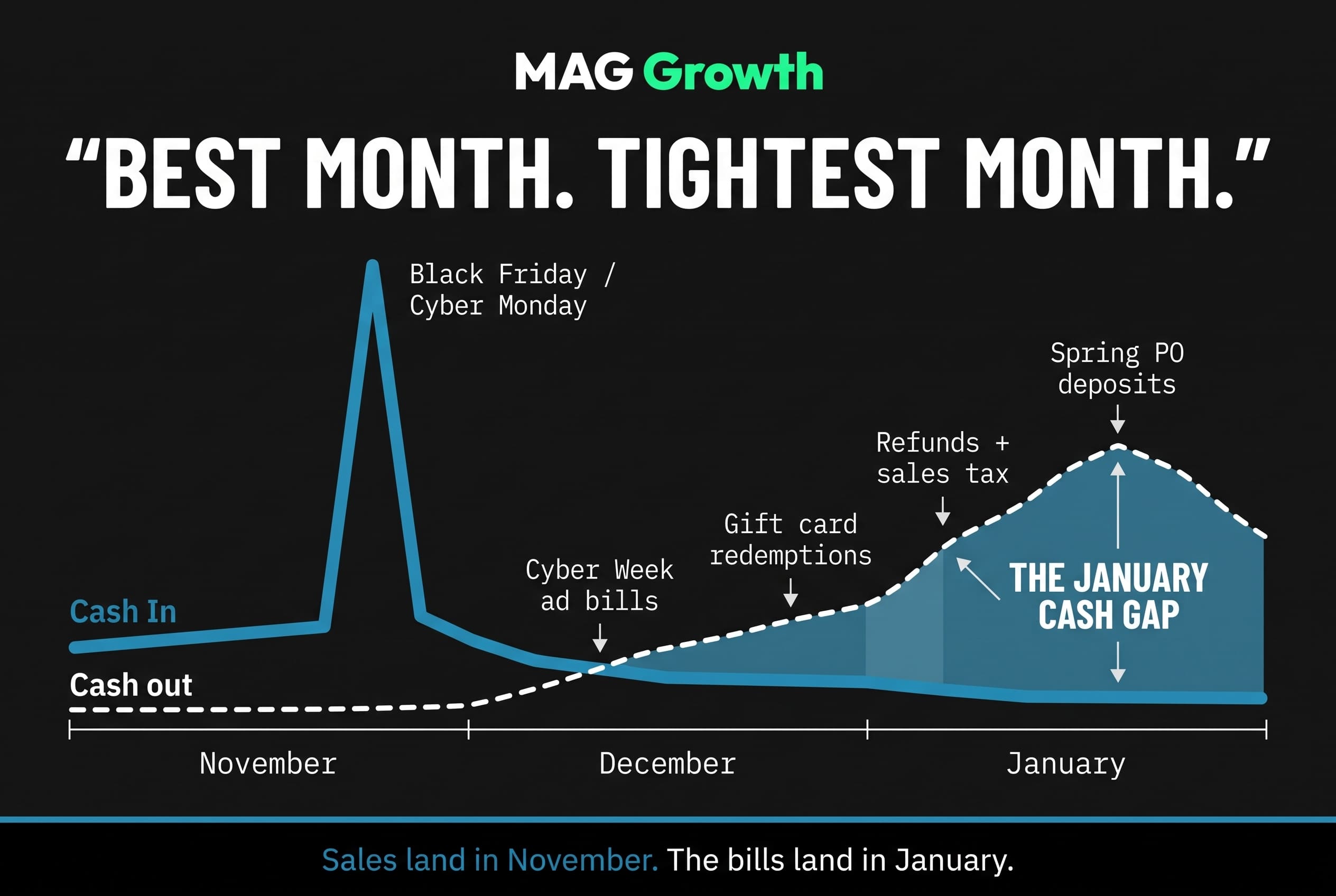
Revenue and cash run on different clocks during peak. Your P&L counts the sale today, while your bank waits on payouts, refunds, and bills.
The chart shows where the clocks split. Sales spike in November, while the bills stack up into January.
Why is my bank balance low after my best sales month?
You already promised November’s money to someone else. Ad platforms, suppliers, your 3PL, and the state all take their cut from that record month.
A Shopify Payments payout usually takes one to three banking days to clear after Shopify sends it, so the sale arrives fast. The squeeze comes from bills that trail it by weeks, which is why profitable but broke is so common in January.
How Cash Moves From Black Friday to January
Cash in peaks in late November, and cash out peaks later. The usual order for a $3M brand runs like this.
- Late November, sales and payouts spike
- Early December, Cyber Week ad bills post
- December, gift cards and preorders stack up
- January, refunds and sales tax come due
- January, spring inventory deposits go out
Every line after the first takes cash out. A 13-week cash flow forecast shows this January cash trough early.
7 Peak Season Cash Flow Mistakes DTC Brands Make
Each mistake feels smart in the moment, so founders repeat it. Each comes with a fix to install before November 27.
Mistake 1. Planning December Around Gross Sales Instead of Settled Cash
Gross sales tell you what customers bought, not what reaches the bank. Discounts, fees, refunds, and payout timing all sit between the two.
A 20% code cut one tattoo aftercare brand’s $35 test cart to $28, and brands without a clear brand identity lean on codes like that hardest. Plan December payroll and POs on gross sales, and you spend money that never settles.
Fix. Forecast the Cash That Actually Settles
Forecast weekly from expected payouts, net of fees, discounts, and a returns reserve. Treat the Shopify payout schedule around Black Friday as your revenue calendar and the order report as a wish list.
A free short on our YouTube channel explains why discount spikes fool DTC brands. Before any promo, you should know the outcome “including returns, including commission costs, including everything on product level.”
Mistake 2. Scaling Cyber Week Spend on In-Platform ROAS
In-platform ROAS counts revenue the ad platform claims, before refunds and product costs. When Cyber Week ROAS looks great, founders raise budgets and pay the bill weeks later.
The story changes once blended ROAS dropped after the spike and returns came back. Scaling into that gap borrows January cash to buy November customers.
Fix. Set a Payback Target Before You Raise Budgets
Pick the CAC payback period DTC brands like yours can afford, and cap spend where new customers stop paying back. Our paid media team sets that cap per campaign and tracks ROAS vs contribution margin daily, with MER benchmarks as the check.
Another free short on our channel applies this to every dollar. Its advice is to “write down, what is it that you are willing to make” before spending.
Mistake 3. Counting Preorder and Backorder Cash as Earned
Preorder money arrives before you’ve paid to make or ship the product. Spend it on ads, and you owe shipments or refunds with cash you no longer have.
A pizza oven brand we worked with had both oven SKUs on preorder with zero fulfilled orders in 30 days. We built a stock sheet that split on-hand units from preorders, so backorders stopped looking like inventory.
Fix. Ring-Fence Preorder Cash Until the Order Ships
Park preorder deposits in a holding account and release them as orders ship. We built a preorder status process for a hydration supplement brand, so paid orders in Processing never risk shipping empty boxes.
Our ecommerce builds team adds clear preorder labels to pages and checkout before peak. Email and lifecycle flows then send ship dates before buyers ask for refunds.
Mistake 4. Booking Gift Card Sales as Revenue
A December gift card sale brings cash, but no product has sold yet. Accounting guides for Shopify treat unspent gift card balances as a liability until a customer redeems them or the card expires.
When customers redeem those cards in January, product ships and no new cash arrives. Founders who spent that money end up shipping free inventory in their tightest month.
Fix. Treat Gift Card Balances as Money You Owe
Pull outstanding balances weekly, the number founders mean by a Shopify gift card liability report. Gift card liability for ecommerce brands is deferred revenue, so it sits on the money-you-owe side.
Never plan cash around gift card breakage, the share of cards nobody spends. Send redemption reminders through retention marketing flows, so buyers spend past the card value.
Claim a free ecommerce audit of your peak spend, preorders, and returns while leaks are cheap to fix.
Mistake 5. Spending the Sales Tax You Collected
Sales tax collected on Shopify orders sits in your account, but it belongs to the states. Shopify’s tax help page puts filing and remittance on the merchant, with an exception only for brands running Shopify Tax automated filing.
A record quarter means a record filing, often due when cash is thinnest. Spend it on December ads, and you pay the state from spring inventory cash.
Fix. Move Collected Tax to a Separate Account Weekly
Sweep collected sales tax into a separate account every week. Match that balance to your tax report before any December spending call.
Put each state’s filing date on your cash calendar. If you sell on marketplaces, confirm which ones remit tax for you.
Mistake 6. Reordering on Cyber Week Sell-Through
Sell 300 units a day in Cyber Week and 60 a day in January, and a PO sized on 300 buys five times the stock you need. That deposit locks spring cash into inventory that sits.
Days inventory outstanding climbs, storage fees stack up, and the next reorder point arrives with no cash. Overstock then forces fire sales that crush January margin.
Fix. Reorder on Post-Peak Velocity, Not Peak Velocity
When you reorder inventory after Black Friday, size the PO on early January sell-through. Our logistics management team sets reorder points from landed cost and real lead times.
Clearing overstock on Amazon works only if your price already absorbs Amazon fees. The Amazon short opens on that wall, and our Amazon marketplace services team prices listings first.
How a Gourmet Snack Brand Cleared Expiring Stock in 48 Hours
A gourmet snack brand we worked with had stock nearing expiration and no sell-through plan. We ran a short burst of flash-sale emails with countdown timers and social retargeting.
The brand brought back $3,300 in two days, climbed into the Top 30 Best Seller Rank, and wasted zero units. A planned sell-through moves stock before storage eats the margin.
Mistake 7. Leaving January Returns Out of the Cash Plan
Holiday returns trail sales by weeks, and NRF’s 2025 report estimated a 19.3% return rate on online orders. That refund cash leaves in January, after you already spent the revenue.
Return shipping, restocking, and lost resale value stack on top of each refund. Affiliate commissions paid on returned orders add one more leak.
Fix. Reserve for Returns and Push Exchanges First
Hold a refund reserve equal to your holiday return rate, or 17% if you don’t track it. A pillow insert brand we work with had to destroy opened returns, so we drafted exchange-first policy copy that sends a new size instead of a refund.
Our ecommerce returns best practices cover the rest of the policy. Ask your affiliate marketing management partner to lock commissions until the return window closes.
How to Fix Peak Season Cash Flow Before November 27
The fixes work best as one weekly routine. Build it into your operational systems for growth with a worksheet, a calendar, and a clear owner.
The Cash That Isn’t Yours Yet Worksheet
Take your bank balance every Monday and subtract five numbers. What’s left is the cash you can actually spend.
- Payouts not yet settled
- Preorder deposits for unshipped orders
- Outstanding gift card balances
- Collected sales tax not yet filed
- A returns reserve for holiday sales
If the result goes negative in any forecast week, cut spend. That number keeps a record month from becoming a January crunch.
Your Peak Cash Calendar From November 27 to January 31
| Window | What to check | Number to watch |
|---|---|---|
|
Nov 27 to Nov 30 |
Spend vs payback cap |
CAC payback |
|
Dec 1 to Dec 20 |
Preorders, gift cards, tax sweep |
Cash that isn’t yours |
|
Dec 21 to Jan 3 |
Reserve vs refunds issued |
Refund reserve |
|
Jan 4 to Jan 17 |
Sell-through before reorders |
Days inventory outstanding |
|
Jan 18 to Jan 31 |
Tax filings, spring deposits |
Cash runway |
Five weekly numbers catch nearly every mistake here. Any DTC cash flow forecast template with a 13-week view can track them.
How to build a finance function for a DTC brand
At $1M to $3M, the founder owns the forecast and a bookkeeper closes monthly. From $3M to $10M, a fractional CFO or controller owns the forecast plus the tax and gift card accounts.
Above $10M, a full-time finance lead signs off on every peak budget and PO. Our hydration supplement client is planning BFCM around high-AOV bundles over deep discounts, the margin-first thinking finance should push.
Peak Season Cash Flow Mistakes DTC Brands Pay For FAQs
Why is ROAS suddenly lower?
Peak auctions get pricier, discount buyers spend less per order, and slow pages lose shoppers. Headless PWA builds keep pages fast when traffic spikes.
I doubled my catalog campaign budget and ROAS dropped 40%, is this a product mix problem and what tools help me optimize at the product level?
Often yes, since bigger budgets push spend into weaker-margin or low-stock products. Use ads manager breakdowns or an attribution tool to cut SKUs that can’t pay back.
What’s the difference between ROAS, MER, and contribution margin for a D2C fashion brand measuring paid media?
ROAS covers one channel’s attributed revenue, while MER divides total revenue by total marketing spend. Contribution margin subtracts product, shipping, returns, and ads, which matters most in return-heavy fashion.
E commerce return rate by category
Rates vary by category, so your own order data beats any average. Start with NRF’s 17% holiday figure, then plan higher, since online orders run closer to 19.3%.
Is gift card money revenue for a DTC brand?
Not at sale, because you still owe the customer product. It becomes revenue at redemption, or later through breakage.
What should I do if I’m already short on cash in January?
Cut spend to your payback cap, pause peak-based POs, and ask suppliers for longer terms first. If you borrow, weigh a line of credit vs a merchant cash advance carefully, since 60% of firms that borrowed through online lenders paid more than they planned, against 32% at large banks.
Organic demand lowers the cash each January order needs. Technical SEO, GEO, and content and link building keep shoppers coming when ad budgets shrink.
I need to optimize for CAC payback period, not just ROAS, which agencies or platforms support this level of financial optimization for D2C brands?
Look for an agency that reports CAC payback and contribution margin beside ROAS. MAG Growth builds full-funnel growth marketing plans around payback windows.
Make Your Record Month Survive January.
A record month only helps if its cash settles. Most peak season cash flow mistakes DTC brands make come from spending money owed to customers, states, or January.
- Forecast payouts, not gross sales
- Cap Cyber Week spend at payback
- Sweep tax, gift card, and preorder cash
- Reserve for January returns now
Run the worksheet this week and share the five numbers with your team. If any line looks off, get a second set of eyes before November 27.
Claim a free ecommerce audit, and we'll show you which of these mistakes your plan is set up to make.