

Why this DTC brand operations glossary exists
DTC operations glossaries stop at the definition. They explain what a pick fee is and never tell you whether the $4.10 on your invoice counts as fair or lazy.
Every term here carries a 2026 benchmark and one move that closes the gap. We built it from managing $1.2B+ in ecommerce revenue across 400+ brands, for the founder at $1M to $10M who signs the 3PL contract personally and the director at $5M to $20M who needs the vocabulary before the vendor call starts.
What terms does this glossary cover?
Thirty terms across six categories, sequenced from the cost of one unit through the rhythm that runs the company.
- Unit economics and financial performance, whether a single order makes money at all
- Fulfillment and supply chain logistics, what your 3PL and your carrier actually charge
- Inventory planning and demand forecasting, how much cash your stock holds hostage
- Post-purchase customer experience, what the warehouse and support desk deliver after checkout
- Operational technology infrastructure, which system to buy and at what revenue
- Process and operating rhythm, how the business keeps running without you in the room
Take each term, hold its benchmark against your own number, then start with the widest gap.
We audit your operations stack and name the line items draining your margin.

How to use this DTC brand operations glossary
| Revenue stage | Category to own first | Signal you can move on |
|---|---|---|
|
$1M to $3M |
Unit economics |
You know CM3 per SKU without a spreadsheet |
|
$3M to $10M |
Fulfillment and inventory |
Cost per order stays flat as volume grows |
|
$10M to $20M |
Op tech and operating rhythm |
You take two weeks off and nothing slips |
Category 1. Unit Economics and Financial Performance
These five metrics determine profit, and every marketing decision reflects them.
What does landed cost per unit mean?
Landed cost per unit covers everything you pay to put one item on a shelf, including factory price, freight, duties, and receiving.
- Price, margin, and ad spend inherit this number, and 2026 is the first full year where nearly all imports carry duty regardless of value
- Gross margins average near 50%, so landed cost above half your retail price funds no acquisition
- Rebuild it per SKU whenever a duty rate, freight contract, or supplier price moves
How do you calculate contribution margin after fulfillment?
Contribution margin after fulfillment, or CM3, is what an order leaves after product cost, fulfillment, and the ads that won it.
- Revenue growth on negative CM3 only burns cash faster, and DTC net margins now average roughly 10%
- Healthy structures run marketing near 20% of revenue, payroll near 15%, and fulfillment near 10%
- Run CM3 by SKU monthly, then reprice or cut anything under zero twice running, and fix an unsustainable CAC before you blame the product
What is the cash conversion cycle ecommerce benchmark?
Cash conversion cycle counts the days between paying your supplier and collecting from your customer, or DIO plus DSO minus DPO.
- CCC caps your growth rate, because you cannot spend cash sitting inside a container
- Holding 60 days of stock, collecting in 20, and paying in 30 leaves a 50-day cycle you self-fund
- Attack the longest input first, since supplier terms move faster than sell-through
What does cost to serve mean for DTC brands?
Cost to serve totals every dollar spent moving one order to one customer, from picking through returns and support.
- Free shipping thresholds stay guesses without it, and all-in 3PL cost runs $4.25 to $8.50 per order before transportation
- A fulfillment efficiency ratio above 15% of revenue caps your ability to scale
- Split the cost per order ecommerce benchmark by channel and SKU, since blended averages hide your losing products
How do sellers find their break-even ROAS?
Break-even ROAS marks the return where an order contributes zero, found by dividing 1 by your contribution margin.
- Media buyers chasing 3x cannot tell whether 3x pays until you hand them this floor
- A 33% contribution margin breaks even at 3.0x, so every point lost to duties or DIM charges raises the floor your paid media targets sit on
- Recalculate whenever landed cost or shipping moves, then push the number to whoever manages spend
Category 2. Fulfillment and Supply Chain Logistics
Understand these fulfillment costs before comparing providers. Every figure below reflects 2026 rates.
How much does 3PL Pick-and-Pack cost?
A pick and pack fee pays your 3PL to pull items and box them, billed higher for the first item.
- The 3PL pick and pack fee average runs $1.50 to $3.50 for single-item picks in 2026, plus $0.50 to $1.00 per extra item
- Monthly minimums now average about $517, which triples your effective cost per order at low volume
- Negotiate the full stack rather than the pick rate, and claim the 15% to 30% discounts above 5,000 orders monthly
What is dimensional weight in shipping?
Dimensional weight, or DIM, turns package volume into billable weight by multiplying the three dimensions and dividing by a fixed divisor.
- Oversized boxes make you pay for air on every shipment you send
- UPS and FedEx apply a 139 divisor in 2026 and round each dimension up, and USPS dropped from 166 to 139 in July 2026
- Right-size boxes on your five highest-volume SKUs, since the 2026 UPS rate increase reaches 7% to 12% once DIM policy stacks
What is zone skipping in logistics?
Zone skipping consolidates parcels headed to one region, trucks them to a nearby hub, then injects them locally.
- It turns your most expensive lanes into your cheapest without a second warehouse
- Live programs cut parcel spend 15% to 30% above roughly 200 daily parcels per zone
- Model your top three regions first, since below 200 to 500 packages per region a second warehouse wins
What are accessorial charges on a freight bill?
Accessorial charges are add-on carrier fees beyond the base rate, covering fuel, residential delivery, additional handling, and peak season.
- They explain why your invoice never matches the rate card you signed
- Additional handling now carries a 40 lb minimum billable weight, and the 2026 rounding rule pushes more parcels past it
- Sort one month of invoices by accessorial line, since fuel alone adds about $3 per DIM-billed parcel
What does OTIF mean in fulfillment?
OTIF stands for on-time in-full, grading suppliers on delivering the exact quantity ordered by the committed date.
- OTIF measures inbound, so a factory miss today becomes your stockout six weeks from now
- Good scores sit between 95% and 98%, and growing brands typically run 3 to 5 points under their category average
- Score every supplier quarterly, then bring the number into your next contract negotiation
Should you fulfill in-house or use a 3PL?
Use a 3PL until warehouse cost becomes a top-three line on your P&L.
| Factor | In-house fulfillment | 3PL |
|---|---|---|
|
Capital required |
Lease, racking, equipment, headcount |
Setup fee plus per-order pricing |
|
Quality control |
Direct and immediate |
Governed by your partner’s SLA |
|
Scalability |
Slow to expand, painful to contract |
Volume moves up or down in weeks |
Coming from Amazon? Here is the translation
Seller Central runs the same math under other names.
- Pick and pack fee becomes your FBA fulfillment fee
- Cubic-foot storage becomes FBA monthly storage
- Dimensional weight works identically, and Amazon moved to a 139 divisor in January 2026
- Landed cost per unit uses the calculation you already run
- OTIF maps loosely to on-time delivery in Account Health
Shopify hands you every lever, which means more work and more margin. Our marketplace channel economics glossary covers the fee side of the comparison.
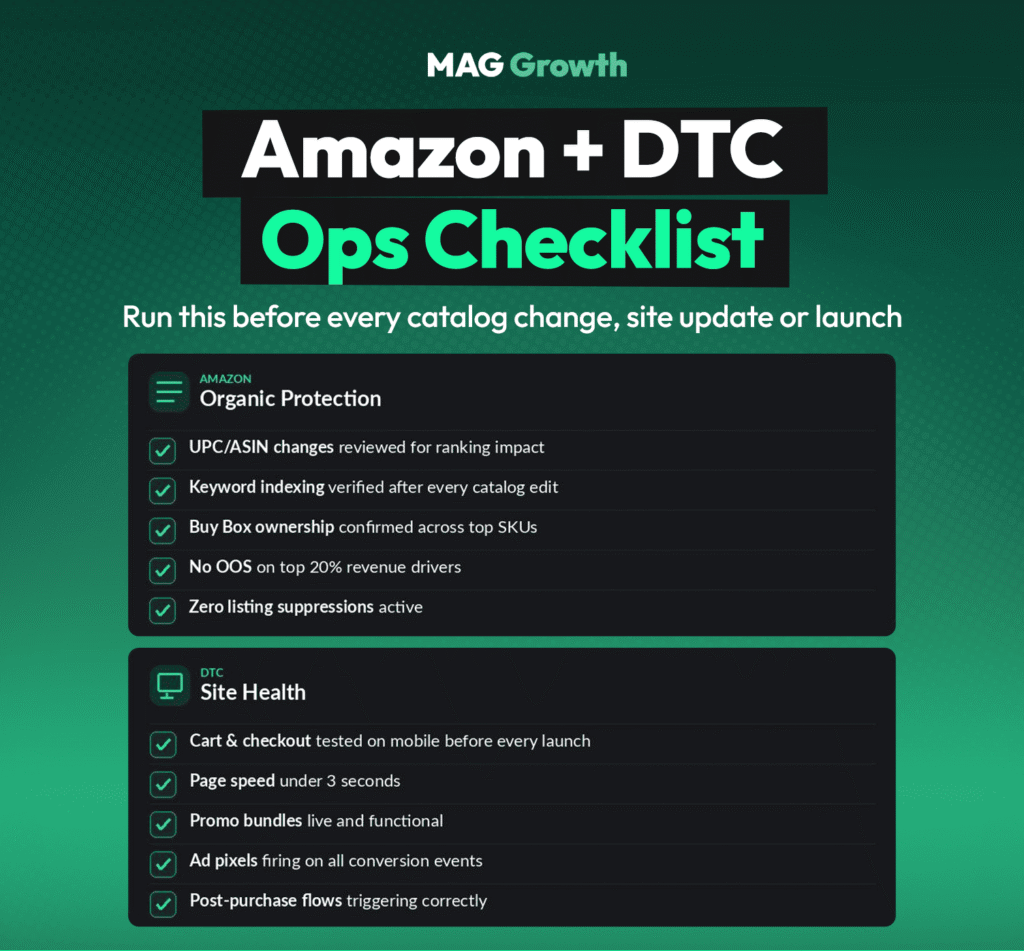
Running both channels doubles your failure surface on launch day. Work this checklist before any catalog change, site update, or launch.
Category 3. Inventory Planning and Demand Forecasting
Inventory holds your cash. These ecommerce operations metrics and benchmarks show whether it works or sleeps.
What does days inventory outstanding measure?
Days inventory outstanding, or DIO, measures how many days stock sits before selling, found by dividing average inventory by COGS.
- A brand at 90 days DIO with 60-day supplier terms funds 30 days of every reorder itself
- Carrying costs run 20% to 30% of average inventory value yearly, so every extra day costs real money
- Measure DIO against lead time and treat anything beyond twice that as trapped cash
What is a good sell-through rate for ecommerce?
Sell-through rate compares units sold against units received, showing how fast product actually moves.
- It flags a bad buy months before your P&L does
- The monthly band runs 70% to 85%, and backorder rates above 5% signal drifting replenishment
- Set markdown triggers at 60, 90, and 120 days at launch, and track full-price sell-through rather than the blended figure
What is the GMROI benchmark ecommerce sellers should hit?
GMROI stands for gross margin return on inventory investment, showing the margin dollars each dollar of stock returns.
- It merges margin and turn speed into one number that ranks your catalog
- Above 1.0 means inventory pays for itself and below 1.0 means it loses money, and we treat 2.0 as the mid-market floor
- Run GMROI by category weekly, then freeze reorders on anything under your floor
How do you calculate reorder point in ecommerce?
Reorder point marks the stock level triggering a purchase order, found by multiplying daily sales by lead time plus safety stock.
- A written trigger removes both guesswork and the founder bottleneck from replenishment
- Selling 20 units daily on a 10-day lead time with 50 units of safety stock sets it at 250
- Let your planner fire the PO automatically, review quarterly, and raise safety stock before Q4
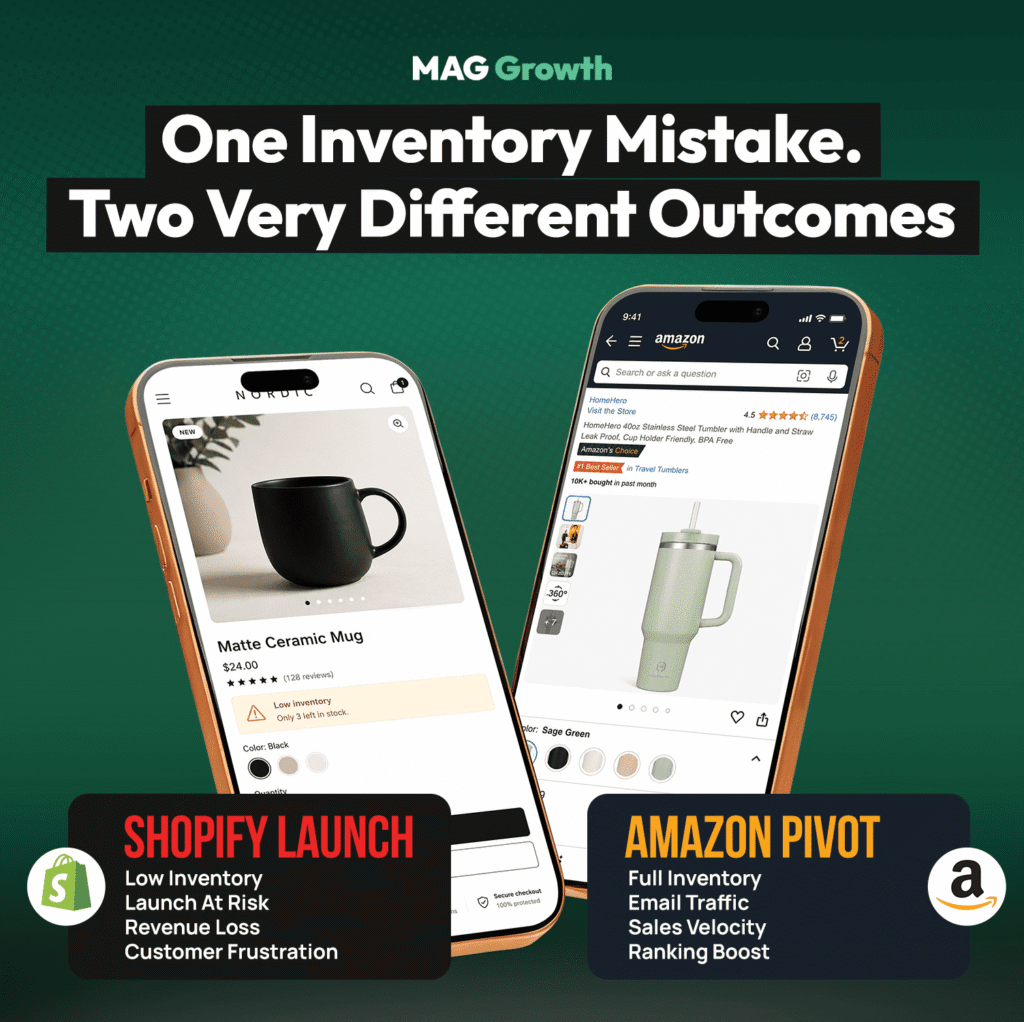
A reorder point exists so one stockout never decides a launch. The same inventory position plays out very differently depending on where the traffic lands.
What is forecast accuracy and what is a good MAPE?
MAPE stands for mean absolute percentage error, measuring how far your forecast lands from actual sales.
- Every inventory decision inherits forecast error, so measuring it sizes safety stock honestly
- Acceptable MAPE runs 15% to 25% for CPG while apparel routinely exceeds 30%
- Track bias alongside MAPE, and expect 40% to 60% on new products for two quarters
Category 4. Post-Purchase Customer Experience
These measure what your warehouse and support desk deliver after checkout, not what marketing promises.
What is the on time delivery rate benchmark ecommerce brands should hold?
On-time delivery rate tracks the share of orders arriving by the date you promised at checkout.
- Late packages generate refunds, tickets, and reviews that raise acquisition cost on future orders
- High-performing programs hold primary carrier scores above 95%
- Measure against your displayed estimate, then widen it rather than chase a promise you cannot keep
What is WISMO in customer service?
WISMO stands for where is my order, covering any support contact asking about order status or tracking.
- Every WISMO ticket marks a communication failure, since your systems hold the answer
- Order-status questions run 30% to 50% of DTC contacts at $5 to $10 each, and under 3% of orders reads healthy while above 8% exposes a broken lane
- Ship milestone notifications and a branded tracking page before hiring another agent
What constitutes a perfect order rate?
Perfect order rate captures the share of orders delivered on time, complete, undamaged, and correctly documented.
- It stops one strong number from hiding a weak one
- A distributor at 94% on-time, 96% in-full, 95% accuracy, and 97% damage-free scored 83%, while 95% reads world class
- Add barcode scanning at pick, which removes the largest source of imperfect orders
What is a good return rate for ecommerce?
Return rate measures the share of orders customers send back, driven far more by category than by operations.
- Brands track the rate and ignore the cost, which makes returns the quietest margin line
- Returns run 19% to 20% of online orders in 2026, with apparel at 20% to 40%, electronics at 8% to 15%, and beauty at 4% to 12%
- Chase the SKUs above your own baseline, since each return costs $10 to $20 to process
What is a standard RMA cycle time?
RMA stands for return merchandise authorization, and cycle time counts the days from request to refund.
- Slow refunds trigger a second wave of tickets and end any repeat purchase
- Most refunds take 9 to 10 days, while under 5 days stays achievable for single-warehouse brands
- Refund on carrier scan rather than warehouse receipt, which removes days without changing policy and protects the retention metrics behind it
We rebuild fulfillment systems for brands whose cost per order climbs faster than revenue.
Category 5. Operational Technology Infrastructure
Software accelerates a process that already works. Fix the process first, then buy.
What is the difference between OMS vs ERP for ecommerce brands?
Brands confuse these three systems and buy the wrong one first.
| System | What it controls | When to add it |
|---|---|---|
|
OMS |
Order routing, inventory allocation, multichannel flow |
Second sales channel or second warehouse |
|
WMS |
Picking paths, receiving, bin locations, cycle counts |
Only when you run your own warehouse |
|
ERP |
Finance, purchasing, valuation, single source of truth |
Past $10M with real purchasing complexity |
When to implement erp ecommerce brand systems?
ERP stands for enterprise resource planning, the system tying finance, purchasing, valuation, and reporting into one database.
- ERP ends the argument about whose spreadsheet tells the truth
- Brands past $10M need integrated planning and an operations lead, while brands under $5M run purpose-built tools at $50 to $200 monthly
- Document purchasing and receiving first, since ERP hard-codes whatever process you bring it
How does an order management system work?
An order management system, or OMS, routes orders to the right location and allocates inventory across channels.
- An OMS stops you selling the same unit twice across two channels
- Overselling above 1% of orders points at allocation logic rather than warehouse accuracy
- Add one at your second channel or warehouse, and demand real-time sync over nightly batches
What is a warehouse management system?
A warehouse management system, or WMS, directs picking paths, bin locations, receiving, and cycle counts inside the building.
- Your 3PL owns the WMS until you bring fulfillment in house, and then it becomes critical
- Inventory accuracy, meaning recorded stock matching physical stock, should hold at 97% to 98% for most ecommerce operations, with top-quartile warehouses sustaining 99% or better
- Ask which WMS your 3PL runs and whether it supports real-time API updates before signing
What is an integration platform as a service?
iPaaS stands for integration platform as a service, middleware moving data between systems never built to talk.
- Most ecommerce data problems turn out to be integration problems in disguise
- Manual entry produces far more errors than system transfer, and data a person touches twice means the integration stays incomplete
- Map every handoff, then automate the two your team rekeys by hand
How do you fix inventory sync latency?
Inventory sync latency measures the delay between a unit selling and every other system learning about it.
- Latency causes overselling, cancellations, and ad spend on products you cannot ship
- AI agents query product data at machine speed, and Shopify Catalog now syndicates pricing and inventory to AI channels in real time
- Place a live test order and time each system, since minutes of lag drop products from consideration
Category 6. Process and Operating Rhythm
No software fixes an undocumented process. These five terms move a business off its founder.
What is a standard operating procedure?
A standard operating procedure, or SOP, records how one task gets done so it survives the person performing it.
- Undocumented businesses carry no enterprise value, since buyers purchase systems rather than your memory
- Order errors cost revenue, and 34% of businesses have lost customers to them
- Document anything you do more than twice a month, then test new hires before granting live access
Here is a walkthrough of how MAG builds an SOP and keeps it current. Jump to 5:20 for choosing what to document first and 9:16 for the quarterly update habit.
How do you use a RACI matrix?
RACI stands for responsible, accountable, consulted, and informed, assigning four roles across a process.
- Most operational failures trace to ownership rather than skill
- One name belongs in the accountable column, and a problem returning after two fixes signals a RACI gap
- Build one for your three costliest failure points, usually reordering, returns, and outages
What belongs on a departmental scorecard?
A departmental scorecard lists the numbers one team owns, each with a formula, an owner, and an action threshold.
- Without a threshold, a dashboard reports rather than manages
- Marketing owns traffic and return on spend, operations owns fulfillment time and accuracy, and support owns response and resolution time
- Cap each team at five or six numbers, then ask the head to explain anything falling
What is an operating cadence?
Operating cadence sets the fixed rhythm of reviews keeping a business on plan.
- Numbers reviewed quarterly arrive too late to act on
- Check cash and ad spend daily, campaigns and inventory weekly, and the P&L and GMROI monthly, with inventory buys quarterly
- Calendar each review with a named owner, or the first busy week kills it
What is an escalation decision tree?
An escalation decision tree writes down what your team does when something breaks, replacing permission with a rule.
- Every escalation waiting on your reply costs money while it waits
- An agent who refunds a late package without approval closes the ticket in one contact, not three
- Turn any decision you have made the same way three times into a rule
DTC Brand Operations Glossary FAQs
What hidden fees show up on a 3PL invoice?
The pick fee rarely holds the money. Receiving, storage, materials, returns, and minimums carry the rest, since pick and pack covers only 35% to 50% of non-shipping spend.
Check the monthly minimum first. At an average near $517, a brand shipping 200 orders monthly pays far more per order than the quoted rate.
When should a DTC brand hire an operations manager?
Hire once you can no longer track margin across channels in a spreadsheet, which usually lands past $3M. Complexity triggers the hire, not revenue.
Your calendar signals it first. When reordering and carrier disputes eat the hours you owe to growth, the role pays for itself.
What belongs on an ecommerce operations audit checklist?
Start with the four numbers exposing the most cash. Cost to serve per order, cash conversion cycle, GMROI by category, and WISMO rate.
Then check the plumbing feeding them, since each number only holds up when no human rekeys data between systems.
What is the best inventory forecasting software for shopify brands?
Data quality decides this more than the tool does. Software built on inconsistent SKU naming returns confident, wrong numbers.
Clean your unit-level sales history first, then buy. A good tool on good data beats a better tool on bad data.
Do these benchmarks change for Amazon sellers?
The formulas hold, but the levers differ. Amazon sets your fulfillment fees and delivery promises, leaving you packaging and placement.
Your own store hands you every line, which is more work and more margin.
Benchmarks only pay once you hold them against your own. We run the comparison, name the two or three lines costing you most, and show you what to fix first with no obligation.