

Your cancel survey hands you a receipt, not a warning. Every subscription churn signal that predicted the cancel already fired somewhere in your stack, weeks before anyone filled out that form.
Most teams respond by rewriting the save offer. That fixes nothing when the subscriber’s card expired, because copy cannot process a payment.
We manage $1.2B+ in ecommerce revenue across 400+ brand partners, and one pattern repeats across every replenishment category. Brands that route signals beat brands that merely spot them.
This DTC Retention marketing guide maps the 12 signals worth watching and the message each one earns. We also cover which signals fire natively in your stack and which ones you build yourself.
Our team reads 90 days of your subscription data and shows you which signals fire in your account and which ones you currently miss.

Part One. Your Cancel Survey Is the Last Subscription Churn Signal, Not the First.
What counts as a subscription churn signal in a DTC program?
A signal is an event you can trigger on, not a mood you noticed in a report. Anything you cannot build a segment or a flow from belongs in your monthly review instead.
That rule cuts most of what passes for warning signs online. Brand sentiment matters, but it cannot fix a 2 a.m. declined charge.
How Do Voluntary and Involuntary Churn Differ in DTC?
Billing failures and value failures need opposite messages. Churnkey studied millions of subscriptions and found that payment failures can drive roughly 40% of total churn, so a big share of your cancellations involved no decision at all.
That bucket also costs the least to fix. Their dataset showed about 70% of failed payments return with smart retries and timed nudges, and none of it requires a discount.
So dunning vs win-back email which recovers more stops being a close call. Retry logic and a payment link beat copy, because these subscribers never chose to leave.
What do most brands get wrong about churn signals?
Four beliefs waste most of the save budget we find in inherited accounts.
- A skip is not a cancel, and reading it that way starts a sequence nobody needed
- Engagement decay alone proves nothing, since loyal subscribers stop opening too
- A predictive score ranks risk rather than confirming a decision
- A signal you cannot trigger on is a report, and reports send nothing
Which subscription churn signals matter and how long do you have?
Here is the routing table. Treat the windows as working ranges for replenishment categories and calibrate them against your own cancellation dates.
| Signal | Bucket | Typical window before cancel |
|---|---|---|
|
Failed charge on renewal |
Billing |
3 to 10 days |
|
Expiring card with no update |
Billing |
14 to 45 days |
|
Chargeback or dispute filed |
Billing |
Already gone, recover later |
|
Repeated retry failure |
Billing |
1 to 7 days |
|
Two or more consecutive skips |
Behavior |
30 to 60 days |
|
Pause with no restart date |
Behavior |
30 to 90 days |
|
Quantity or frequency downgrade |
Behavior |
60 to 120 days |
|
Portal visit with no change made |
Behavior |
1 to 14 days |
|
Support contact about the product |
Experience |
7 to 30 days |
|
Engagement decay across email and SMS |
Experience |
60 to 180 days |
|
Reorder gap past the usage cycle |
Experience |
30 to 90 days |
|
One-time purchase of the subscribed SKU |
Experience |
14 to 45 days |
Part Two. What a Missed Signal Costs You
Why does late intervention cost more than early intervention?
Timing changes what your offer means. Three weeks out it reads as service, and on the cancel screen it reads as a negotiation you already lost.
Churnkey measured the expensive version. Their data showed discounts held 53% of would-be cancelers and pauses saved another 19%, all bought at the priciest moment available.
Move the same intervention earlier and you change the currency. A skip, a swap, or a frequency change solves the same problem and costs you nothing.
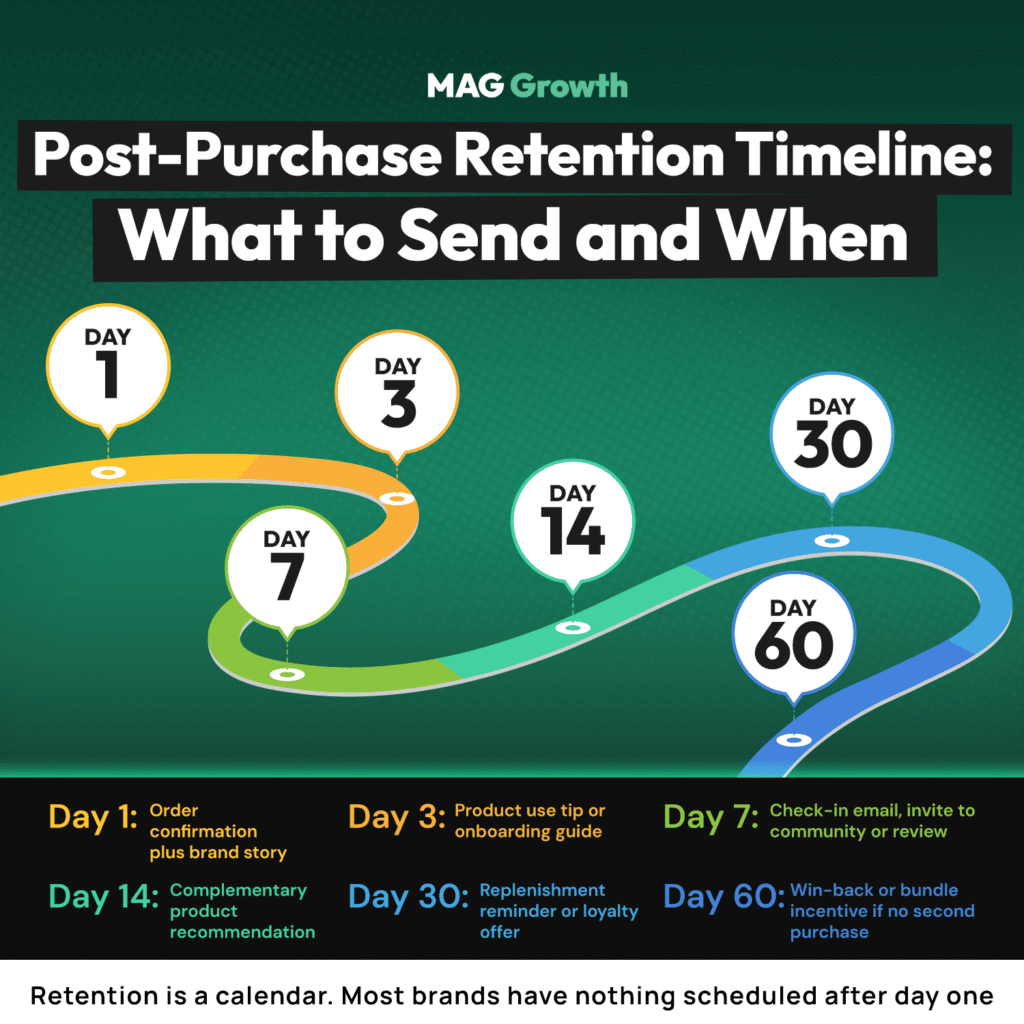
A calendar covers the first purchase well enough. Subscriptions need triggers, because a subscriber’s problems arrive on their schedule rather than yours.
What does over-triggering cost when the signal was a false positive?
Nobody prices this one. Sending a save offer to a subscriber who planned to stay burns margin on that order and teaches the segment that waiting produces discounts.
Precision protects you. When half your at-risk segment was never at risk, you run a discount program wearing a churn label.
What is a normal DTC subscription churn rate and what should I run at my size?
Benchmarks rarely match your category, so ask a better question. Founders at $1M to $10M should ask which signals they can act on this month without buying anything.
Sequence it by stage.
- At $1M, run billing signals only, since dunning covers most recoverable churn
- At $5M, add skips and pauses as triggered flows once volume makes patterns readable
- At $10M, add reorder gap and portal behavior, then report save rate by signal
- At $20M, add scoring and audit precision quarterly
Stop after the first two lines if you wear every hat. Recurly reported that pause usage jumped 337% year over year for merchants offering pause-before-cancel, which proves subscribers take an off-ramp when you build one.
From our accounts. One replenishment brand sent a third of its monthly cancellations from subscribers whose payment had already failed at least once. The retention calendar ignored them entirely, because the team had filed all of it as voluntary churn and funded copy instead of dunning.
What does signal routing look like in a real account?
Coffee runs on the same replenishment math as any subscription category, and one specialty coffee brand came to us sending the same email to everyone. Engagement had slid for months, so we rebuilt the program around who someone was and what they had just done.
Our team shipped 12 automated Klaviyo flows, layered RFM segmentation underneath them, and put the campaign calendar on a schedule. The full specialty coffee brand case study covers the build, and the headline numbers landed inside 30 days.
- Revenue climbed 179% in one month
- Email revenue share moved from 12% to 35%
- Unsubscribes fell 60%
- The welcome flow converted at 8.2%
Watch the unsubscribe number, not the revenue number. Opt-outs drop when messages start matching what someone actually did, which is the same precision that keeps a save offer away from a subscriber who never planned to leave.
Our retention team builds the routing, the triggers, and the offer rules so save spend lands only where it changes the outcome.
Part Three. The 12 Signals and the Message Each One Needs
Work the tiers in order, because tier one buys the most time for the least money. The table maps every message, and the sections underneath explain the mechanism.
| Signal | Send this | Never send this |
|---|---|---|
|
Failed charge on renewal |
Payment update link within the hour |
A discount |
|
Expiring card with no update |
Pre-expiry card refresh prompt |
A win-back email |
|
Chargeback or dispute filed |
Human support outreach |
An automated marketing send |
|
Repeated retry failure |
Backup payment method request |
Another silent retry |
|
Two or more consecutive skips |
Frequency change or swap offer |
A save discount |
|
Pause with no restart date |
Restart reminder tied to usage |
Cancel-confirmation copy |
|
Quantity or frequency downgrade |
Confirmation and a usage tip |
An upsell |
|
Portal visit with no change made |
Self-service options reminder |
Nothing at all |
|
Support contact about the product |
Human resolution follow-up |
A promotional campaign |
|
Engagement decay across email and SMS |
Channel switch to SMS or post |
A daily email push |
|
Reorder gap past the usage cycle |
Replenishment nudge with a skip link |
A generic newsletter |
|
One-time purchase of the subscribed SKU |
Frequency audit message |
A subscribe-and-save pitch |
Tier 1. Which subscription churn signals are billing problems?
None of these four earn a save offer. Give them a payment path, and move fast.
1. Failed charge on renewal
Nobody signals higher intent than a subscriber who did everything right and still lost their order. Send the payment link inside the hour, since Ordergroove found retry tools recover around 11% of rejected orders and your message carries the rest.
2. Expiring card with no update on file
You can see this one coming a month out, which makes it your cheapest churn. A card updater fixes it silently, and Ordergroove reported that credential refresh recovers about 28% of expired cards before the charge ever fails.
3. Chargeback or dispute filed
A dispute means the subscriber picked a channel other than yours, which usually points at billing confusion. Answer with a human, then fix the descriptor, the renewal amount, or the charge date that caused it.
4. Repeated retry failure across cycles
One decline is noise and three is a wall. Churnkey found expiry, loss, and theft account for 10% to 15% of declines, and those never clear themselves, so ask for a backup method instead of burning capped retry attempts.
Tier 2. Which behavior signals inside the subscription predict a cancel?
Brands misread these four constantly. Each one asks for a smaller change than the offer you plan to send.
5. Two or more consecutive skips
One skip means normal life and repeat skips mean the frequency is wrong. Ordergroove’s merchant analysis found overstock caused 27% of subscription cancellations, and their data shows subscribers last 135% longer with skip access and 71% longer with swap access.
6. A pause with no scheduled restart date
An open-ended pause defers the paperwork on a cancel. Time your restart reminder to the product’s consumption cycle, because a 60-day supply paused in June needs an August message rather than a July check-in.
7. Quantity or frequency downgrade
A downgrade tells you the value works and the volume does not. Confirm the change and send a usage tip, and never answer it with an upsell that proves you ignored them.
8. Subscriber portal visit with no change made
Someone opened the portal, looked around, and changed nothing. They hunted for an option they could not find, so send a plain list of what they control themselves before the next visit ends at cancel.
Tier 3. Which engagement and experience signals sit outside the billing record?
These four live in other systems, which explains why teams miss them. Each needs a proxy property before it triggers anything.
9. Support contact about delivery, quality, or billing
A ticket from a subscriber is a churn signal with a timestamp. Churnkey reviewed nearly three million cancellation sessions and found budget cited 33% of the time and light usage 31%, and noted that budget frequently hides a product or experience problem, so suppress promos until the ticket closes.
10. Engagement decay across email and SMS
This signal proves little alone and plenty in combination. Pair it with a skip, a pause, or a stretched reorder gap, then switch channels rather than switching offers.
11. Reorder gap stretching past the product’s real consumption cycle
Your billing frequency guesses at a usage cycle the subscriber actually lives. Send a replenishment nudge with a skip link, since Recurly found 52% of consumers canceled a subscription last year over lack of use.
12. One-time purchase of the same SKU the subscription covers
A subscriber buying the same product a la carte pays full price to fix your timing. Audit the frequency and never pitch subscribe-and-save to someone already subscribed.
How Do I Build These Triggers Without a Predictive Tool?
Which subscription signals fire natively and which need a proxy?
Recharge sends subscription events into Klaviyo as timestamped metrics, covering cancellations, pauses, SKU swaps, and frequency changes. That handles tier one and most of tier two immediately.
Build on the Recharge skip event Klaviyo trigger first. The native event fires on every skip, so a counter property separates the first from the third.
Tier three needs proxies you create. Turn reorder gap into a date property, support contact into a helpdesk tag, and portal activity into an event your subscription app passes through.
Is Klaviyo churn risk score accuracy good enough to route messages?
It ranks well and decides poorly. Klaviyo requires at least 500 customers with orders before generating a churn prediction, which excludes most brands under a few million.
Qualify the segment with a real event, then sort it by score. The event tells you what someone did, while the score only tells you who looks risky.
How many save messages should one subscriber get?
Cap it at one per signal and two per quarter across email and SMS. Two flows firing save offers in the same week reads as desperation, so build the cap as a suppression segment rather than inside each flow.
The Two Numbers That Tell You the Routing Works
Report save rate by signal instead of blended. A blended number hides billing recovery carrying a program whose offer messages lose money.
Then report intervention precision, meaning the share of contacted subscribers who genuinely planned to leave. Review both monthly by signal and quarterly by tier, using your subscription app and Klaviyo rather than new tooling.
More Retention and LTV Resources From MAG Growth
Each one handles a different part of the same job, which is keeping subscribers whose behavior already announced their exit.
- Our retention marketing services own the routing itself, from bucket rules to the offer ceiling that protects margin
- Our email and lifecycle team builds the triggers, proxy properties, and frequency caps these 12 signals depend on
- Ongoing maintenance matters here, because an app update can silently break the events feeding your flows
- Brand identity work prevents disputes, since clear descriptors and packaging remove the confusion that creates them
- Affiliate marketing management shapes who subscribes, and deal-driven partners deliver subscribers who skip and cancel more
- First purchase vs second purchase LTV explains why early orders decide everything after them
- How we boosted repeat revenue 179% with flows shows the flow architecture behind this routing
- How to improve customer retention and LTV covers the program these signals sit inside
Frequently Asked Questions About Subscription Churn Signals
How long before a subscriber cancels do the signals appear?
Billing signals give you days and behavior signals give you weeks. A failed charge leaves under two weeks, while a stretched reorder gap can run 90 days.
Is a skip the same as a cancellation signal?
No, and that mistake costs money. Subscribers last 135% longer when they can skip, so watch repeat skips rather than the feature.
Should I send a discount when a subscriber pauses?
Not first. Send a restart reminder built around their consumption cycle, then hold the discount for anyone who ignores it.
How do I tell involuntary churn from voluntary churn in my own data?
Flag every cancellation with a failed payment in the prior 30 days. Churnkey put payment failures near 40% of total churn, and most brands find that hiding inside their voluntary bucket.
Do I need a churn prediction tool to act on these signals?
No, and brands under $5M should skip it. Eleven of these run on events or date math, and Klaviyo needs 500 customers with orders before it scores anything.
Which subscription churn signal is the most reliable?
The failed charge, because it needs no interpretation. It also pays best, since roughly 70% of failed payments come back without a discount.
What should I send when a subscriber contacts support?
Send a human resolution follow-up, then suppress them from promos until the ticket closes. A campaign arriving mid-complaint turns a fixable problem into a cancellation.
When should I send a save offer on a subscription?
Send it last, after the free options fail. Recurly found pause usage grew 337% year over year for merchants offering a pause before cancel once brands made the free option easy to find.
Audit Your Signals Now
- Route the signal before choosing the message
- Billing failures never need a discount
- Repeat skips mean frequency, not price
- False positives train subscribers to wait
- Save rate by signal beats blended
Run growth at a $5M to $20M brand? Start with the routing table and audit which of the 12 you can trigger today, because that gap is your build list for the quarter.
Own the brand and wear every hat? Run tier one alone, since dunning, a card updater, and a payment link recover the largest slice of your churn without touching your offer.
Finding out where you stand costs nothing. The audit is free, carries no obligation, and the findings stay yours.
Send us 90 days of subscription data and our retention team will show you which churn signals fire, which ones you miss, and what each one costs you.