


After Cyber Monday, every founder asks whether last Black Friday ran on new customers or old ones. BFCM new vs returning customer benchmarks answer it, but only when you compare yourself to brands your own size.
We manage $1.4B+ in ecommerce sales across 430+ brands, and the revenue mix is the first number we pull in a peak audit. It shows whether Black Friday built a base or discounted yours.
Your retention & LTV plan needs three things from this peak. You get a stage benchmark, a target mix to set before the November 24 offer freeze, and a 30-day December read.
A $700K brand and a $15M brand need different splits, so full-funnel growth marketing reads the mix by stage. Stage also decides whether to target new or existing customers on Black Friday.
Send last year's BFCM numbers and we'll show where your revenue mix lands for your size, free and with no obligation.

BFCM Revenue Mix Benchmarks at a Glance
Stage rows come from Triple Whale’s BFCM 2025 breakdown of $2.9 billion in revenue. The last row uses Bluecore’s 2025 benchmarks, which split returning into retained and reactivated.
| Revenue stage | BFCM revenue mix | Pre-peak move |
|---|---|---|
|
$0 to $1M |
34% returning, 66% new |
Grow the list before you grow ad spend |
|
$1M to $10M |
44% returning, 56% new |
Budget reactivation as its own line |
|
$10M+ |
55% returning, 45% new |
Protect margin on loyal buyers |
|
All sizes, by buyer type |
53% retained, 12% reactivated, 35% new (share of purchases) |
Split returning into retained and lapsed |
Why Your BFCM Revenue Total Hides Who Bought
What is a BFCM revenue mix?
A BFCM revenue mix splits peak sales into three buyer buckets. New-to-brand customers order for the first time, retained customers bought recently, and reactivated buyers return after going quiet.
Your lapsed window decides which bucket a returning buyer lands in, since Shopify only splits first-time from returning. A coffee brand might call 90 quiet days lapsed, while a furniture brand waits a year.
Why does total BFCM revenue mislead founders?
Two brands can post the same record Black Friday and enter January with opposite businesses. One built it on one-time strangers, the other on loyal buyers who would have paid full price.
Both totals look identical on Cyber Monday. Treat the mix like bloodwork, not a weigh-in.
What the Wrong Mix Costs You by January
What happens when new buyers carry your whole Black Friday?
Many Black Friday customers do not come back, and you paid peak CPMs to get them. Ometria’s Black Friday 2025 analysis found Black Friday 2024 shoppers were six times less likely to buy again than new customers won at other times.
Three in four who returned waited for the next Black Friday. We priced that sale-only customer in Stop Buying One-Time BFCM Customers With Your Best Discount, and the pre-ship fixes live in 6 BFCM Customer Retention Mistakes to Fix Before November 24.
What happens when your best customers just buy on discount?
You hand margin to people already coming back. Ometria’s 2025 campaign review found Black Friday revenue from existing customers grew four times faster than from new ones.
That often means your sitewide code hit your VIP list first. Discounting existing customers on Black Friday buys sales you already had.
Coupon sites leak public codes to loyal buyers. Our affiliate marketing management team audits partner codes before peak.
Why do lapsed buyers get skipped at peak?
Many brands lump lapsed customers into the general list. Bluecore’s benchmark review showed the average retailer reactivated just 6.6% of lapsed buyers in all of 2023, yet reactivated shoppers placed 13% of Black Friday 2024 purchases.
That share held near 12% in Bluecore’s 2025 report. Brands that win back lapsed customers before Black Friday claim the biggest reactivation window of the year.
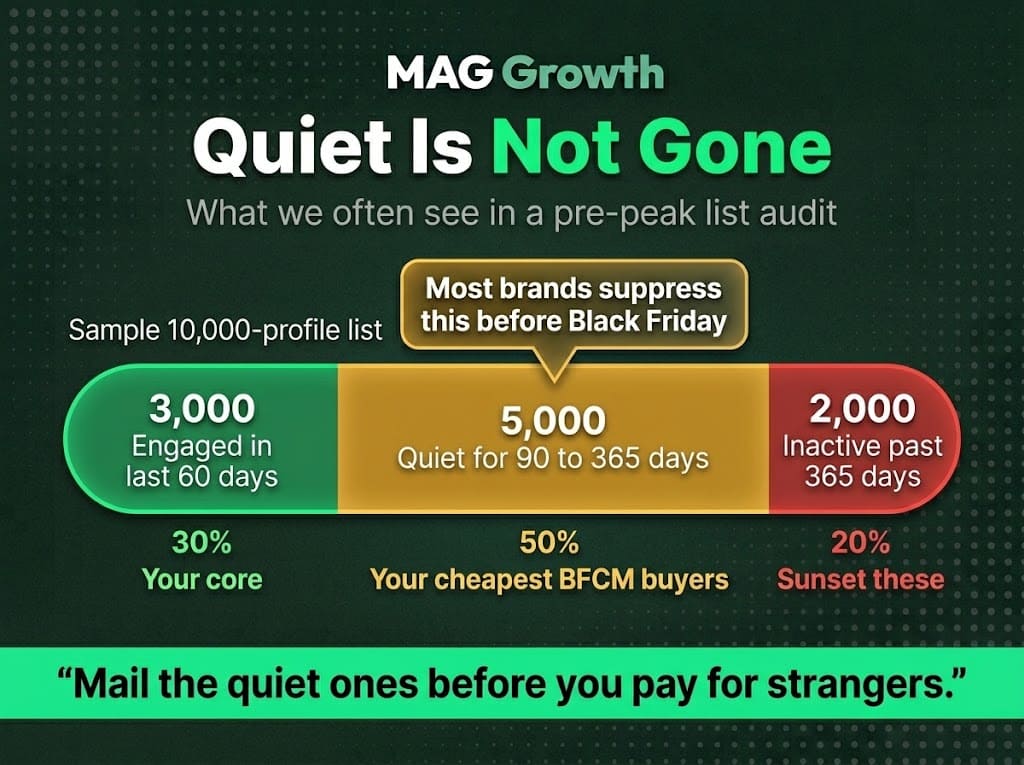
In pre-peak audits, we often find the quiet middle of a list outweighs its engaged core. Suppressing it cuts off your cheapest BFCM buyers.
BFCM New vs Returning Customer Benchmarks by Revenue Stage
These BFCM new vs returning customer benchmarks come from Triple Whale’s 2025 data, sorted by GMV band. Read them as BFCM revenue by brand size, a planning band and not a grade.
What share of BFCM revenue should come from returning customers under $1M?
Brands under $1M saw returning customers drive roughly 34% of BFCM revenue. That is normal for a young brand with few past buyers.
The job here is capture, not reactivation. Every Black Friday buyer should land in a welcome flow, as outlined in how to increase LTV with email and SMS.
Reading your gap. Our rule of thumb is that under 25% returning means your list is too thin to carry peak. Grow the list before you grow ad spend.
What share should come from returning customers at $1M to $10M?
Brands between $1M and $10M saw returning customers drive about 44% of BFCM revenue, a fair planning target for how much of your Black Friday revenue should come from repeat customers. Most scaling founders sit in this band, where Black Friday returning customer revenue decides whether Q1 is profitable.
Our retention marketing team closes this gap, from lapsed tags and Klaviyo win-back flow setup to VIP early access. The fixes in how to improve customer retention and LTV lift returning share without a deeper code.
More than 10 points under 44% means auditing your Klaviyo segments and win-back flow. More than 10 points over means discount depth gave contribution margin to buyers who would have paid full price.
What share should come from returning customers above $10M?
Brands above $10M saw returning customers drive about 55% of BFCM revenue, outweighing new buyers. That protects blended CAC, because 55% of peak revenue needs no paid click.
Reading your gap. Above this band, check whether discount depth did the work. Below it, acquisition is outrunning retention.
How much of Black Friday comes from reactivated buyers?
Reactivated shoppers placed about 12% of Black Friday purchases in Bluecore’s 2025 benchmarks, next to 53% retained and 35% new. These are order shares, so treat them as a directional split.
Reading your gap. That is about one returning order in five from a quiet buyer. In our audits, under 5% reactivated usually means your lapsed segment was suppressed or never mailed.
We'll compare your last BFCM revenue mix against your stage band and show which slice to fix before November 24.
How to Set Your Pre-Peak Revenue Mix Target
How do you sort buyers into new, retained, and lapsed before Black Friday?
Sort them with two tags, order count and last order date, then set a lapsed window. The three steps below build it in Shopify and Klaviyo.
Step 1, tag customer status in Shopify and Klaviyo
Tag every customer before your first BFCM send. That tag set is your Black Friday customer segmentation template, built from the Shopify customer report and mailed through Klaviyo segments.
Step 2, choose a lapsed window that fits your purchase cycle
For one outdoor recreation accessories brand, we built 30-day and 60-day engaged segments plus a 90-day inactive exclusion. We kept that exclusion apart from permanent suppression, because high-ticket gear sells on a long cycle.
Step 3, set suppression and Smart Sending caps
For a custom signs and frames brand, our email and lifecycle team split prospects from purchasers, built a global suppression list, and paused win-backs after new orders. We capped frequency with Klaviyo Smart Sending, the same segmentation approach behind how we boosted repeat revenue 179% with flows.
How do you pick a target mix for your stage?
Take a $3M brand that expects about $150,000 over the BFCM weekend. At the 44% returning band, a full-funnel growth marketing plan sets roughly $66,000 from returning buyers and $84,000 from new ones.
Split that slice by the Bluecore ratio, and about $12,250 should come from reactivated buyers. At a $90 average order, this worked example needs 136 orders, or 3.4% of a 4,000-person lapsed file.
Why are reactivated buyers the cheapest cohort in your customer journey?
A lapsed buyer already paid your acquisition cost once and knows the product fits. That settles the cost to acquire vs retain customers on Black Friday, and it tips a win-back campaign vs new customer ads toward the win-back.
The reason to return can be early access or a VIP preview instead of your deepest discount. Creative production builds those preview assets, while brand identity gives lapsed buyers a reason beyond price.
How to Read Your Mix 30 Days After Cyber Monday
Did Black Friday buy customers or just discount the ones you had?
Read your mix 30 days after Cyber Monday against your band and discount depth. This post-BFCM cohort analysis shows what to change.
| Pattern you see | What it means | Fix for next peak |
|---|---|---|
|
Returning share above band with deep discounts |
You paid loyal buyers to buy early |
Give VIPs early access instead of a deeper code |
|
New share above band with low 30-day repeat |
You bought one-time bargain hunters |
Cap promo cohort CAC and add a post-purchase flow |
|
Reactivated share near zero |
Your lapsed file never got mailed |
Build a lapsed segment and win-back flow by October |
|
Mix inside band with stable margin |
Peak worked as planned |
Lock the playbook and raise the list target |
Which numbers should you pull in December?
Your December cohort read needs five numbers. Pull them for the BFCM window only.
- Revenue by customer status
- Reactivated buyer count
- 30-day second purchase rate
- Discount depth by segment
- Unsubscribes from new buyers
BFCM customer repeat purchase within 30 days matters most. Our guide to first purchase vs second purchase LTV explains why that second order is where profit starts.
Late first deliveries can kill that second order, as mistake 3 in our BFCM retention mistakes post shows. Logistics management and ongoing maintenance keep delivery promises and Klaviyo tags working through peak.
What This Looks Like for a Founder-Led Brand
The outdoor gear brand from Step 2 had a list mixing engaged and long-quiet buyers. We split it by engagement, kept quiet buyers mailable, and scheduled a BFCM early access preview.
The idea was to sell returning buyers a head start rather than a deeper markdown, the same play we ran for a coffee brand’s VIP list in November 2025. That customer journey gets graded in the December read, the same read our free audit runs on your last peak.
How a Pet Toy Brand Built a Returning Base It Owns
A pet toy brand drew 92% of its revenue from Amazon, so it owned almost no returning customers. We built its own store through ecommerce builds, then ran full-funnel growth marketing with lifecycle email and SMS, a recurring purchase option, and a community program.
Revenue grew 78% in nine months, and the owned site reached 52% of online sales by month nine. Lifetime value on the owned channel ran four times higher than the brand’s Amazon buyers, per the pet toy case study.
You cannot count owned channel revenue during BFCM without owning the customer. Headless and PWA storefronts and technical SEO keep repeat visits fast, while GEO and content and link building help AI assistants describe your early access offer.
Related MAG Growth Retention Resources
Frequently Asked Questions About BFCM New vs Returning Customer Benchmarks
What percentage of Black Friday sales come from returning customers?
Plan around your revenue stage, not one average. In Triple Whale’s 2025 data, returning buyers drove about 34% of BFCM revenue under $1M, 44% at $1M to $10M, and 55% above $10M.
Is it bad if most BFCM revenue comes from new customers?
Under $1M it is normal. It becomes a problem when those buyers never return, and Ometria found only 11% of Black Friday 2024 shoppers came back for Black Friday 2025.
What counts as a lapsed or reactivated customer?
A lapsed customer has passed your normal reorder window, and a reactivated customer buys again after that. Set the window from your median gap between orders, since Bluecore found retailers won back only 6.6% of lapsed buyers in 2023.
How do I see new vs returning revenue in Shopify?
Run the first-time vs returning customer sales report under Analytics and Reports for your BFCM dates. Shopify’s customer report guide counts a buyer as returning from the second order onward.
Should returning customers get the same Black Friday discount?
Give them early access or a VIP preview instead of a deeper code. Ometria’s 2025 review found existing-customer revenue grew four times faster than new, so your base already shows up.
How does the BFCM mix change as a brand grows?
Returning share rises as the file grows, so raise your target yearly. Track it with our DTC LTV to CAC benchmarks, because Bluecore’s 2025 data shows mid-market brands trail enterprise repeat share by more than 20 points.
Plan Your Mix Before November 24
BFCM new vs returning customer benchmarks only help if you set the target before the sale. Full-funnel growth marketing treats the mix as the plan, because revenue shows how much you sold and the mix shows who bought.
- Find your revenue stage band
- Tag lapsed buyers before sending
- Give VIPs access, not codes
- Plan reactivated orders as a number
- Read the cohort in December
Founders. Pull last year’s first-time vs returning report this week and find your gap against your band. Then build the lapsed segment before you approve a single Black Friday code.
Directors. Put the target mix in the peak plan beside ROAS and blended CAC. Then book the 30-day December read now.
Get a free retention audit for your Shopify brand, framed as a BFCM revenue mix review of your stage band, your gap, and the slice to fix before the freeze.