

The best week to renew or cancel software before Black Friday is any week except Black Friday week. We learned that paying for Gong for two years when it earned its price in the first six months.
Most DTC stacks carry tools that stopped paying off long ago, and nobody notices until a renewal invoice lands. The worse surprise comes in late November, when you find out which forgotten app was quietly holding your order flow together.
We bring that lens from over $1.4B in ecommerce revenue managed across 400+ brands on Amazon and DTC. The same pattern shows up on client boards, where a tool or connector looks fine until order volume puts weight on it.
This brand building & operations guide gives you a two-test audit that sorts every tool into one of four verdicts. It also hands you a January cancellation calendar, so Black Friday runs on a stack you already stress-tested.
Get a free pre-BFCM stack and integration review from the team trusted with over $1.4B in ecommerce revenue.

Renew vs Cancel at a Glance
Every tool in your stack lands in one of four verdicts once you run both tests. The first test asks whether it still earns what it earned at setup, and the second asks whether anything breaks at peak without it.
| Verdict | What the two tests show | Your move before Black Friday |
|---|---|---|
|
Renew |
Still earning, and peak depends on it |
Renew, and lock the price on the annual contract |
|
Downgrade or renegotiate |
Still earning, but nothing breaks without it |
Drop a plan tier or reopen terms before auto-renewal |
|
Cancel in January |
Stopped earning, but peak depends on it |
Keep it through December with a dated sunset plan |
|
Cancel now |
Stopped earning, and nothing depends on it |
Export your data and cancel this month |
Part One. Why Your Stack Costs More Than the Invoice Says
The subscription line on your P&L shows only the cheapest part of tech stack bloat. The bigger cost hides in unused licenses, feature bloat, and storefront scripts that tax every page during peak load.
Which tools should you audit?
Every tool that touches an order, a customer, or a dashboard belongs on the list. For a $5M to $20M brand, that usually spans these categories.
- Helpdesk and chat
- Reviews and UGC
- Email and SMS are crucial for communicating special offers during a black Friday sale.
- Analytics and attribution
- Upsell and bundling apps
- Affiliate and creator platforms
- Fulfillment and inventory sync connectors are essential for managing a black Friday sale effectively.
Affiliate platforms need an owner who checks payouts against real sales, which is the core of how discounts are managed effectively. Affiliate marketing management keeps that channel profitable. Fulfillment connectors need the closest look, since they rarely appear on a renewal calendar until one breaks.
Why do most tools lose value after the first 90 days?
Software fixes your broken processes on day one. Afterward, you keep paying full price for a lesson your team already learned.
Zylo’s 2026 SaaS Management Index shows companies waste 36 percent of their software licenses. If that rate held for a stack costing $60,000 a year, roughly $21,600 would be paying for seats nobody opens, which is a costly mistake during a black Friday sale.
Why We Canceled Gong After Two Years
Gong paid for itself in our first 90 to 180 days, when its trackers helped our sales team drop filler phrases and standardize every call. By year two it worked like a costly note-taker, so we replaced it with Google Meet and a custom AI workflow.
Our VP of Sales and Marketing, Noah Wickham, breaks down that value curve in the video below. His warning at 12:04 about tools built for a different business model applies to every DTC renewal on your desk.
Is unused software always safe to cancel?
No, and that belief causes more peak-season outages than any bad vendor. Three misconceptions drive most of the bad cuts.
- Unused means safe to remove
- Expensive means it earns its keep
- The renewal date sets the deadline
A connector nobody logs into can still route every order from Shopify to your warehouse. The real deadline is your Shopify code freeze before Black Friday, not whatever date the vendor picked for auto-renewal.
Part Two. What Breaks When You Cut the Wrong Tool in November
A bad cut in January costs you a week of cleanup. The same cut in November can cost you the weekend that makes your year.
What breaks when integrations fail during peak?
Integrations fail quietly, and peak load is when quiet failures turn into lost orders. One timer brand we worked with had Shopify orders blocked from Amazon fulfillment while its late shipment rate sat at 16%, four times Amazon’s 4% threshold.
Our team placed a manual MCF order in Seller Central to find out whether Amazon or Shopify was at fault, and the brand kept selling on Shopify after the fix. A phone accessories brand needed 800+ Shopify listings relinked after its inventory sync drifted, which no renewal invoice would ever have flagged.
Why do November cancellations break more than January ones?
Code freezes lock your site down just as November traffic surges. Shopify merchants processed a record $14.6 billion over BFCM weekend in 2025, hitting $5.1 million per minute.
A tool you cut in November gets no stress test before the order volume spike hits. The same cut in January gets a quiet month to fail safely, which is why the sunset plan matters more than the cancel button.
Five Mistakes That Turn an Audit Into an Outage
Most audit failures come from sequence, not judgment. These five do the most damage.
- Cutting tools during the code freeze
- Canceling before exporting your data
- Cutting a tool with no owner
- Removing connectors without test orders
- Deciding on gut feel alone
Save the checklist below and walk it through with every tool owner before anything gets canceled. One skipped line is all it takes to turn a cleanup into a peak-week outage.
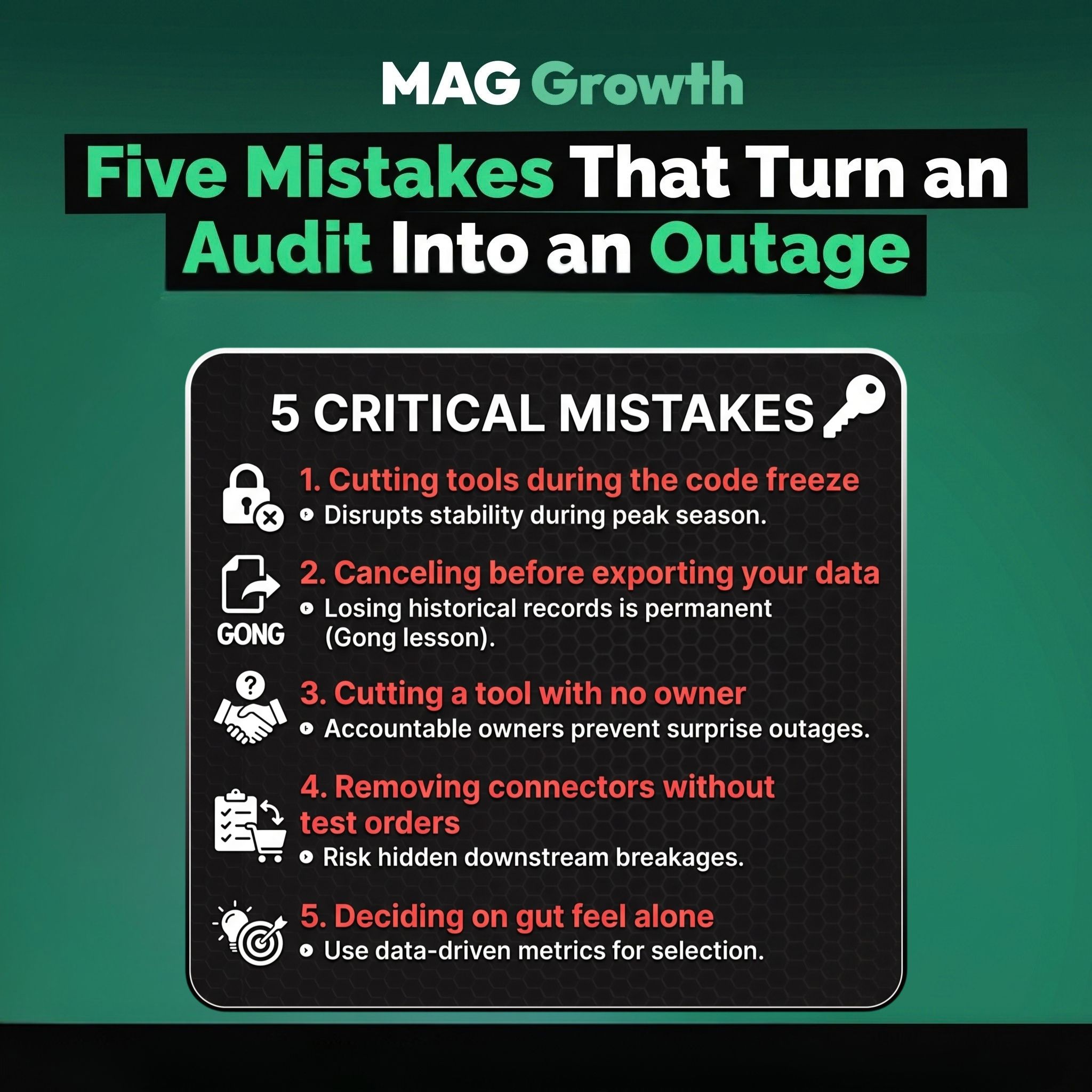
We felt the export mistake with Gong, since pulling usable video clips out of it was hard even while we paid for it (Noah covers this at 9:24). An ongoing maintenance plan should own your freeze calendar, so no one removes a connector the week before Black Friday.
We test your integrations and flag which tools can go now and which must wait for January.
Part Three. How to Renew or Cancel Software Before Black Friday
The fix is two tests, six steps, and one calendar. Run them this month and Black Friday runs on a stack you already tried under load.
The Two-Test Framework
The value curve test asks whether a tool still earns what it earned at setup, in hours saved, revenue touched, or errors avoided. The peak load test asks what breaks if the tool disappears during the busiest hour of your year.
Cross the two answers and every tool lands in one of the four verdicts from the table above. That turns a vague renew or cancel debate into a sorting job your team can finish in a week, ensuring no user misses their discount.
How should the audit change at your revenue stage?
At $1M to $5M, the founder usually runs the audit alone, so speed beats rigor and a one-page sheet is enough. At $5M to $20M, the ecommerce director should own it and present verdicts the way they would present a budget.
Above $20M, vendor consolidation and contract renegotiation carry real savings, so procurement should join before any annual contract renews. At every stage, our working rule is simple, with every tool carrying a named owner, one value metric, and a renewal date on a shared calendar.
How to Run the Audit in Six Steps
Run these steps in order, since each one feeds the next, especially when preparing for a major deal event. A focused team can finish them within a week.
Step 1. List every tool, its owner, and its renewal date
Pull every charge from card statements and app billing pages, then match each one to a person who uses it. Any tool without an owner goes straight to the review pile.
Add the renewal date, contract length, and auto-renewal terms beside each tool. That list becomes your renewal calendar, and it is often the first time anyone sees the whole stack in one place.
Step 2. Time the manual work each tool replaces
Before you judge a tool, run a one-week manual task audit and time every click it saves. Founders guess low on repetitive work, and the gap between the guess and the timer shows where automation pays, especially during a cyber Monday rush.
Noah covers this method with Joe from Order Automator starting at 5:35, then shows how a short morning brief replaces hours of manual checks at 9:20. Write down the time saved per week for each tool, because Step 3 needs that number.
Step 3. Run the value curve test
Compare what each tool delivered in its first 90 days with what it delivers now. Divide its annual cost by your yearly orders to get software cost per order, then check that number against your contribution margin.
That is the fastest way to measure software ROI for ecommerce without a finance team. A tool whose value flattened while its price climbed earns a plan downgrade or a cancel verdict.
Step 4. Run the peak load test with a manual test order
For every tool that touches an order, ask what would fail if it vanished at noon on Black Friday. Then prove it with a manual test order in a quiet window, the same way our team isolates MCF failures in Seller Central.
Check integration health across order routing, inventory sync, tracking updates, and customer emails. Our logistics management team runs this kind of test on fulfillment connectors, because a green dashboard does not prove orders are flowing.
Step 5. Sort every tool into a verdict
Use the at-a-glance table to give each tool one of four verdicts. Write the reason beside it in one line, so anyone on the team can challenge the call.
Watch for app sprawl in the renew pile, since every storefront app adds code to your pages. Shopify itself scores apps by comparing storefront Lighthouse results before and after install, and technical SEO work catches that same speed cost on live stores.
Step 6. Put January cancellations on the calendar now
Every cancel-in-January tool gets a sunset plan with a date, an owner, a data export, and a replacement if needed. Book the cancellation before the auto-renewal date, then set a reminder for the first week of January.
Cancel-now tools go this month, before your code freeze starts. Everything else stays untouched until December, so a well-meant cleanup never undoes your BFCM readiness.
Free Stack Audit Template
Copy these columns into a spreadsheet and fill one row per tool. The sheet doubles as your 2027 renewal calendar.
- Tool and category
- Owner
- Renewal date and terms
- Annual cost
- Setup value
- Current value
- Peak dependency
- Verdict and sunset date
Sort the finished sheet by verdict, then by renewal date, to ensure users don’t miss out on discounts. The top rows are your October work, and the bottom rows are your January plan.
Which numbers prove the audit worked?
Track five KPIs on one ops dashboard instead of twenty. Together they show whether the cuts saved money without costing orders.
| KPI | What it tells you | When to check |
|---|---|---|
|
Software cost per order |
Whether stack spend shrinks as orders grow |
Monthly |
|
Time saved per week |
Whether automation replaced real manual work |
Weekly |
|
Integration errors |
Whether connectors survived the cuts |
Daily during peak |
|
Late shipment rate |
Whether fulfillment held under peak load |
Daily during peak |
|
Average order value |
Whether reinvested budget lifted each order |
Weekly |
Pull these from Shopify Analytics, Seller Central reports, and your audit sheet, then feed the daily numbers into an automated morning brief. Review weekly through peak, quarterly after that, and rerun the full audit every October.
What does a tool that holds weight look like under pressure?
A gourmet snack brand we worked with had excess inventory close to expiring and no sell-through plan. Its email and SMS setup was ready, so our team launched a flash-sale sequence with countdown timers and social retargeting right away.
The brand recovered $3,300 in 48 hours, reached a Top 30 Best Seller Rank, and wasted zero inventory, with a 34% campaign open rate. That is a renew verdict in action, because the tool proved its value the moment pressure hit.
When does a custom AI workflow beat a subscription?
A custom AI workflow wins when the paid tool was built for a different business model and you use a sliver of it. That is how we replaced Gong, and it is the honest test in any custom AI workflow vs off-the-shelf software debate, particularly in the context of premium solutions.
The same logic settles Shopify Flow vs third-party automation apps, so pay for an app only when native workflows fall short. Build in January either way, and price any build carefully, since AI-native app spend rose 108% in a year.
Where should the budget you free up go before Black Friday?
Put the savings into the two levers that move peak revenue fastest, a post-purchase offer and a faster delivery promise. Noah and Joe cover both in the second half of the Order Automator video, at 10:12 and 13:53, discussing strategies for maximizing sales during a black Friday deal.
Some savings belong in channels that keep paying after December. GEO puts your brand in AI search answers, and content and link building grows the organic authority that paid traffic cannot buy, unlike a black Friday deal that offers temporary boosts.
Lever 1. Post-purchase offers
A post-purchase offer appears after checkout, so the buyer has already said yes and the first sale carries no added friction. That makes a post-purchase upsell for Shopify one of the cleanest ways to lift average order value before BFCM.
Pair it with retention marketing so the next order comes from email and SMS, then check results against DTC LTV to CAC benchmarks. A paid media team can then bid toward that higher order value, which is full-funnel growth marketing applied to peak.
Lever 2. Faster delivery through Amazon MCF
Slow delivery drives about 20% of checkout abandonment among shoppers who leave for a reason other than browsing, per Baymard Institute’s cart research. If you hold an FBA inventory pool, which is common for brands that moved from Amazon to DTC, Amazon MCF for faster Shopify delivery runs both channels from a single inventory pool.
Amazon opened MCF to Shopify merchants in 2025, and our guide to the best black Friday software deals. Amazon MCF for Shopify and TikTok Shop orders covers setup and Buy with Prime. Whether you pick Amazon MCF vs a 3PL for Black Friday, show the delivery date on every product page, a point Joe makes at 16:13.
More Guides for Peak-Season Operators
These guides go deeper on the decisions this audit surfaces. Each one covers a different part of running a DTC brand through peak.
- The complete guide to DTC brand operations
- Agency vs in-house ecommerce marketing costs
- Raising prices across Amazon and Shopify
- The state of AI brand voice in DTC
- Seven trust killers when moving from Amazon to Shopify
- 30 DTC brand operations terms defined
Keep the glossary open when you present verdicts upward, since terms like contribution margin carry the argument. If the audit shows you need more hands than tools, the agency vs in-house guide prices both paths.
Renew or Cancel Software Before Black Friday FAQs
When is the best time to cancel software subscriptions for an ecommerce brand?
Decide in October, then cancel this month or in January depending on whether peak depends on the tool. Act before each auto-renewal date, since an annual contract that renews quietly locks in another year of shelfware.
Is it safe to cancel apps during a Black Friday code freeze?
No, because a code freeze exists to block store changes while traffic runs at its highest. Pulling an app mid-freeze puts your busiest hour at risk, and in 2025 that hour saw Shopify merchants selling $5.1 million per minute.
How many Shopify apps is too many?
Any app without a named owner and a value metric is one too many, and the excess is app sprawl. Each storefront app also carries a speed cost, which is why Shopify measures every app against Lighthouse scores before approving it.
How do I know if a tool is still worth what I pay for it?
Compare what it delivered in its first 90 days with what it delivers now, in hours, revenue, or errors avoided. If its software cost per order keeps rising while that value stays flat, the tool is losing ground.
Should I cancel a tool nobody uses if it connects to other apps?
Not before peak, since a connector nobody logs into can still route orders and sync every SKU. Give it a cancel-in-January verdict, run a test order without it after the holidays, and cut it once orders flow cleanly.
Is Gong worth it for a small team?
Gong earned its price for our sales team in the first 90 to 180 days, then flattened into a note-taker, much like a premium software deal that loses its value over time. Small teams outside SaaS sales should expect the same curve and plan a cheaper custom workflow once the coaching gains stick.
Can a custom AI workflow replace paid software?
Yes, when your process is stable and you use only a narrow slice of the paid tool. Build it in January, run it beside the old tool for a month, and cancel only after it handles a full reporting cycle.
Does Amazon MCF work with Shopify for Black Friday orders?
Yes, Shopify orders can ship from your FBA inventory, and Amazon extended MCF to Shopify merchants in 2025. Place a manual test order before November, so a sync problem shows up before your order volume spike does.
How often should a DTC brand audit its tech stack?
Run the full audit once a year in October, before renewals and the code freeze. Between audits, check software cost per order quarterly and watch integration errors daily during peak.
What should I do with the money I save from canceling tools?
Move it into peak levers that raise the value of each order, such as a post-purchase offer or a faster delivery promise. Speed matters because roughly one in five avoidable checkout exits comes from slow delivery, per Baymard’s abandonment data.
Key Takeaways Before Your Stack Meets Black Friday
The right call on any tool comes from two tests, not from the invoice. Run them now and January handles the risky exits, especially after the holiday deal frenzy.
- Score every tool on value and peak load
- Time manual work before you cut anything
- Cancel dead weight before the code freeze
- Move risky cancellations to a January sunset plan
- Put savings into post-purchase offers and faster delivery
Run both tests on your five most expensive tools this week. If the peak load test turns up a connector nobody can explain, get a second set of eyes before November.
Book a free pre-BFCM stack and integration review, and our team will tell you what to renew, cut, or move to January.