

If your new Shopify store is pulling visitors but almost no sales, the problem is usually trust, not traffic. The most damaging moving from Amazon to Shopify mistakes happen in the first 100 words a shopper reads and the first design they see, long before checkout.
You are not alone in leaving, and that is exactly why this matters. Amazon’s active US seller count fell from 584,000 in January 2025 to 500,000 in March 2026 as rising fees and thinner margins pushed brands to build their own channels . The move makes sense, but most sellers carry the same trust assumptions off-platform, and that is where it breaks.
Here is the hard truth most migration guides skip. Amazon hands you trust for free, and the day you launch your own store that loaner trust disappears. Amazon captured about 40.5% of all US ecommerce sales in 2025, which means shoppers arrive on Amazon already expecting Prime shipping, easy returns, and a refund if anything goes wrong.
Your standalone store carries none of that borrowed safety net. We have managed $1.2B+ in ecommerce revenue across 400+ brands, and the pattern repeats in almost every migration we audit. The catalog moves fine, and the trust does not move at all.
That gap has a price. Web users judge a site in about 50 milliseconds, and roughly 94% of that first impression is design and trust related, not product related.
Fix these seven mistakes and you close the trust gap that is quietly draining your revenue. You should then implement a strict DTC brand operations framework to ensure your shipping speeds match those high customer expectations.
Get a clear read on which trust gaps are costing you sales before you spend another dollar on ads.

Mistake 1: Expecting Amazon's Trust to Follow Your Catalog
Why don’t customers trust my new website after leaving Amazon?
They do not trust it yet because you have not earned it yet. On Amazon, the platform vouches for you, and on Shopify you vouch for yourself from a standing start.
Sellers make this mistake because the logic feels sound. The product sold thousands of units on Amazon, so surely buyers will trust it anywhere, but that reasoning confuses product demand with brand trust.
Shoppers were never trusting your brand on Amazon in the first place. They were trusting Amazon’s returns policy, its buyer protection, and its refund guarantee, none of which followed your listing to Shopify.
This costs you at the worst possible moment, the first visit. A cold visitor from a Meta ad or Google search has no reason to believe your shipping promise or your product claims, so that doubt shows up as a bounce and an abandoned cart.
The fix is to build trust on purpose from the first visit, treating it as something you earn rather than inherit.
- Put your guarantee and return window above the fold
- Repeat those terms near the buy button
- Add an About page with a real founder photo
- Give a contact method that actually reaches a human
We see this trust gap in roughly the majority of Amazon-native brands we audit in their first 90 days. The brands that close it fastest lead with proof, which starts with the reviews we cover next.
Mistake 2: Assuming Your Amazon Reviews Transfer to Shopify
Do Amazon reviews transfer to Shopify?
No, Amazon reviews do not transfer to Shopify, and you do not own them. The customer who wrote the review owns the copyright, and Amazon holds a broad license to use that content on its own platform.
Sellers assume 5,000 Amazon reviews are a portable asset they can paste onto a Shopify page. That assumption can put your Amazon account at risk and expose you to a copyright problem you do not want.
Amazon’s Community Guidelines also block using the marketplace to divert customers to an outside store for sales. So the reviews stay on Amazon, and your new product page starts empty.
The cost is a brutal social proof cliff. Your Amazon listing shows thousands of reviews, and your Shopify page shows zero, so the same product suddenly looks untested and risky to a first-time visitor.
The fix is to stop trying to move reviews and start referencing and rebuilding them the compliant way.
- Link shoppers to your Amazon listing to read reviews there
- State your Amazon star rating as a fact, not copied text
- Collect fresh first-party reviews on Shopify from order one
- Get written permission before quoting any individual review
Is it legal to copy Amazon reviews to your website?
Copying and pasting the review text is not safe, because you do not hold the rights to it. You would need written permission from each reviewer, which Amazon’s contact rules make nearly impossible to collect at scale.
Restating a star rating is fine, but lifting the words is not. That distinction matters, and it leads straight into how you generate real reviews from scratch.
Mistake 3: Launching With Zero Social Proof and Hoping
How do I get reviews on a new Shopify store?
You collect them deliberately with a post-purchase flow, starting with your very first order. Building social proof without a marketplace is a system, not a lucky break.
Brands make this mistake by treating reviews as something that just accumulates, the way they did on Amazon. On your own store nothing accumulates unless you ask, and most first-time DTC sellers never set up the ask.
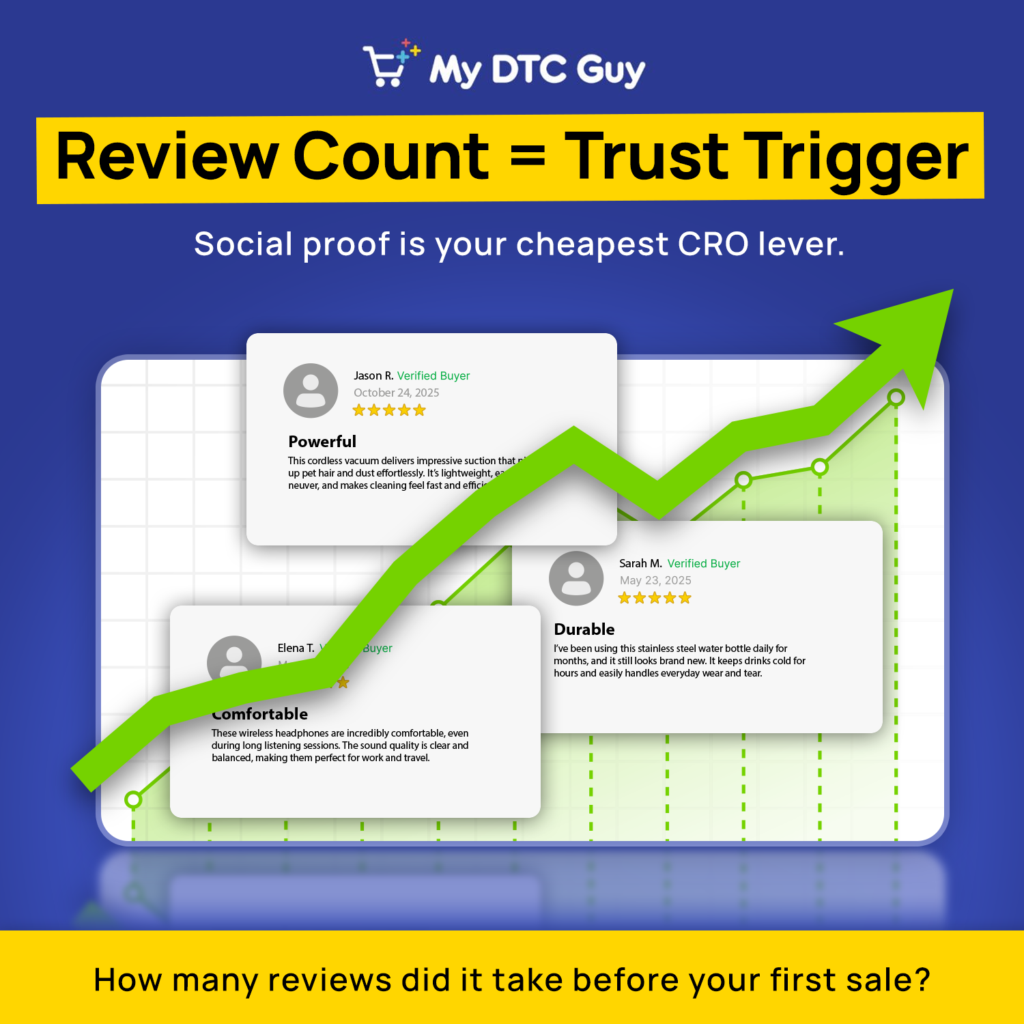
The cost is measured directly in conversion rate. Product pages with reviews convert far better than bare pages, and purchase likelihood for a product with five reviews runs about 270% higher than the same product with none.
Zero reviews is not a neutral starting point, it is an active leak. Every visitor who wanted proof and found none is a sale you paid an ad to lose.
The fix is to run an automated review-collection flow that starts the day your first order ships.
- Trigger a Klaviyo email a set number of days after delivery
- Ask for a photo or video, not just a star rating
- Offer a small loyalty incentive for an honest review
- Show a verified-buyer badge, which lifts purchase odds about 15%
That verified-buyer lift is a documented 15% improvement in purchase likelihood, and a perfect 5.0 average actually reads as fake, with purchase likelihood peaking in the 4.0 to 4.7 range. Reviews only work, though, if the store around them looks trustworthy, which is the next trap.
Mistake 4: Confusing a Pretty Theme With a Trusted Store
How do I build trust on a new ecommerce store beyond good design?
You pair clean design with visible proof, because design alone gets you looked at, not believed. A beautiful theme with no trust signals is a showroom with no salesperson.
Sellers over-index on the theme because design is the fun, visible part of a launch. They pick a premium theme, tweak the colors, and call the brand done, but a shopper reads polish and proof as two different things.
The cost is a store that looks the part and still does not convert. Visitors form that first judgment in about 50 milliseconds and most of it rides on trust cues, so a slick page with no reviews and no guarantees still triggers doubt.
A theme sets the mood, but it does not answer the question every cold buyer asks. That question is whether this specific store is safe to buy from.
The fix is to treat trust signals as core design elements, not decoration added at the end.
- Show real customer reviews with photos on the page
- State returns and shipping terms in plain sight
- Display recognizable payment and security badges
- Give a visible, working way to reach a human
Design earns the click, and proof earns the sale, so you need both working together. The same principle applies when you rebuild the product pages themselves, which most sellers copy straight from Amazon.
Our team will pinpoint exactly which trust leaks are costing you conversions on your new store.
Mistake 5: Reusing Marketplace-Style Product Pages
Why do shoppers trust Amazon more than independent stores?
They trust Amazon because the platform standardizes trust, and your store has to build that context itself. Amazon pages are built for fast comparison, while a DTC page has to tell shoppers who the brand is and why it is safe to buy.
The mistake is copying your Amazon listing layout straight onto Shopify, bullet dump and all. That marketplace format strips out the brand story and the guarantees a cold visitor needs, because Amazon supplied all of that invisibly.
The cost is a page that answers what the product is but never why to trust this specific store. On Amazon that context was free, and on Shopify its absence reads as risk.
A specs-only page works when the platform is already trusted, and yours is not yet. So the page has to do the trust-building work Amazon used to do for you.
The fix is to rebuild each product page for a visitor who has never heard of your brand.
- Lead with the outcome the product delivers
- Add lifestyle imagery, not just white-background shots
- State the guarantee and return window on the page
- Place reviews directly beside the add-to-cart button
Reviews sitting next to the buy button matter most for higher-priced items, where displaying reviews lifted conversion by about 380% versus 190% for cheaper products.
Fixing the page is only half the win, because the real long-term asset is the data behind every one of those orders.
We broke this down in a DTC masterclass on building a cyclical funnel beyond Amazon. Jump to the 35:49 mark where we answer whether customers actually trust DTC stores more than the marketplace.
Mistake 6: Ignoring the Owned Customer Data You Just Gained
What owned customer data do I actually get after leaving Amazon?
You finally get direct access to your buyers, their emails, their purchase history, and their behavior. Owned customer data after leaving Amazon is the single biggest asset the move unlocks, and most sellers ignore it.
The mistake is running a Shopify store with the Amazon mindset, where the customer belonged to the platform. On Amazon you never owned the buyer relationship, and many sellers carry that passivity over instead of building a database.
The cost is a slow, expensive growth model. Without owned data, you pay for every sale through ads, and you cannot cheaply bring back the buyers you already won.
First-party data is what lets you drive repeat purchases at a fraction of paid acquisition cost. Ignore it, and you rebuild your audience from scratch with every campaign.
The fix is to capture and activate customer data from the moment you launch.
- Collect emails with a real incentive, not a weak popup
- Build Klaviyo flows for welcome, abandoned checkout, and post-purchase
- Segment your list by what people actually bought
- Feed repeat-buyer reviews back into your social proof
This data is also your trust engine over time, because repeat buyers and their reviews compound into the proof new visitors look for. That compounding only happens if you give it time, which is why the last mistake is about pacing the move itself.
Mistake 7: Cutting Amazon Off Before Shopify Can Stand
Should I shut down Amazon when I move to Shopify?
No, keep Amazon running as your cash engine while Shopify earns its own audience. The safest migrations are hybrids, not hard cutovers.
Sellers make this mistake out of frustration with Amazon fees, so they treat the move as an escape and pull back from the marketplace fast. That removes the revenue and the review-generation machine before the new store can replace either.
The cost is a cash gap. DTC traffic and trust take months to build, and brands that abandon Amazon too early often cannot grow Shopify fast enough to cover the lost sales.
Amazon is the profit engine that funds the transition, not the enemy you rush to quit. Treat it as the bridge that carries you until the new channel can stand on its own.
The fix is to run a deliberate hybrid until Shopify proves it can hold its own.
- Keep Amazon live as your primary cash flow
- Sync inventory so you do not oversell across channels
- Use marketplace profit to fund Shopify audience-building
- Keep earning fresh Amazon reviews during the overlap
Handled this way, the move becomes a controlled expansion instead of a risky leap. Now you can score your own store against every mistake above and see exactly where you stand.
Your Amazon-to-Shopify Trust Audit Checklist
| Trust area | What to check | Missing or weak? |
|---|---|---|
|
Guarantee and returns |
Visible above the fold and near the button |
Score 1 if not |
|
First-party reviews |
Live review flow collecting from order one |
Score 1 if not |
|
Review placement |
Reviews sit beside add-to-cart |
Score 1 if not |
|
Brand identity |
Real About page, founder, contact method |
Score 1 if not |
|
Payment and security |
Recognizable payment and security badges |
Score 1 if not |
|
Owned data capture |
Email capture plus core Klaviyo flows live |
Score 1 if not |
|
Hybrid channel plan |
Amazon still live with inventory sync |
Score 1 if not |
Here is how to read your score:
- 0 to 2 mistakes means your store is healthy, keep tightening
- 3 to 5 mistakes means your trust layer needs real work
- 6 or more mistakes means the trust gap is costing you sales now
A quick reference on what to prioritize first, by funnel impact:
| Priority | Fix | Why it matters most |
|---|---|---|
|
First |
First-party reviews live |
Reviews can lift conversion up to 270% |
|
Second |
Guarantee near the button |
Removes risk at the point of doubt |
|
Third |
Email capture and flows |
Turns one-time buyers into repeat revenue |
What to Do Next With Your Score
If you found one or two mistakes, you can fix these yourself this week. Turn on a post-purchase review request, move your guarantee above the fold, and place reviews next to your buy button, then check our Amazon to Shopify migration guide for the step-by-step. Small trust fixes usually move conversion before any new ad spend does.
If you found three or more mistakes, the trust gap is bigger than a weekend fix. This is the exact work we do for Amazon-native brands every day, from review systems to owned-data flows to the full migration plan. You do not have to guess which leak to plug first, because a proper audit shows you the order that recovers the most revenue.
Moving From Amazon to Shopify Mistakes FAQs
How long does it take to build trust on a new Shopify store?
Plan on three to six months before your store sells without leaning on discounts. Reviews, repeat buyers, and search presence each build slowly, and you cannot rush any of them.
Attack the parts you control this week. Enable a review flow, position your guarantee by the Buy button, and let Amazon support your Shopify growth.
How much does moving from Amazon to Shopify cost?
You will spend far more on rebuilding trust than on the platform itself. Review software, email and SMS tools, fresh product page creative, and paid traffic all replace the marketplace demand you used to get free.
Watch the revenue gap more closely than the invoices. Sellers who keep Amazon running fund the move from profit instead of draining reserves.
What is the best Shopify review app for Amazon sellers?
Choose whichever app requests reviews automatically after delivery and shows photos and video. Judge.me, Loox, and Yotpo each do this, so weigh catalog size and budget rather than feature lists.
Install it before your first order ships. Wait a month and you forfeit the early orders that should have seeded your proof.
Can I ask my Amazon customers to review my Shopify store?
Never route Amazon buyers to your store through Amazon messaging, because the Community Guidelines forbid pulling customers off-platform. Sellers who try it gamble their selling account.
Reach the same people through channels you own. Package inserts, your email list, and your social following all belong to you.
Do trust badges actually increase Shopify conversions?
Shoppers respond to payment and security marks they already recognize from other checkouts. Design your own seal and it earns you nothing, because nobody has seen it before.
Treat badges as support, not as your proof. Show real reviews, state your return window, and provide real customer support.
Should I use the same product photos from my Amazon listing?
Carry them over, then build past them. Amazon rewards compliant white-background shots, while your own page has to show the product in use and say something about the brand.
Shoot lifestyle images, gather customer photos, and add detail crops. Your imagery now handles trust work that Amazon quietly absorbed for you.
What is the first thing to fix if my Shopify conversion rate is low?
Put reviews on your product pages before you touch anything else, because bare pages leak the most sales. Buyers commit far more readily once a product carries even a few.
Then lift your guarantee and return window above the fold. Both changes usually move conversion before a single new ad dollar does.
Let our team audit your store and hand you a prioritized fix list for the trust gaps costing you sales.