

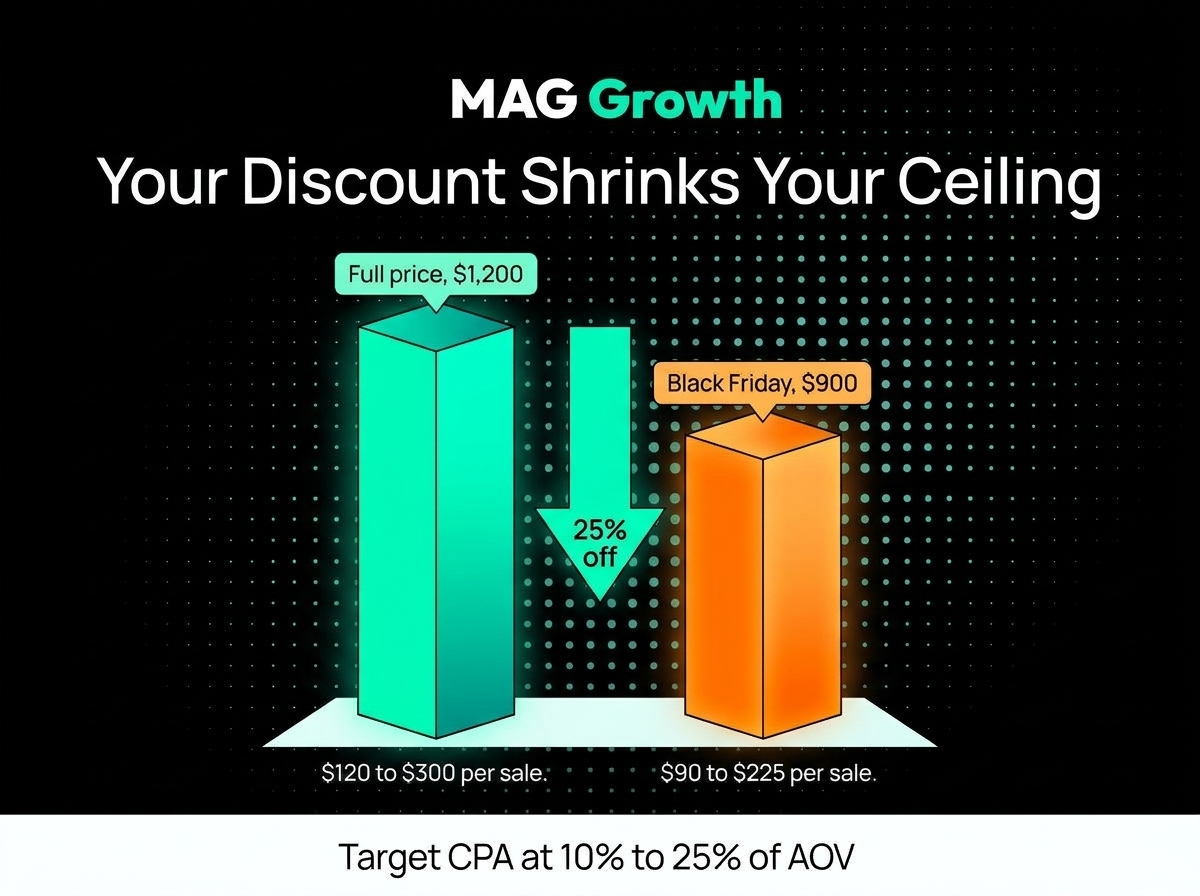
Performance Max vs standard shopping for high AOV brands starts as a margin question, not a campaign question. We typically cap target CPA between 10% and 25% of AOV, which gives a $1,200 hero product $120 to $300 to win each order.
Black Friday shrinks that budget fast. A 25% discount drops the price to $900 and the ceiling to $90 to $225.
Google never marks down a click because you marked down the product. CPCs climbed about 22% month to month during the 2024 holiday window in one large merchant dataset, squeezing peak season profit margins from both sides.
We manage $1.2B+ in ecommerce revenue for 400+ brands and tune that range for each client. No single structure fits every catalog, so we run full-funnel growth marketing tier by tier, starting with the math in this guide.
Growth leads at $5M to $20M brands get a tier split they can defend. Founders at $1M to $10M see fast whether their acquisition cost fits.
Send us your 10 biggest SKUs and your planned Black Friday discount, and our free Performance Max audit maps a spending ceiling for every tier, with no obligation.

Part One. Why One Campaign Type Can't Run a High-AOV Catalog
What is the real difference between Performance Max and Standard Shopping in 2026?
Standard Shopping gives you query level control on a few Google surfaces, and Performance Max trades that control for reach and algorithmic bidding. Google closed several control gaps in 2025, from campaign-level negatives to channel reporting, so the difference runs smaller than most comparisons claim.
| Criterion | Performance Max | Standard Shopping |
|---|---|---|
|
Where ads show |
Search, Shopping, YouTube, Display, Discover, Gmail, and Maps |
Search, Shopping tab, Images, and search partners, with YouTube, Gmail, and Discover as opt-ins |
|
Negative keywords |
Up to 10,000 per campaign, on Search and Shopping queries |
Full negatives at campaign and ad group level |
|
Search term visibility |
Search terms report that groups low-volume queries |
Query-level search terms report |
|
Bidding options |
Smart Bidding only |
Manual CPC or Smart Bidding |
|
Data needed to learn |
Six weeks or more for a new campaign |
None on Manual CPC, 15 conversions in 30 days for Target ROAS |
|
Best-fit products |
Proven sellers that need scale |
Hero SKUs with thin sale margins |
Most comparisons still miss one fact about Performance Max negative keywords for Shopping. You can add up to 10,000 negatives per campaign, but they only filter Search and Shopping queries and leave YouTube, Display, and Gmail open.
Premium catalogs gain most from one shared list. Google’s own example shows a luxury retailer blocking “cheap” and “bargain” across every campaign with a single campaign-level negative list.
Why do high-AOV brands feel this choice more than anyone else?
Performance max vs standard shopping for high AOV bites harder because expensive products sell less often. A bid strategy may need roughly 50 conversions, or three full conversion cycles, to calibrate, and a $1,200 product may not reach that in a quarter.
Wasted clicks also cost more. With a $225 ceiling and one buyer per 100 clicks, you can pay $2.25 per click at most.
What is a good target CPA for high ticket ecommerce?
No universal number exists, and anyone quoting one without your margin is guessing. A good CPA for high ticket products starts inside 10% to 25% of AOV, and we adjust it for margin and category.
- $300 AOV, $30 to $75 at full price, $22.50 to $56.25 at 25% off
- $600 AOV, $60 to $150 at full price, $45 to $112.50 at 25% off
- $1,200 AOV, $120 to $300 at full price, $90 to $225 at 25% off
Pick your point from contribution margin, not a competitor’s ROAS screenshot. Our breakdown of the levers that raise ad spend without hurting margin shows how to calculate that margin first.
Which myths cost high-AOV brands the most money?
Four beliefs cost brands the most before their first peak with us. Each one fails once you test it against sale-price margin.
- Performance Max can’t take negative keywords yet
- Standard Shopping stopped working
- One campaign type can carry every product
- A tougher ROAS target protects margin
The chart below shows how a 25% discount cuts the ceiling on a $1,200 product. Part Two shows what that smaller ceiling costs in Cyber Week.
Part Two. What an Account-Wide Choice Costs You in Cyber Week
What happens when Performance Max runs your hero SKUs through Cyber Five?
Budget can drift to YouTube or Display, where your negatives never reach, and the channel performance report shows exactly how much. Your thinnest-margin hero then fights a $40 accessory for the same pool.
A summary of Tinuiti’s Q3 2025 benchmarks shows Performance Max took 68% of Shopping spend. It drove 2% more conversions than Standard Shopping, but its ROAS trailed by 2%.
What happens when the whole catalog sits in Standard Shopping?
Manual bid adjustments become a daily chore in the most expensive week of the year. You also give up automated reach across channels, so scale stalls because Standard Shopping mostly answers searches shoppers already typed.
How much wasted spend is too much?
Our high-AOV plans hold wasted spend at 10% or less, and we set that line per client. At $30,000 a month, 10% equals $3,000, while 20% waste burns $6,000 before the sale opens.
Where do Performance Max and Search start bidding against each other?
Both campaign types chase the same shopper, and brand searches cost you most. An Optmyzr study of 503 accounts found keyword overlap between Search and Performance Max in 91.45% of them.
Add a brand exclusion in Performance Max to send those searches back to Search. Google recommends brand exclusions over negative keywords for your own name, because exclusions also catch misspellings and variants.
Book a free Google Shopping campaign structure review, and we'll check your tier split, hero SKU ceilings, and campaign overlap before Cyber Five, with no obligation.
Part Three. How to Run Performance Max vs Standard Shopping for High AOV by Product Tier
The best Google Ads campaign structure for high ticket ecommerce uses product tiering and prices each tier on its own. Our Google Ads team builds feeds, campaigns, and bidding this way for every client.
How do we segment Google Shopping campaigns by product?
We sort the catalog by what each product has proven and give every tier its own budget. Budget segmentation stops a new test product from draining money a best seller already earned.
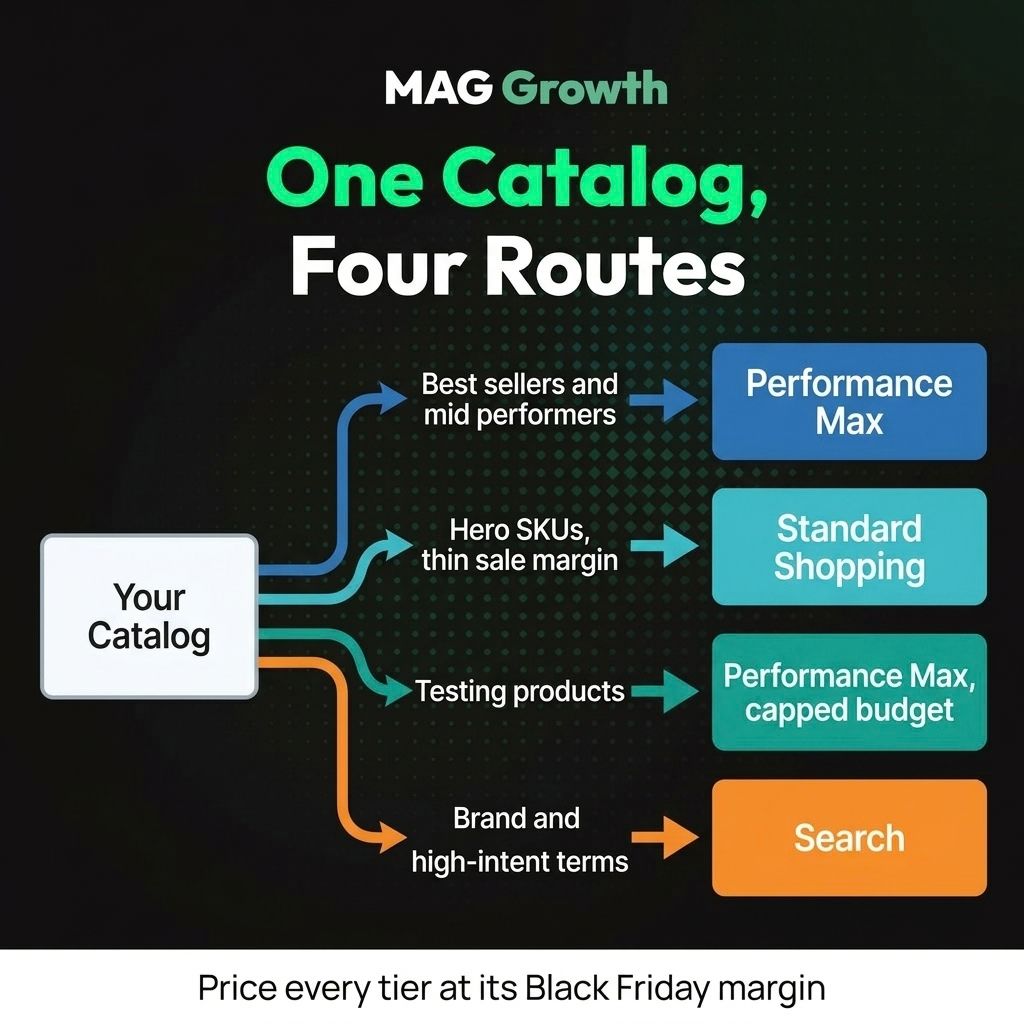
| Tier | Campaign type | Job |
|---|---|---|
|
Best sellers |
Performance Max |
Scale proven winners across surfaces |
|
Hero SKUs with thin sale margin |
Standard Shopping |
Control every query at the sale price |
|
Mid performers |
Performance Max with its own budget |
Grow volume inside the ceiling |
|
Testing products |
Performance Max with a capped budget |
Prove demand before earning more |
|
High-intent Search |
Search |
Catch shoppers typing exact models |
|
Brand protection |
Search |
Hold branded queries at low cost |
Full-funnel growth marketing adds a funnel layer on top of the tiers. A full funnel Google Ads structure gives each stage its own campaign type, audience, and offer.
- Top of funnel meets new shoppers
- Middle of funnel brings researchers back with proof
- Bottom of funnel runs Performance Max, Shopping, and Search
A hero SKU earns Standard Shopping when three conditions hold at once. In each case, query level control protects a margin the discount already squeezed.
- The product drives a large share of peak revenue
- Its Black Friday margin sits close to the ceiling
- You need to block or bid on specific search terms
In the Standard Shopping vs Performance Max for small catalogs question, Standard Shopping usually wins because Performance Max has too little to learn from. A dozen slow SKUs rarely hit the 15 conversions in 30 days Google lists for Target ROAS.
Think of Standard Shopping as a torque wrench for a few critical bolts. Performance Max works as the power drill that moves through the rest of the catalog fast.
When should you use Standard Shopping instead of Performance Max?
What targets do we set for each campaign type?
These ranges come from a recent high-AOV plan we built, and they reflect that client’s margins. We rebuild them for every brand.
- Target CPA at 10% to 25% of AOV
- Performance Max conversion rate target of 4%
- Wasted spend at 10% or less
- Brand Search click-through rate of 15% to 35%
- Non-brand Search click-through rate of 2% to 8%
- High-intent product keyword click-through rate of 5% to 12%
How does the split change as you grow from $1M to $20M?
Budget sets your tier count. Small budgets rarely feed more than two.
$1M to $5M
Run two tiers plus brand protection, because five tiers on a thin budget starve every campaign. The plan referenced above spends no less than $2,500 a month.
$5M to $10M
Run the full split and give your biggest hero products a Standard Shopping campaign. Track new customer acquisition cost by tier.
$10M to $20M
Report each tier’s budget as its own line. Check overlap across all three campaign types monthly.
How do I set up the tier-by-tier structure step by step?
Google recommends giving a new Performance Max campaign six weeks or more. Black Friday lands on November 27, so any campaign you launch after mid October will still be learning at peak.
Step 1. Pull 90 days of product data
Export revenue, conversions, and margin per product from Google Ads, Merchant Center, and Shopify. Keep slow sellers, because they fill your testing tier.
Step 2. Sort products into tiers
Tag each product with a Merchant Center custom label for best seller, mid performer, testing, or hero. Add the labels through a supplemental feed, so you never touch the main feed.
Step 3. Calculate each tier’s ceiling at the Black Friday price
Multiply the sale price by your target CPA percentage. A ceiling built on list price quietly approves losses all week.
Step 4. Move hero SKUs into Standard Shopping and exclude them from Performance Max
Ad Rank now picks the winner when both campaigns carry a product, because Performance Max lost its automatic priority. A hero SKU left in both campaigns bids against itself.
Step 5. Build Search campaigns for brand protection and high-intent terms
Brand Search defends your name cheaply, and high-intent Search catches shoppers typing exact models. The brand exclusion keeps each campaign on its own job.
Step 6. Lock the structure before November
Freeze tiers, budgets, and exclusions once learning settles. Read how to adjust Google Ads bids for BFCM for peak bidding and Promotion Mode.
Copy this tier sheet into a spreadsheet. Give each product one row.
- Product
- Tier
- AOV
- Black Friday sale price
- Margin at sale price
- Spending ceiling per order
- Campaign type
- Monthly budget
Which setup mistakes break the hybrid structure?
Our pre-peak audits catch these often. Each sets two campaigns fighting over one dollar.
- Hero SKUs still running in both campaigns
- Brand exclusions missing from Performance Max
- Tiers reshuffled in the middle of Cyber Five
- Ceilings priced at list instead of sale price
- Test products funded like best sellers
Which KPIs prove each tier is earning its budget?
Blended ROAS hides a failing tier behind a strong one. Track these per tier weekly.
- CPA against the tier’s ceiling
- Wasted spend percentage
- Conversion rate and click-through rate
- ROAS by tier
- New customer acquisition cost
Compare Performance Max ROAS vs Standard Shopping ROAS inside a tier, never across tiers. The two carry different products by design, so a raw comparison rewards the easier SKUs.
Three rules keep each tier honest. We apply them every week a campaign runs.
- Swap weak creative every week
- Escalate any campaign that falls below its ROAS target
- Escalate any campaign with no sales in 15 days
The channel performance and search terms reports show where money went. Shopify, GA4, and a profit tracker confirm the margin.
What does the tier split look like in a real account?
Our published Google Ads case studies show the scale tiers at work, with Shopping inside Performance Max and Search covering intent. We add the Standard Shopping carve-out only when a hero SKU’s sale margin calls for it.
A fishing kayak brand, with its Amazon category down about 50%, nearly doubled its site revenue, up 98% over eight months, on Performance Max and Search. Its paid search clicks rose from 11,000 to 39,000, and website orders grew 59%.
An industrial pipeline equipment brand lifted website revenue 200% in month one with Performance Max and Merchant Center. The paid media and landing page work that cut one brand’s CAC 42% shows what a strong landing page adds.
How do you scale Performance Max for ecommerce once the tiers work?
Better signals drive scale, not bigger budgets. Add these once every tier holds its ceiling for a month.
- Goals that favor new customers, so bids lean toward first-time buyers over repeat ones
- Gross profit reporting from cart data and COGS
- Promotion Mode for short peak windows, if your account has beta access
- Merchant Center promotions
Demand Gen for early-stage reach, once lower-funnel campaigns convert
Pricey products have long research cycles, and our Meta Ads team fills branded search with new shoppers. Your Search tier then catches them cheaply.
Social ads on TikTok and other social platforms reach people who browse long before they buy, and programmatic ads keep hero SKUs in front of researchers across the open web. Our paid media program ties every channel to one margin number, and that is full-funnel growth marketing in practice.
The map below routes every tier to its campaign type. Use it as your checklist for Steps 2 through 5.
More Google Ads and Peak Prep Resources From MAG Growth
Frequently Asked Questions About Performance Max vs Standard Shopping for High AOV
Is Performance Max worth it for expensive products?
In performance max vs standard shopping for high AOV, the answer is yes for most products if hero SKUs run in their own campaign. Google’s channel performance report now shows which surfaces spent your money.
Can I run Performance Max and Standard Shopping on the same products?
You can, but keep each hero SKU in one campaign, because both campaigns would bid in the same auction. For a clean test, use separate product sets or Google’s built-in experiment.
Does Performance Max take priority over Standard Shopping?
No, although many guides still claim it does. Since late 2024, Ad Rank decides which campaign shows when both carry the same product.
Does Performance Max support negative keywords now?
Yes, but they only block Search and Shopping queries, not YouTube or Display. Google’s help page on Performance Max negatives confirms that limit.
How long does Performance Max take to learn?
Give each new campaign six weeks or more, longer for slow-selling catalogs. On how many conversions Target ROAS needs in Shopping, Google lists 15 conversions in 30 days for each Merchant Center ID.
What should my target CPA be for a $1,000 product?
Start at $100 to $250, or 10% to 25% of AOV, and adjust for margin and category. A 25% discount drops that range to $75 to $187.50.
Should I change my Shopping structure before Black Friday?
Yes, and for performance max vs standard shopping for Black Friday, finish the split by mid October. Google advises allowing one to two conversion cycles for a campaign to settle after any significant change.
Should I bid on my own brand name in Google Search?
Yes for most high-AOV brands, because it cheaply protects your name. Tinuiti saw brand CPCs climb 19% between Q1 2024 and Q1 2025, so watch it.
What is a good conversion rate for Performance Max?
No universal answer exists, because category, price, and traffic mix all move it. One recent high-AOV plan of ours targets 4%, and we set that number per client.
How do I know if Performance Max is wasting my budget?
Check the search terms and channel reports for spend with no sales. We cap waste at 10% or less, and anything higher signals a structure problem.
Test Every Tier
Performance max vs standard shopping for high AOV comes down to which tier can afford which kind of control. Price each product at its sale margin, and its campaign type follows.
- Margin decides the ceiling
- Price every ceiling at sale price
- Tier before you bid
- Protect hero SKUs with
- Standard Shopping
- Judge every tier on its own
Your next move depends on your seat. Both steps use data you already have.
- Directors fill in the tier sheet before the next budget review
- Founders price the ceiling on five best sellers at the Black Friday price
If you plan to hire a Google Ads agency for Shopify, ask how they would price each tier. We run Google Shopping management for high ticket brands, and every Google Ads audit for ecommerce we run starts there.
Our Google Ads team builds the tier split, hero SKU carve-outs, and peak bidding for high-AOV brands.