

What happens to your Black Friday margin when one SKU ships three ways at three different peak rates? Most two-channel brands find out from the invoice, weeks after the promo ends.
Brands read carrier rate tables, but they pay peak surcharges per order and per lane. Knowing how to cut peak shipping surcharges starts with one fact: a 3PL order, an MCF order, and an FBM order each stack fees on a different calendar.
We manage over $1.4B in ecommerce revenue across 400+ brands, running Amazon and Shopify fulfillment for the same businesses. That view shows where a SKU earns money in one lane and loses it in another.
Our agency talks about how to cut peak shipping surcharges across your 3PL, MCF, and FBM lanes in this playbook. We also discuss 3PL pass-through charges, box fixes, free-shipping thresholds, and the KPIs to track.
Send us your top SKUs and we will price each lane at 2026 peak rates, with no obligation.

Part One. Why Peak Surcharges Hit Two-Channel Brands Harder
Two-channel brands pay peak fees in three places and see the total in none of them. The carrier bill, the 3PL invoice, and the Seller Central fee report each show one slice.
What happens when one SKU ships through three lanes at peak?
Shopify orders leave through a 3PL or through Multi-Channel Fulfillment, while Amazon FBM orders leave on labels you buy. Each lane has its own start date, its own stacking rules, and its own invoice.
So a BFCM promo can look profitable on the Shopify dashboard and still lose money on every MCF order. Nobody catches it until the Cyber Week margin report comes in short.
Why doesn’t the carrier rate table show your real peak cost?
The table shows one fee, while your order carries a stack. USPS holiday pricing lands on top of the 8% transportation surcharge that has applied since April 26, and both run through January 17, 2027, per DCL Logistics.
MCF adds its 3.5% fuel and logistics surcharge on top of the holiday fees, according to Supply Chain Dive. A 3PL ships every client on its own carrier account and splits the charges back out client by client, so the per-order view is the only one that adds everything together.
Misconceptions to clear first
- The volume tier is my biggest risk
- My 3PL absorbs peak fees
- MCF avoids carrier surcharges
- Free shipping costs the same all year
The steep tiers only apply to high-volume shippers above 20,000 packages who run over their baseline, and most $1M to $20M brands ship far fewer. The flat per-package fees are the real exposure, and EasyPost’s 2026 analysis found residential demand charges rose 22% to 32%.
Part Two. The Peak Margin Math Across Your Three Lanes
Run the math once in September and reuse it all quarter. Every number below comes from published 2026 schedules, so your own invoice is the only input left to add.
What are the 2026 peak surcharge dates by lane?
| Lane | 2026 peak charge | Window |
|---|---|---|
|
Handling and size fees, then residential demand fees |
Sept 27, then Oct 25 to Jan 16, 2027 |
|
|
Handling and size fees, then residential demand fees |
Sept 28, then Oct 26 to Jan 17, 2027 |
|
|
Temporary price change on USPS Ground Advantage, Priority Mail, Priority Mail Express, and Parcel Select |
Oct 4 to Jan 17, 2027 |
|
|
MCF peak fees plus the fuel and logistics surcharge |
Oct 15 to Jan 14, 2027 |
|
|
Per-package peak fee in three windows |
Oct 25 to Jan 16, 2027 |
The dates that matter most are September 27 for size and handling fees and October 25 for residential demand charges. Rates peak between November 22 and December 26 at UPS, so the same box costs more in Cyber Week than in October.
What is the peak season shipping cost per order in each lane?
The residential fee is rarely what flips a SKU negative. The additional handling surcharge peak season rate does, because it climbs to $11.90 per package at Amazon Shipping and at UPS during the highest window.
| Lane | Peak add per package, Nov 22 to Dec 26 | What flips it negative |
|---|---|---|
|
3PL on UPS Ground Residential |
$0.75 demand surcharge, plus any 3PL invoice markup |
A soft mailer over 18 x 14 x 6 inches triggering Additional Handling |
|
3PL on USPS Ground Advantage |
$0.40 to $0.55 on a 0 to 3 lb parcel, stacked on the 8% transportation surcharge |
Heavy parcels into zones 5 to 9 |
|
MCF |
About $0.32 per unit on average, plus 3.5% on the fee |
Single-unit orders that miss the multi-unit discount |
|
FBM on Amazon Shipping |
$0.75 per package, with no residential fee |
Oversized boxes hitting $11.90 Additional Handling |
Take a modeled $40 BFCM order with $6.00 of contribution left after product cost, fees, and base postage. A $0.75 demand fee leaves $5.25, while one $11.90 Additional Handling hit turns the order into a $6.65 loss.
At 1,000 peak orders, that box choice swings $11,900 in contribution margin, and at 10,000 orders it swings $119,000. This is a worked example built from published 2026 rates, so rebuild it with your own invoice.
When does MCF beat your 3PL for Shopify orders?
MCF wins on multi-unit orders, since Amazon cuts per-unit fees by up to 50% when an order ships more than one unit. A single-unit Shopify order carries the full fee, the peak increase, and the 3.5% surcharge.
Bulky SKUs usually belong with a 3PL or FBM, and our guide on how to split FBA and Shopify inventory for BFCM covers which stock should feed MCF at all. Make the MCF vs. 3PL for shopify orders call per SKU, never once for the whole brand.
What peak shipping targets should a brand hit at each stage?
These are the planning standards our team uses on managed accounts. Grade your own process against them before October 25.
- Average $1M to $5M brands learn peak cost from the first November invoice
- Good $1M to $5M brands price top SKUs per lane by October 15
- Average $5M to $20M brands negotiate rates once a year
- Good $5M to $20M brands hold pass-through terms in writing and track surcharge share weekly
Book a peak shipping margin check and we will show which SKUs lose money in which lane.
Part Three. How to Cut Peak Shipping Surcharges, Step by Step
Six steps fit inside one working session. Take them in order, since each step feeds the next.
Step 1. Pull your top SKUs and the lanes they ship through
Start with your top Q4 units, since a short SKU list drives most peak volume. For each one, record packed dimensions, billable weight, and last Q4’s lane mix across 3PL, MCF, and FBM.
Billable weight is the higher of actual and dimensional weight, so measure the packed box instead of the product. Our DTC brand operations glossary walks through the dimensional weight math if your team needs a refresher.
Step 2. Price each SKU at peak rates in every lane
Build one row per SKU per lane in a shared sheet. These columns turn a carrier rate table into per-order margin by lane.
- SKU
- Lane
- Billable weight
- Base rate
- Peak surcharge
- Fuel %
- Fulfillment fee
- Peak cost per order
- Contribution at the BFCM price
Any row below zero marks a negative-margin SKU for that lane. Our paid media team trims spend on those SKUs through the peak window, the same discipline behind how paid media and landing page testing cut CAC by 42% for a DTC brand.
Step 3. Ask your 3PL how peak charges reach your invoice
Most brands never ask, which is how a 3PL invoice markup survives a whole peak. Fulfill.com notes that a brand using a 3PL meets surcharges on the carrier bill and again through the provider’s pass-through rules.
- Do you pass surcharges at cost or marked up?
- Whose carrier account ships my orders?
- Whose volume counts toward the demand tier?
- When do peak charges hit my invoice?
- How do you classify residential addresses?
Get your 3PL carrier surcharge pass through terms in writing before October. Our logistics management team runs this review for brands that would rather not argue invoice lines in December.
Step 4. Fix your boxes before September 27
Size and handling fees start first, so this step has the earliest deadline. Dimension-based Additional Handling carries a 40 lb minimum billable weight at UPS, so a light product in a long box bills like a heavy one.
Soft packs count too, since UPS applies Additional Handling to poly bags or bubble mailers beyond 18 x 14 x 6 inches. UPS also added a cubic trigger at 10,368 cubic inches in January 2026, so re-measure your five highest-volume boxes this week.
Step 5. Move the lane, not just the carrier
Rerouting by SKU saves more than switching carriers, because each lane rewards a different order shape. Use these defaults as a starting point.
- Multi-unit orders go to MCF
- Single-unit and bulky orders go to the 3PL
- FBM labels move to Amazon Shipping where residential fees hurt
Amazon Shipping charges $0.75 per package from November 22 to December 26 and adds no residential surcharge, which settles the amazon shipping peak surcharge fbm question for most parcels. For multi-unit volume, an email and lifecycle program can push bundles to your list before the highest window opens.
Moving Shopify orders off FBA inventory changes your fees and your stock risk at the same time. Start this My Amazon Guy conversation with ShipBob at 17:35 for rising Amazon fulfillment fees, then skip to 34:03 for one inventory pool across Amazon, Walmart, and TikTok Shop.
Step 6. Reset your free-shipping threshold and promo depth for peak rates
A threshold set in June assumes June shipping costs. Eightx estimates surcharges at roughly a third of a commercial Ground invoice and over half of a typical DTC residential parcel, so recalculate against peak cost per order before October 25.
Check the new free shipping threshold for BFCM against your AOV, using our DTC AOV benchmarks as a guide to what shoppers accept. Then cut promo depth on any SKU that stays negative, since a shallow discount costs less than a deep one that ships at a loss.
Our ecommerce builds team updates Shopify shipping profiles and rates to match. Landing page optimization keeps the new threshold visible, using the same testing that lifted landing page CVR 67% for a health and wellness brand.
A surprise shipping fee at checkout is one of the trust killers brands carry over from Amazon. Shoppers also ask AI assistants about shipping costs, so our GEO team makes sure those answers repeat your new terms.
If you raise prices instead, follow our rules for raising prices across Amazon and Shopify. Price and threshold should move together, never one at a time.
Common execution mistakes
- Pricing on list rates, not invoices
- Checking one lane only
- Right-sizing boxes after September 27
- Assuming your 3PL absorbs fees
- Keeping June’s free-shipping threshold
- Judging peak on shipping cost alone
What We've Seen Across Managed Accounts
Our pet toy brand client came to us with Amazon producing 92% of revenue and marketplace fulfillment costs wearing down product margins. We built its own store, regrouped the catalog into curated sets, and moved buyers onto an owned channel.
- 78% more revenue in nine months
- Owned store at 52% of online sales by month nine
- Customer lifetime value 4x higher than Amazon buyers
That study tracked revenue and retention, not surcharges. It still shows the peak question every Amazon-native brand inherits, since half its sales now leave through lanes an FBA fee report never shows, and curated sets raise units per order the way MCF discounts reward.
Measuring Your Peak Shipping Costs
Shipping cost alone tells you little at peak. Track margin by lane, or the cheapest carrier will still hide your worst SKU.
Which KPIs should you track by lane?
- Peak cost per order
- Surcharge share of shipping spend
- Contribution margin per order
- Share of orders hitting
- Additional Handling
- MCF share of Shopify orders
- Invoice variance against quote
Invoice variance is the KPI that catches a 3PL invoice markup. Anything above your written pass-through terms goes back to the provider inside the dispute window.
How often should you review peak shipping costs?
Review weekly from September 27, daily through Cyber Week, and in full in January. Pull carrier invoice detail from your 3PL, the Seller Central fee report for MCF, Amazon Shipping and Shopify shipping reports, and the Step 2 worksheet.
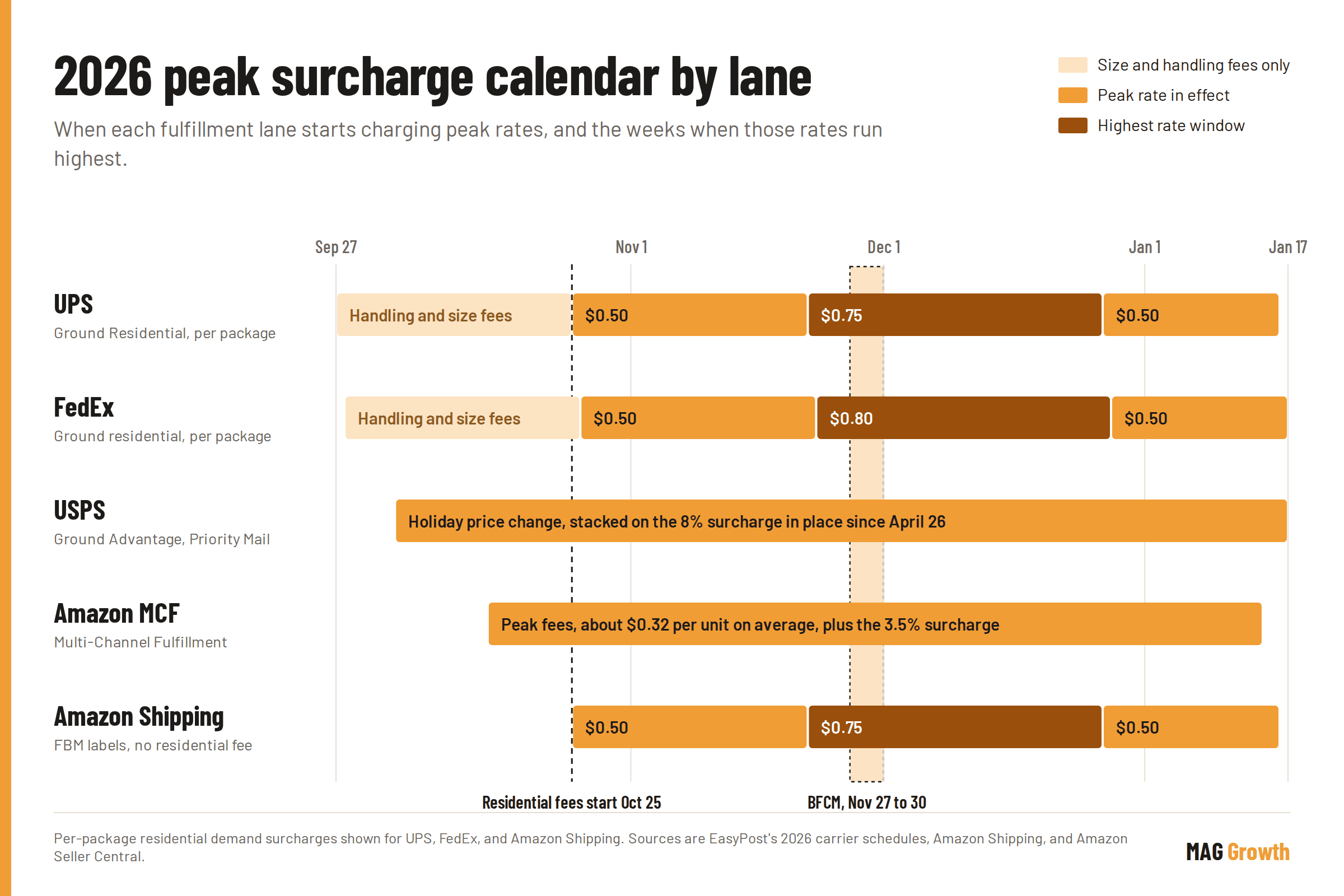
Match that review cadence to each lane’s peak window. The calendar below shows when every lane starts charging and when its rates run highest.
Shopify settings drift over a four-month peak window. Our ongoing maintenance team keeps shipping profiles and rate apps current, then rolls them back when rates reset in mid-January.
Advanced Tactics Once Your Lanes Hold
How do I lower my 2027 peak rates now?
The high-volume tiers compare peak weeks against volume baselines calculated in June, so a strong June makes your peak weeks look smaller. Negotiate surcharge caps in Q1, when your 2026 invoices prove your mix and carriers have room to move.
Shoulder weeks cost less too, since UPS residential ground runs $0.50 in the October and January windows versus $0.75 in the highest one. A retention marketing calendar with early access before November 22 pulls loyal buyers into those cheaper weeks.
When does a second warehouse beat paying peak rates?
A second node pays off when long-zone parcels dominate your peak volume. Compare zone costs on your top routes against the node cost, and use our complete guide to DTC brand operations to time fulfillment partners by revenue stage.
More Resources on Peak Shipping and Multichannel Fulfillment
How to Cut Peak Shipping Surcharges FAQs
When do 2026 peak shipping surcharges start and end?
Size and handling fees start September 27 at UPS and September 28 at FedEx, with residential demand charges following on October 25 and 26. The last fees end January 17, 2027, per the published 2026 carrier schedules.
Do peak surcharges apply to MCF orders?
Yes, MCF orders pay holiday peak fees from October 15 through January 14, 2027. Amazon says the increase averages $0.32 per unit, with the 3.5% surcharge added on top.
Does Amazon Shipping charge peak surcharges on FBM labels?
Yes, but it skips the residential fee that UPS and FedEx add. The per-package charge runs $0.50 to $0.75 across three windows, according to Amazon Shipping.
Is MCF cheaper than a 3PL during peak season?
It often is for multi-unit orders and often is not for single units or bulky items. One 2026 fee breakdown puts MCF 30% to 50% above similar FBA services and frequently above 3PL rates for products over 3 pounds.
Does my 3PL mark up carrier peak surcharges?
Some do, and written pass-through terms are the only way to know. Your orders usually ship on the 3PL’s own carrier account, so charges land on its invoice before they reach yours.
Do volume-based demand surcharges apply to my brand?
Usually not directly, since the tiers target shippers above 20,000 packages who exceed their baseline. Your 3PL’s combined account may cross that line, so ask whose volume counts.
How do I avoid Additional Handling fees at peak?
Right-size your boxes before September 27, when the peak rate starts. Soft mailers over 18 x 14 x 6 inches trigger it at UPS, so re-measure those first.
Should I raise my free-shipping threshold for BFCM?
Raise it only if peak cost per order pushes top SKUs below zero at the current level. Surcharges already make up about a third of a typical commercial Ground invoice, so model it before you move.
Can I dispute a surcharge on my 3PL invoice?
Yes, when a charge breaks your written terms or misclassifies an address. Misclassified residential addresses cause wrong surcharges and billing disputes, so check that line first.
Your Peak Margin Is Set Before October 25
- Price every SKU per lane
- Fix boxes before September 27
- Get 3PL terms in writing
- Reset thresholds for peak rates
- Judge peak on margin
Send us your SKU list and we will run a free peak shipping audit across every lane before October 25.