

Executive Summary
The AI paid media trends for DTC brands 2026 look like a platform story and behave like a measurement problem. Meta and Google handed targeting, bidding, and ad writing to their own models this year, and most operators read the numbers backward.
We manage $1.2B+ in ecommerce revenue across 400+ brand partners, and one pattern surfaced in every category. Reported return held firm while contribution margin quietly slipped, so teams rebuilt creative that was never broken.
The machine did not take your budget. It took the levers you used to explain your budget.
Key findings
- Reported ROAS drifted further from incremental ROAS
- Holdout testing dropped to a mid-market price
- Creative volume replaced audience structure entirely
- Generated assets cut production cost, not judgment cost
- Feed quality now decides ad copy quality
- Agent sessions entered pixel data and lookalike seeds
- High-intent networks absorbed defensive budget
Who this report is for
This paid media report serves the ecommerce director at a $5M to $20M brand explaining a reporting contradiction to a CEO this quarter. It also serves the scaling founder at $1M to $10M asking whether their numbers look normal.
Both get one answer. The numbers look normal, the cause runs structural, and the fix starts in measurement rather than your ad account.
Methodology note
This report draws on MAG Growth’s work with 400+ DTC brand partners across beauty, food and beverage, apparel, health and wellness, and outdoor gear. We verified every platform change against that platform’s own documentation or earnings disclosures in August 2026.
Finding 1. Your Reported ROAS Grades Its Own Homework
Reported and incremental return always diverged. The gap widened this year because the model choosing who sees your ad also decides which sales it claims.
Nobody rigged anything. A system chasing conversions hunts the people standing closest to the register, and plenty of them already had a card out.
Why did my ROAS drop after switching to Advantage+
It rarely dropped. Automated campaigns swallow retargeting and branded demand that once sat in separate line items, so one number now claims sales your prospecting never caused.
Two brands can post an identical 4x and run different businesses underneath. Our breakdown of why Meta ROAS drops rules out account-level causes first.
What is incremental ROAS and how do I measure it
Incremental ROAS answers one question, which is how much revenue vanishes when you switch the spend off. Withhold ads from a matched group of users or regions, then compare both groups over a fixed window.
The arithmetic ends the argument. Spend $60,000 at a reported 4x and you book $240,000, but if a holdout proves 35% of those sales would have landed anyway, your real number reads $156,000 and 2.6x.
That figure redirects next quarter’s budget. It also reframes your marketing efficiency ratio, since MER tracks blended revenue while reported ROAS tracks claimed revenue.
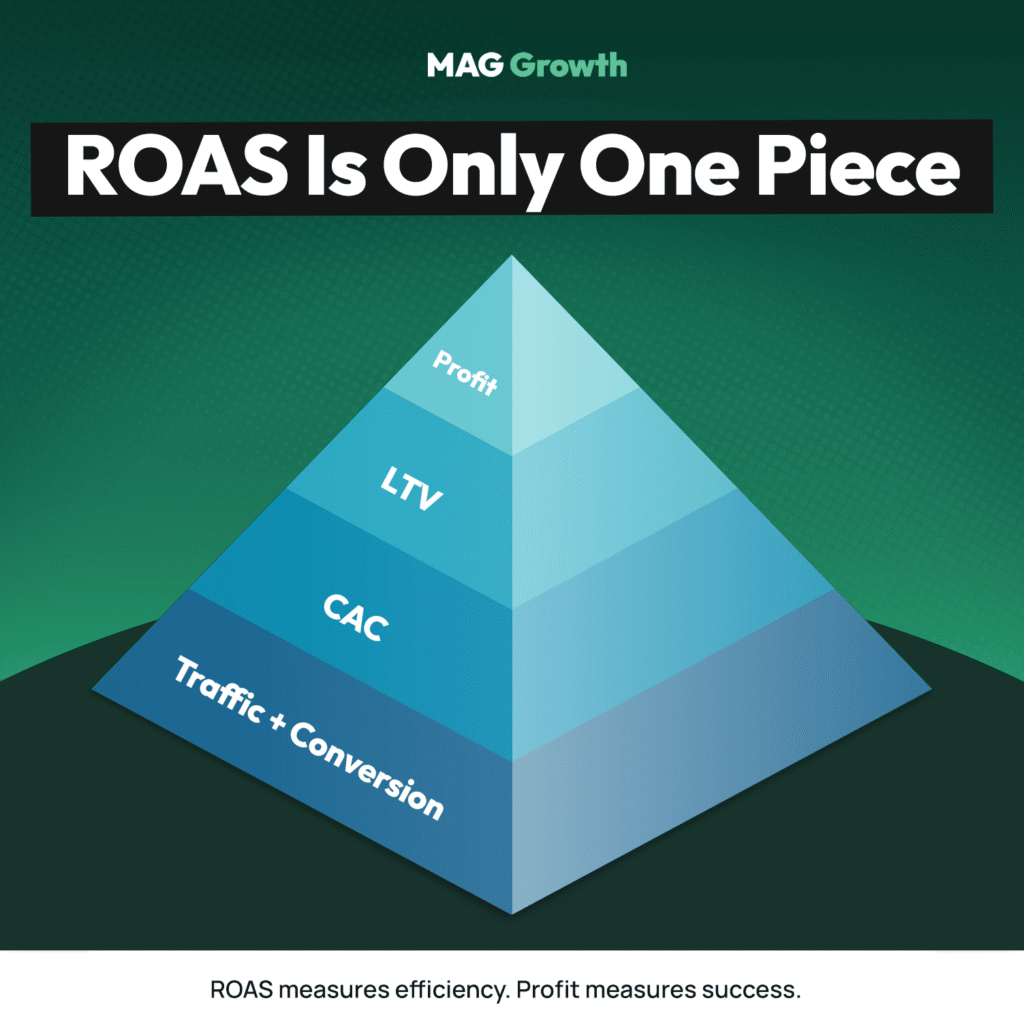
Efficiency and success are not the same measurement. ROAS sits at the bottom of a stack that ends in profit, and every layer above it moves independently.
What is the cost of incrementality testing for DTC brands now
The price collapsed while everyone looked elsewhere. Google states that an experiment once costing near $100,000 now runs for as little as $5,000, and calls the shift democratization of an enterprise-only tool.
Spend $40,000 a month and that test costs four days of budget to validate the other twenty-six. Very few operators have spent it.
What MAG Growth is seeing in practice
Most accounts we inherit have never run a holdout. The team quotes reported ROAS to two decimals and cannot say how much of it is incremental.
One wellness partner ran the test and learned its best seller carried the headline number while losing money underneath. Our paid media work opens with measurement, because reallocating on a bad number costs more than doing nothing.
Our team reads ninety days of your account data and shows you exactly where reported return and real return separate.

Finding 2. Creative Took Over the Targeting Job
Your levers disappeared. Meta rebuilt ad selection around models reading creative first and treating audience inputs as suggestions.
Meta Andromeda runs retrieval, an engine Meta built to handle the flood of variations automation produces. Meta credits it with an 8% increase in ads quality and stronger automation results.
GEM, Meta’s generative ads recommendation model, sits above it and runs at large language model scale. On its latest earnings call, Meta credited GEM and sequence learning with an 8.3% rise in ad clicks and a 15.7% lift in conversions.
In this video with Sam Piliero, founder of The Moonlighters, and Noah Wickham, VP of Sales & Marketing at My Amazon Guy, we break down what Andromeda changed and how much creative it takes to keep the system fed. Skip to 11:56 for the Andromeda shift and 13:44 for creative volume.
Are AI campaigns better than manual campaigns for ecommerce
They find buyers better and explain themselves worse. Automated delivery beats hand-built audiences on volume, then removes the breadcrumbs you need to diagnose a result.
Feed a smart system weak assets and it burns budget faster than any manual campaign. The real question behind Advantage+ vs manual campaigns for small brands is whether you can run automation without an independent measurement layer.
Under $20,000 a month, run automated delivery plus one quarterly lift test, and reserve manual ad sets for isolated hypotheses.
How many ad creatives per month for Advantage+
Give the model enough distinct concepts to choose between. We hold clients to eight to twelve genuinely different concepts monthly, each carrying two or three variations, refreshed every two to three weeks.
Variations do not count as concepts. Five color grades of one hook hand the system a single idea in five costumes, the most common mistake in accounts we inherit.
Accounts running under fifteen live assets starve the retrieval stage. Mix formats as deliberately as you count them, pairing static frames with vertical video.
Did AI ad creative cost reduction 2026 change the math
It slashed production cost and left judgment cost untouched. Generative tools pushed AI-generated ad imagery scale toward zero marginal cost, and Meta reported over 9 million small businesses now use at least one AI creative tool.
Redeploy the capital freed from photoshoots into media. Deciding which ideas deserve to exist never got cheaper, and the speed of ai creative testing dtc teams now sustain only pays off when somebody reads the results.
Generation also demands a bench. Your hero asset dies mid-week, and the fix is the next tested concept already built.
How does automated paid media campaign control work now
Treat it as governance, not daily optimization. Nobody outpaces intraday delivery shifts by hand, so write rules that pause losers and step budget onto winners unattended.
Audit those rules monthly. One apparel partner recovered roughly $10,000 in monthly test waste by switching on kill thresholds it had written down a year earlier.
What MAG Growth is seeing in practice
Brands treating creative production as a monthly quota beat brands treating it as a quarterly campaign. The gap shows in cost per acquisition within two refresh cycles and widens through Q4.
Our Meta Ads team sets concept volume before budget. Founders find that order backward until they watch a campaign starve on four assets.
Finding 3. The Machine Writes Your Ad, So Your Feed Became Copy
Google moved generation inside the auction. Its AI Max layer expanded from Search into shopping campaigns, where Merchant Center data builds ads answering conversational queries rather than exact product searches.
Google also shipped AI Brief, letting advertisers set tone, messaging, and audience guidance before the system generates anything. A briefing tool only exists because the system does the writing.
Do AI shopping ads use my product feed
Yes, and they treat it as source material rather than a lookup table. Attribute completeness, title structure, and description accuracy now shape what the ad claims about your product, not merely whether it appears.
A thin catalog produces confident, wrong advertising. The model describes only what your data shows it, so gaps surface the wrong benefit to the wrong shopper.
What does product feed optimization for AI shopping ads require
Review the feed-like copy, not plumbing you configured once. Inventory counts, pricing, imagery, and attribute coverage drive the match, and stale values quietly drop you from queries you used to win.
A thin feed breaks in order.
- Ads generate against gaps and pitch the wrong benefit
- Richer competitors win the conversational queries
- Performance holds flat while new-query share falls
What MAG Growth is seeing in practice
Feed work ranks as the least glamorous, highest return item on most Google Ads accounts we take over. Titles written for a 2019 keyword-match world read badly to a model asked why a product fits a shopper’s question.
We rewrite feed attributes before touching bids. The lift arrives quietly, as eligibility for queries the account never saw.
Finding 4. AI Assistants Became Buyable Inventory, and Your First Buy Should Stay Small
OpenAI began testing ads in ChatGPT in the United States, labeling sponsored placements and separating them from the answer. Its documentation confirms only Free and Go plan users see ads, while Plus, Pro, Business, Enterprise, and Edu accounts stay clean.
That rule tells a DTC operator everything. The paying, higher-income slice of the largest assistant audience sits out of reach today.
Are ChatGPT ads for ecommerce brands worth it yet
Test them, do not reallocate to them. Intent quality runs high, because a shopper describing their situation in a sentence reveals more than a keyword ever did.
A $5M brand should commit 1% to 3% of monthly paid media budget across sixty days. Spend more and you buy learning you cannot act on, spend less and the data stays too thin to read.
What should the test actually measure
Skip ROAS, because the volume will not carry it. Judge whether the traffic behaves like your best channel or your worst.
- Time on site against your channel average
- Pages per session against your channel average
- New customer rate rather than blended orders
Those three settle it inside a month. Our social ads team opens every new surface this way, because the test never causes damage, the budget attached to it does.
What MAG Growth is seeing in practice
Every operator asking about assistant ads this quarter is asking a budget question. Almost none finished the measurement work that would let them read the answer.
Our team runs a paid media diagnostic on your creative volume, feed quality, and conversion signal, then tells you which input is costing you the most.
Finding 5. Agent Sessions Poison the Data Your Campaigns Learn From
Automated visitors browse far more than they buy. HUMAN Security found ecommerce captured 43.8% of agentic traffic in June 2026, with product and search routes taking 79% of activity while checkout held at 2.34%.
The growth rate matters more than the share. HUMAN reported AI agent and agentic browser traffic grew 7,851% year over year in 2025, outpacing human traffic growth eightfold.
Is AI traffic hurting my retargeting audiences
It can, and the mechanism bores people into ignoring it. Sessions that browse deeply and never convert mimic high-intent shoppers, the exact profile your retargeting pools and lookalike seeds chase.
Run the math at your scale. Let 8% of product page sessions run automated and your 30-day view-content audience holds one in twelve visitors who cannot buy.
What does AI agent traffic ecommerce attribution require
Separate the traffic before you interpret it. Three moves cover the work.
- Exclude identified agent sessions from custom audiences
- Tag orders from assistant surfaces as their own source
- Reconcile platform order counts against site analytics monthly
Server-side tracking carries more weight now. A browser session no longer proxies a person reliably, so backend order data becomes the record everything else reconciles against.
What MAG Growth is seeing in practice
Almost no mid-market account separates this traffic today. Ignoring it costs little now, which makes this the cheap moment to fix it rather than after it corrupts a seed audience you spent a year training.
The same shift hit the inbox, where agent-completed orders arrive without marketing consent. We covered that in our report on AI inbox email marketing trends.
Finding 6. The Channel You Cannot Buy Outperforms the One You Can
The year’s sharpest reversal happened outside your ad account. Adobe Analytics reported AI-sourced traffic to US retail sites grew 393% year over year in Q1 2026, with March 2026 AI traffic converting 42% better than non-AI traffic.
Twelve months earlier that measurement ran the other way, at 38% worse. Call it an eighty-point swing inside a year.
Shopify saw the same direction from a different vantage point, reporting AI-driven traffic up 8x year over year in Q1 2026 with orders from AI-powered searches up nearly 13x. Two independent datasets agreeing on direction beats either figure alone.
What does that mean for my paid budget
Your paid channels now compete against an unpaid channel that converts better. Nobody should cut spend over that, but the cost of staying invisible to assistants just jumped.
The fix overlaps what you already do. Clean product data, readable pages, and complete attributes feed both the programmatic ads supply chain and the assistants naming brands.
Finding 7. Budget Drifts Toward Wherever Intent Already Lives
Running growth entirely through social feeds stakes your business on one auction. As automated delivery pushed every advertiser into identical broad targeting, smart operators bought closer to the purchase.
Retail networks absorbed that shift. EMARKETER put US retail media spending at $60.32 billion in 2025 and $71.09 billion in 2026, with Amazon taking roughly 89% of the incremental dollars this year.
Search economics moved the same way. EMARKETER expects Google to earn 48.5% of search ad spending in 2026, below half for the first time in two decades, with Amazon claiming most of the ground it lost.
How much should a DTC brand spend on paid media in 2026
Spend against contribution margin and payback, not a published percentage. Set a payback window, commonly sixty to ninety days for repeat-purchase categories, and release budget as cohorts clear it.
Percentage-of-revenue rules break under AI delivery. Your denominator now includes revenue your ads never caused, which drags Finding 1 into your budget meeting.
What MAG Growth is seeing in practice
Brands adding a high-intent channel rarely see social numbers improve, and almost always see blended acquisition cost fall. One consumer electronics partner cut blended CAC roughly 18% without touching social spend, because the new channel harvested demand the feed had built.
Judging each channel on its own reported return sets the trap. Harvesting channels always look brilliant alone, which is Finding 1 in a different outfit.
What Is Changing in AI Paid Media Trends for DTC Brands 2026
| Layer | What the AI decides now | What you still control |
|---|---|---|
|
Delivery |
Audience, placement, bid, ad selection |
Budget, objective, exclusions |
|
Creative |
Which asset shows, and increasingly its copy |
Concept volume, hooks, brand guardrails |
|
Feed |
How your product gets described per query |
Attribute completeness and accuracy |
|
Measurement |
Which conversions get claimed |
Holdout design and reporting hierarchy |
Control moved up a level. You steer inputs now, not campaigns, which turns automated paid media campaign control into a governance job. Document your deliberate settings, then review them monthly.
Measurement became the differentiator. Every advertiser runs identical automated delivery, so the edge belongs to whoever knows what actually lifts revenue. Fund one test per major channel each quarter.
Signal quality replaced account structure. Server-side tracking, clean events, and accurate values now beat campaign architecture. Fix inputs before rebuilding anything.
Creative volume became a fixed cost. The ai marketing efficiency ratio impact of automation lands as a bigger creative line and a smaller management line. Staff against that shift.
What Top Performers Are Doing Differently
The top quartile of accounts we manage share five habits. None look exotic, and each irritates somebody internally.
They report two ROAS numbers. Average performers defend one figure while top performers publish reported and incremental side by side. The second number costs $5,000 a quarter and ends arguments that ran for months.
They brief the machine instead of fighting it. Average performers rebuild structure whenever results wobble while top performers hold structure and change inputs. Account surgery mostly resets learning.
They kill losing assets inside three days. Average performers nurse a weak concept for a fortnight while top performers pull anything missing target. Comments and shares on an ad that never sells earn nothing.
They treat the product feed as owned media. Average performers hand it to a developer and forget it while top performers review it on their ad copy cadence. Those two jobs merged.
They read branded search as a scoreboard. Average performers judge prospecting on its own reported return while top performers watch branded search volume as proof upper-funnel work landed. Our retargeting and prospecting budget split shows where to draw the line.
| Metric | Status in 2026 | What to do with it |
|---|---|---|
|
Platform-reported ROAS |
Inflated by claimed conversions |
Keep as a directional trend only |
|
Incremental ROAS |
Immune to platform reporting |
Promote to your budget decision metric |
|
MER |
Honest but slow and blended |
Review monthly against contribution margin |
|
New customer CAC |
Distorted once agent sessions enter audiences |
Rebuild after excluding automated traffic |
|
Creative concepts per month |
The main input you still control |
Set a floor and hold it |
Predictions for 2027
These calls come from what we watch inside client accounts, not consensus forecasts.
Incremental ROAS lands in the board deck. Reported return survives as a trend line while budget decisions move to tested lift and contribution margin. Brands still leading with platform ROAS in 2027 signal that nobody senior reads the report.
Feed management moves under the creative team. A model writing ads from product data forces the people owning brand language to own the feed. The reporting line changes before the job description does.
Unpolished proof beats polished production. Generated assets flood every feed, making evidence of a real customer scarce. Founder-shot footage and raw reviews will win on cost per acquisition.
Agent-sourced orders earn their own channel line. Volume crosses the point where blending them into direct distorts CAC by category. Brands tagging today hold a year of clean history while everyone else holds a gap.
Measurement expertise becomes the agency differentiator. The platform runs campaigns now, so pressing buttons stops being a service anyone pays for. Agencies that cannot show a holdout design lose accounts to those that can.
AI Paid Media Trends for DTC Brands 2026 FAQs
What are the best incrementality testing tools for small DTC brands?
Start with the lift tests built into whichever platform takes most of your spend, since they cost nothing extra and need no data engineering. Google now permits an experiment at a $5,000 minimum, landing a first test inside a mid-market monthly budget.
Do I need an agency to run a geo holdout test?
Not for your first platform-native test, which most competent operators launch themselves. Bring in help for cross-channel geo design, because matched market selection and pre-period validation produce confident nonsense when you guess.
How do I audit a Meta ads account for AI campaign waste?
Check conversion event quality and audience exclusions before campaign structure. Confirm the purchase event fires once with an accurate value, exclude existing customers from prospecting, then check whether reported conversions cluster in retargeting and branded placements.
Should small brands still run manual campaigns?
Run them to test specific hypotheses and reach audiences the model cannot infer. Below roughly 50 weekly conversion events, manual ad sets gather too little data to teach you anything automation has not already found.
How do I benchmark my paid media performance against peers?
Compare inside your category and revenue band, since average order value and repeat rate move every number here. Our DTC paid media glossary defines the metrics and our MER benchmarks break targets down by stage.
Where should a brand spend first across channels?
Buy where your demand already sits, which for most DTC brands means branded search plus one paid social channel. We compared the entry points in Meta ads vs Google ads vs TikTok ads.
What does a DTC paid media agency cost?
Pricing tracks scope rather than spend, and two variables move it most, creative production volume and analytical depth. We build engagements around what a brand needs this quarter, so the first conversation covers scope, not a rate card.
How do I choose a DTC paid media agency for AI campaign management?
Ask how they would prove a channel drives incremental revenue and listen for a test design instead of a dashboard tour. Then ask what they would change in your product feed, because an agency ignoring it optimizes the half that matters least.
The Opportunity Hiding in a Broken Dashboard
Your reported return rose while your margin did not, and creative never caused that. A model started claiming credit for demand you already owned, and correcting it costs under four days of media spend.
Speed decides who profits. One holdout, a creative floor, and a clean product feed take weeks, and almost none of your competitors have started.
Brands measuring honestly take budget from brands chasing a number the platform invented, and that gap widened across 400+ brand partners this year. Our paid media work opens there, the same way our CAC reduction work for a DTC brand opened with measurement rather than bids.
Send us ninety days of account data and we will show you where your reported return and your real return split apart.