

Why This DTC Retention and LTV Glossary Exists
Most retention glossaries define lifetime value, repeat rate, and churn, then stop. You still cannot tell your CFO whether a 4.25% churn rate signals a billing failure or a product failure.
This DTC retention and LTV glossary defines 39 terms and attaches a benchmark to each. We built it from managing $1.2B+ in ecommerce revenue across 400+ brands, for the hired director who answers to finance, lifecycle, and ops at once.
What terms does this glossary cover?
Five clusters, ordered the way money leaks out of a customer you already paid for.
- Churn and recovery, voluntary vs involuntary churn, dunning recovery rate, retry logic, cancellation save rate, pause rate, win-back flow, revenue vs customer churn
- Cohort math, cohort curve, revenue vs contribution LTV, LTV to CAC ratio, CAC payback period, new-customer vs blended CAC, 60-day repeat rate
- Loyalty economics, points liability, breakage, redemption rate, cost per point, member vs non-member repeat rate
- Returns leakage, return rate by category, cost per return, bracketing, returnless refund, exchange vs refund rate, WISMO and WISMR
- Predictive segmentation, RFM analysis, predictive churn scoring, predicted date of next order, purchase latency, one-and-done rate
We pull your churn, cohort, and returns numbers, then show you which one costs most.

Churn Anatomy and Payment Recovery
Most brands report churn as one number. That number hides two problems with different owners.
What is involuntary churn in ecommerce?
Involuntary churn ends a subscription because a payment failed. Voluntary churn ends it because the customer chose to leave.
- Recurly’s July 2026 data puts ecommerce at 4.25% median annual churn, splitting into 2.87% voluntary and 1.38% involuntary, so roughly a third traces to billing
- Billing platforms report involuntary churn at 20% to 40% of total churn
MAG Growth benchmark:
Split the two before funding anything. A save flow aimed at a payments problem burns a quarter and moves nothing.
What is a good dunning recovery rate?
Dunning retries a failed recurring payment and messages the customer. Recovery rate measures the share you win back.
- Dunning recovers 30% to 50% of failed payments when you time the sequence to the failure type instead of a fixed schedule
- A report stated that ecommerce brands on its network recovered over $34 million
MAG Growth benchmark:
Give dunning an owner and a KPI. Teams treating it as a billing setting leave the recovery behind.
How does retry logic work for failed subscription payments?
Retry logic sets the schedule and routing your billing system uses after a decline. Silent retries attempt the charge again without alerting the customer.
- Soft declines often clear later, while hard declines from closed accounts need a new card
- Sequence by timing, varying the amount, and routing through optimal card networks based on the decline code
MAG Growth benchmark:
Email only after silent attempts fail. A payment-failure notice turns a technical glitch into a cancellation decision..
What is a cancellation save rate?
Cancellation save rate measures the share of subscribers who enter your cancel flow and stay. Read it beside pause rate, since everyone there already decided to leave.
- Public save-rate benchmarks stay thin, so manage against your own trailing baseline
- Discounting saves the customer and destroys the revenue you preserved
MAG Growth benchmark:
Rank save offers by retained contribution margin. A 40% save rate built on 30% discounts loses to a 25% rate built on pause and swap.
Cancellation friction now carries legal exposure. We define the negative option rule in our DTC CRO Glossary.
Is a subscription pause better than a cancel?
A pause holds the billing agreement and stops the next shipment. A cancel ends it, so winning that customer back costs acquisition spend again.
- 38% of consumers prefer pausing, brands adding the option saw usage rise 337%, and three in four of those subscribers returned within months
- Subscription pause vs cancel retention starts as a portal design decision, not a marketing one
MAG Growth benchmark:
Log a pause as a retention win. Teams recording it as churn stop building for it.
What is a win-back flow?
A win-back flow targets customers who passed their repurchase window or cancelled outright. It is the only lifecycle flow aimed at people already gone.
- Nearly one in four new subscriptions comes from a previously cancelled customer, making win-back an acquisition channel with no media cost
- Escalating discounts teach good customers to lapse deliberately, so cap the offer
MAG Growth benchmark:
Trigger win-back off predicted next order date, not a flat 90-day timer. Consumption cycles vary enough that one delay misses most of the list.
We define the related sunset flow in our DTC Email and SMS Glossary.
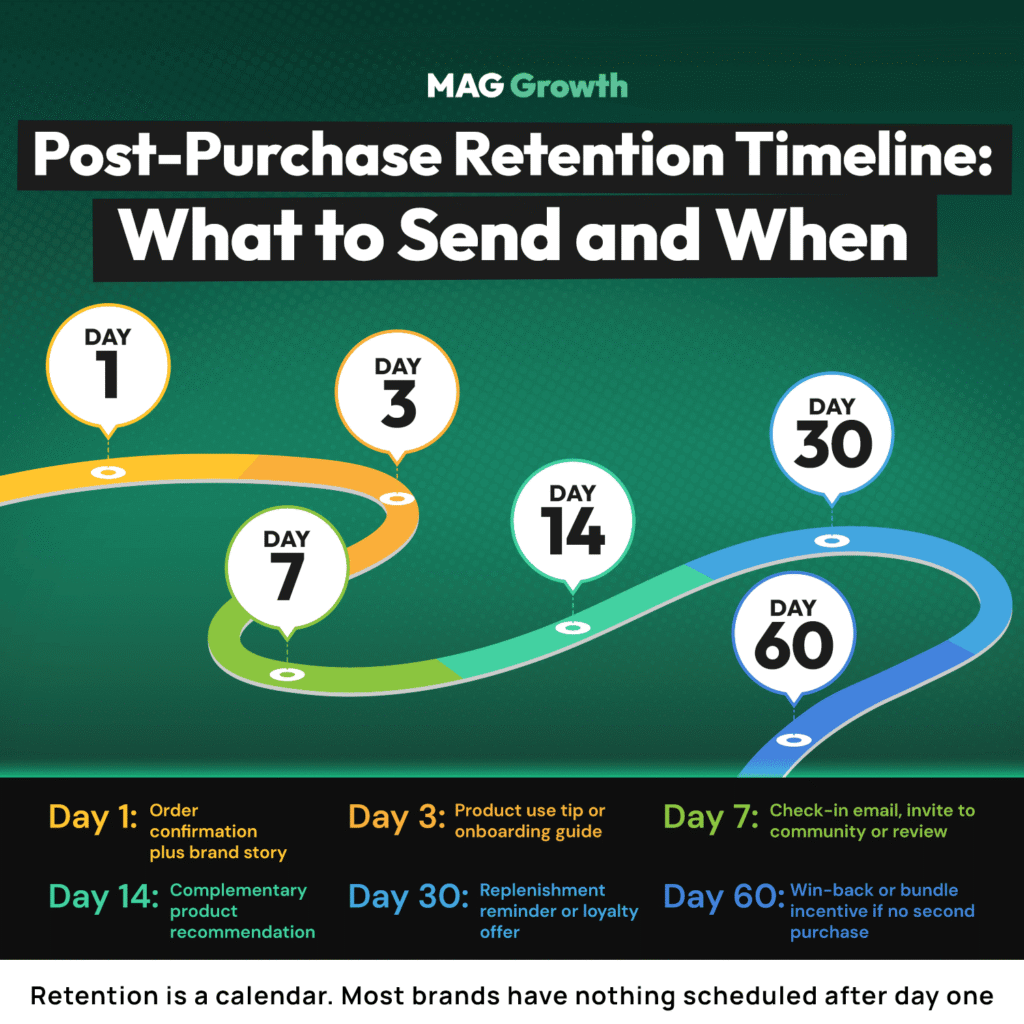
Retention runs on a schedule, and most brands stop sending after the order confirmation. Here is the post-purchase sequence we build for clients, from day one through the day 60 win-back.
What is the difference between revenue churn and customer churn?
Customer churn counts subscribers lost. Revenue churn counts dollars lost, and the two diverge when high-value accounts leave at a different rate.
- 3% customer churn can carry 5% MRR churn when departing accounts skew above average value
- Involuntary churn falls as price rises, from 1.30% at $10 to $25 monthly to 0.18% above $250
MAG Growth benchmark:
Report both. Track customers alone and you celebrate a flat number while revenue erodes.
Subscription churn benchmarks at a glance
| Churn zone | Annual rate | What it usually means |
|---|---|---|
|
Strong |
Below 2% |
Recovery and retention programs run well |
|
Normal |
2% to 4% |
Where most well-run subscription businesses sit |
|
Investigate |
Above 5% |
Product-market fit gap or payment operations gap |
Source, Recurly, July 2026. Any churn rate calculator for ecommerce should separate the two types before reporting one figure.
Cohort and Payback Math
Blended reporting hides damage. Every term here exists because an average erases the signal you need.
How to read a cohort retention curve
Cohort analysis groups customers by first-order month and tracks each group forward. Where the curve flattens matters more than where it starts.
- A steep early drop with a flat tail reveals an onboarding problem, while a shallow drop that never flattens reveals a product problem
- Bain found repeat behavior compounds, with apparel buyers spending 67% more in months 31 to 36 than in their first six
MAG Growth benchmark:
Run cohort analysis for ecommerce brands monthly while scaling. Quarterly cadence acts on a signal already a quarter old.
What is the difference between revenue LTV and contribution LTV?
Revenue LTV totals what a customer spends. Contribution LTV subtracts cost of goods, shipping, fees, and returns first, which makes it the only version that funds anything.
- Revenue LTV inflates every ratio it touches, and the gap widens in high-return categories
MAG Growth benchmark:
Publish one LTV number and make it the contribution version. Circulate two and the flattering one wins every budget argument.
We define contribution margin in our DTC Paid Media Glossary.
What is a good LTV to CAC ratio for DTC brands?
The ratio weighs lifetime value against acquisition cost. Our paid media glossary works the acquisition side, so this entry works the LTV side.
- The common LTV to CAC ratio benchmark for DTC brands sits at 3 to 1, and our strongest accounts hold nearer 4 to 1
- Cutting CAC works fast and reverses fast, while lifting LTV works slowly and holds
MAG Growth benchmark:
When the ratio slips, find which half moved before touching the ad account. Any LTV to CAC calculator hiding that split sends you at the wrong lever.
See the acquisition side in our LTV to CAC benchmarks post.
How do you calculate CAC payback period?
Payback counts the months until a cohort’s cumulative contribution profit covers acquisition cost. It answers a cash question LTV to CAC never touches.
- Put new-customer CAC in the numerator and contribution margin per order in the denominator
- A CAC payback period ecommerce benchmark inside six months recycles cash, while anything past twelve lends money to your customers
MAG Growth benchmark:
A brand can hold a healthy efficiency ratio for six months while payback stretches from eight to fourteen. Order value holds, repeat rate collapses, and only the cohort table shows it.
Why does blended CAC look fine while payback gets worse?
Blended CAC divides total acquisition spend by every customer, repeat buyers included. New-customer CAC divides it by first-time buyers only, and payback depends on that second number.
- Strong repeat volume drags blended CAC down while new-customer acquisition gets pricier
- The two drift furthest apart exactly when retention works, which is when teams stop checking
MAG Growth benchmark:
Treat payback as a new-customer metric. Any model built on blended CAC forecasts cash you do not have.
What is a good repeat purchase rate for DTC brands?
The 60-day repeat rate measures the share of a cohort placing a second order within 60 days. It predicts where the LTV curve lands earlier than any other signal.
- Consumables run highest because consumption forces the reorder, while durables run far lower
- Waiting twelve months for an LTV read means acting on a cohort you can no longer influence
MAG Growth benchmark:
Judge any 60-day repeat purchase rate benchmark against your own trailing cohorts first. Category, price point, and promo mix move it more than any published average.
Definitions get you the vocabulary, and watching someone work the numbers gets you the method. This video segment covers customer lifetime value and remarketing.
Loyalty and Rewards Economics
Nobody writes this cluster for brands your size. Every solid definition targets airlines and large CPG, so programs at $5M to $20M launch without a finance conversation.
What is points liability in a loyalty program?
Points liability is the obligation on your balance sheet for rewards customers earned but have not redeemed. Accounting treats it as a real line item.
- Calculate it as outstanding points times fair value per point times expected redemption rate, with fair value often near one cent
- Points issued at purchase form a separate obligation, so revenue defers until redemption or expiry
MAG Growth benchmark:
Model the liability before launch, not after your accountant finds it. Every earn-rate change is a balance sheet decision wearing a marketing costume.
What is breakage in a loyalty program?
Breakage measures the share of issued points members never redeem. It mirrors redemption rate, since the two always sum to the whole.
- Breakage typically runs 5% to 30%, with CPG retailers landing between 20% and 30%
- Unredeemed points generated no repeat purchase, which was your reason for issuing them
MAG Growth benchmark:
Stop reporting breakage as a saving. A threshold so high that members quit means you built a discount nobody reaches.
What is a good loyalty redemption rate?
Redemption rate measures the share of issued points members spend. The redemption threshold sets the balance they need before spending anything.
- Lower thresholds lift redemption, cut liability, and raise repeat purchase together
- Rolling expiry tied to inactivity beats a fixed annual purge, because it rewards a maintenance order
MAG Growth benchmark:
Place the first reward inside one average order value. Members who reach nothing after two purchases stop looking.
How do you calculate cost per point?
Cost per point measures what one point costs you at redemption. Fair value per point sizes the liability for accounting, and teams routinely confuse the two.
- Cost per point moves with what members redeem against, so free shipping costs less than product
- Status rewards like early access carry near-zero marginal cost
MAG Growth benchmark:
Mix the catalog so status rewards absorb redemption pressure. A program built purely on discounts converts loyalty into a permanent price cut.
Does your loyalty program actually increase repeat rate?
Member versus non-member repeat rate compares behavior inside and outside the program. It answers whether the program caused anything.
- Your best customers enroll first, so members always outperform non-members
- Only a holdout of eligible, non-enrolled customers gives a clean read
MAG Growth benchmark:
Run the holdout before renewing the platform contract. Most programs get judged on enrollment counts, the one number that cannot fail.
Definitions start the work, and a sharp team converts them into contribution margin you can bank.
Returns and Refund Leakage
Returns get filed under logistics and skip the retention conversation. A return flips a profitable order negative faster than anything else here.
What is a normal return rate by product category?
Return rate measures the share of orders customers send back. Your category sets it far more than your product pages do.
- Online returns run near 20% of orders, with apparel at 20% to 40%, electronics at 8% to 15%, and beauty at 4% to 12%
- Fit and sizing drives roughly half of apparel returns, making it a content problem, not a policy one
MAG Growth benchmark:
Stop chasing return rate by product category and start moving cost per return and exchange share. Your category sets one, your decisions set the other.
How do you calculate cost per return?
Cost per return totals return shipping, labor, inspection, and restocking for one returned order. That figure turns returns from an ops metric into a margin metric.
- All-in cost lands near $25 to $30 and climbs to $28 to $35 at peak, with the support ticket adding roughly $5 more
- On a $75 order at 40% margin, one $28 return erases that order’s contribution and part of the next
MAG Growth benchmark:
Build a cost per return ecommerce benchmark into your contribution LTV model. Omitting it overstates lifetime value across every apparel category.
What is bracketing in ecommerce?
Bracketing means ordering several sizes, keeping one, and returning the rest. Wardrobing means using an item once and sending it back.
- A majority of online shoppers now bracket, up sharply from roughly 40% in 2018
- Fit tools and garment measurements remove the uncertainty driving it
MAG Growth benchmark:
Treat bracketing as demand you priced wrong. The margin fix is a cheaper exchange path, not a stricter policy that costs you the customer.
When should you offer a returnless refund?
A returnless refund pays the customer back without recovering the item. Use it when retrieving the product costs more than the product returns.
- Shopify frames it as worth considering for low-value items where return shipping and handling exceed what restocking recovers
- Without a cap the policy invites abuse, so limit how often one customer uses it
MAG Growth benchmark:
Run the math per SKU instead of one sitewide rule. The threshold protecting margin on a $12 accessory destroys it on a $90 one.
What is the difference between exchange rate and refund rate?
Exchange rate measures returns resolved with a replacement. Refund rate measures returns resolved with money back, and that split decides how much revenue survives.
- Shopify lists exchange rate, refund rate, and return-to-resale rate as the core returns KPIs
- An exchange keeps the revenue and the customer, a refund keeps neither
MAG Growth benchmark:
Make the exchange path faster and cheaper than the refund path. Most portals do the reverse, then report refund rate as customer preference.
What are WISMO and WISMR tickets?
WISMO means where is my order. WISMR means where is my refund, and proactive notification eliminates both.
- Returns generate 15% to 25% of support tickets, and one return usually creates one to three contacts
- WISMO takes 20% to 40% of support volume and passes 50% at peak
MAG Growth benchmark:
Notify at every return step the way you notify on shipping. The cheapest ticket never opens.
Returns cost stack at a glance
| Category | Typical return rate | Retention read |
|---|---|---|
|
Apparel |
20% to 40% |
Exchange path decides whether LTV survives |
|
Electronics |
8% to 15% |
High unit cost makes each return expensive |
|
Beauty |
4% to 12% |
Low resale value favors returnless refunds |
Predictive Retention and Segmentation
Read this cluster before buying a prediction tool. Most models need more customers than a brand under $2M has.
What is RFM analysis?
RFM scores every customer on recency, frequency, and monetary value. Those scores split one undifferentiated list into segments that earn different messages.
- Recency carries the most predictive weight, and quintile scoring produces 125 combinations you should collapse into five or six segments
- Klaviyo maintains a practical RFM guide for brands running it in-platform
MAG Growth benchmark:
Define each segment as a rule, not a label. “At risk” without a day threshold stays a word, and words cannot trigger flows.
How accurate is predictive churn scoring?
Predictive churn scoring estimates the probability a customer stops buying inside a set window. Klaviyo scores the probability of no purchase in the next 90 days, banding it low below 33%, medium from 33% to 66%, and high above 66%.
- Klaviyo requires at least 500 customers who placed an order before the comparison means anything
- Scores rank a segment reliably and judge an individual profile poorly
MAG Growth benchmark:
Route by score band, not by individual score. Segment-level accuracy holds, profile-level precision does not.
What is predicted date of next order?
Predicted date of next order forecasts when one customer buys again. It converts a model output into a calendar date, which makes it the most useful field for flow timing.
- Klaviyo’s model needs at least two historical orders to produce a date
- A past date beside a high churn score means the model already wrote that customer off
MAG Growth benchmark:
Rebuild replenishment and win-back triggers on this field. A flat 30-day timer misfires across most of your catalog by definition.
What is purchase latency and how do you set a dormancy threshold?
Purchase latency measures the typical days between one customer’s orders. The dormancy threshold marks the point past that gap where you classify them as lapsed.
- Set the threshold per category, since a coffee subscriber and a mattress buyer cannot share one number
- Take the median gap for that product, add a margin, then treat anything beyond it as at risk
MAG Growth benchmark:
Publish the threshold as a number in your segment documentation. Leave it undefined and three reports will carry three definitions of lapsed.
What is the one-and-done rate?
One-and-done rate measures the share of customers who buy once and never return. It inverts your repeat rate and reframes the same data as a loss.
- Every one-and-done customer absorbed full acquisition cost and returned one order of contribution
- Discount-led cohorts produce the highest rates, which argues against promo-led acquisition
MAG Growth benchmark:
Report it by channel and by first product purchased. Both cuts surface fixable causes a blended repeat rate buries.
How to Use This Glossary
You now hold 39 terms and probably four numbers sitting outside their bands. Multiply the customers hitting each stage by the drop-off there by your contribution margin per order, and the priority ranks itself.
Involuntary churn and returns usually pay first, since both fixes run operationally with no creative dependency. Across $1.2B+ in managed revenue, brands that name their leaks precisely fix them faster than brands with better tactics and vaguer language.
Related reading, The Complete Guide to DTC Retention Marketing in 2026, our Retention Marketing services, the DTC Paid Media Glossary, the DTC Email and SMS Glossary, and the DTC CRO Glossary.
DTC Retention and LTV Glossary FAQs
How much does retention marketing cost?
Size it against your payback period instead of a fixed budget share, since retention spend buys cash flow whenever payback runs past six months. Model one point of retention against your own contribution margin before accepting a quote.
What is the best subscription retention software for Shopify?
The category covers three jobs, billing and retries, lifecycle messaging, and analytics, and one tool claiming all three usually delivers a weak version of two. Split your churn first, because that diagnosis decides which of the three you buy.
How do dunning and failed payment recovery tools compare?
Compare them on retry intelligence rather than email templates, so ask whether the platform varies retry timing and amount by decline code. Then ask for recovery reporting by failure type, since a blended number hides what the logic earned.
How do you evaluate a retention marketing agency for DTC brands?
Ask them to split your churn before they pitch, because a partner who cannot separate the billing problem from the value problem will sell you flows for a payments failure. Then ask what they refuse to do.
What should a free ecommerce retention audit include?
Expect named failures in your account, meaning your churn split, your cohort curve, your cost per return, and your one-and-done rate by channel. Ask to see the deliverable format before booking, since a generic report means you booked a sales call under another name.
Bring us the numbers from this glossary and we will show you the three fixes that move contribution margin first, with no obligation until you ask.