

Executive Summary
The AI retention marketing trends for DTC brands in 2026 all point the same way. AI stopped working only as a tool you aim at your customer and started sitting between your brand and the repeat purchase.
That shift outweighs any single tool decision you will make this year. MAG Growth manages over $1.2B in ecommerce revenue across 400+ brands, and we watched operators optimize flows all year for customers who no longer made the buying decision.
Seven findings drive this report.
- AI referral traffic flipped from underperforming to outperforming inside twelve months
- Agents now touch roughly a fifth of holiday online retail spend
- Predictive LTV and churn models demand data volume most $1M brands lack
- Reorder agents reach the 80% of repeat buyers who skip subscriptions
- Retailers adopted AI almost universally and scaled it rarely
- Failed payments still trigger a fifth to two fifths of subscription churn
- Owned channels remain the only relationship AI does not mediate
Who this retention report serves
Ecommerce directors at $5M to $20M brands who own the growth number and have to explain what changed. Founders at $1M to $10M who want to know whether their repeat rate looks normal and whether their predictive tools can even run.
Methodology note
We combined third-party market data from Adobe Analytics, Salesforce, Klaviyo, and published subscription benchmarks with what MAG Growth observed across 400+ brand partners and $1.2B+ in managed ecommerce revenue. We anonymize every client outcome and state results in past tense.
Every point of repeat rate you lose costs you revenue you already paid to acquire.

Finding 1. AI Retention Marketing Trends for DTC Brands Start With a Traffic Reversal
A channel story turned into a retention story this year. AI referral traffic to retail sites grew hard in 2026, and it changed quality in a way almost nobody called.
What do AI referral traffic ecommerce statistics 2026 actually show?
AI assistants sent 393% more traffic to US retail sites year over year in the first quarter of 2026, and Adobe reported March alone running 269% ahead of the prior year. The prior holiday window was up 693%.
Volume tells only half the story: traffic converted 38% worse than paid search and email in March 2025, then 42% better by March 2026 – a channel record.
Growth held after the holiday spike faded. Adobe found AI-referred traffic still climbing 138% year over year in May 2026, more than fourteen times its October 2024 baseline.
These shoppers behave differently once they land. They spend 53% more time on site and view 23% more pages per visit, close to double the browsing depth Adobe measured two months earlier.
What this means for DTC brands. Your newest cohorts arrive pre-researched through a channel you never built and cannot see cleanly in analytics. They convert well on the first order, so your acquisition dashboard looks healthy while the retention picture underneath gets harder to read.
What MAG Growth is seeing in practice. Partners running clean cohort analysis found first-order cohorts converting strongly and following through weakly on the second order. The buyer converted through an assistant, skipped every owned channel, and had no reason to recall the brand name when the product ran out.
Finding 2. The Reorder Is the First Transaction Agents Take From You
Almost no retention content covers this finding. Agentic commerce coverage crowds around discovery and checkout and skips the transaction agents handle best.
What is agentic commerce for ecommerce brands?
Agentic commerce means software acting for the shopper across the entire purchase, not just answering questions. One agent now handles the full sequence.
- Compares options against structured product data
- Completes checkout on the buyer’s behalf
- Tracks delivery and files returns
- Reorders consumables before they run out
Machines find reordering easy. It demands no discovery, no persuasion, and no brand story, so agents take that transaction first.
Salesforce estimated that AI agents influenced more than 20% of all global online retail sales during the 2025 holiday season.
How do AI shopping agents impact brand loyalty?
Agents carry no brand memory. They read price, availability, shipping speed, and return flexibility, and industry analysis shows they switch vendors the moment fulfillment reliability slips.
That converts repeat purchase into a data competition. Your replenishment flow assumes the customer reads your message, and an agent-mediated reorder means nobody reads it.
The infrastructure keeps moving. Digiday reported that OpenAI launched agent checkout with Etsy sellers and pulled back on a wider Shopify rollout, so most buyers still finish on the merchant storefront.
What this means for DTC brands. The first-party data vs AI mediated sales question stopped being theoretical this year. Every agent-run order hands you the transaction and takes the touchpoint.
What MAG Growth is seeing in practice. Brands with deep owned-channel penetration absorbed the shift best. Email, SMS, loyalty, and subscription sit outside any intermediary, which is why our complete guide to DTC retention marketing treats them as infrastructure rather than campaigns.
Finding 3. Predictive LTV Only Works Above a Data Line Most Small Brands Miss
This finding will irritate anyone who bought predictive analytics and got nothing back. The models work, but vendors rarely highlight the eligibility rules behind them.
What are the churn prediction data requirements for a DTC brand?
Klaviyo’s predictive models require sufficient order history to run. Its 2026 lifecycle breakdown lists the published thresholds.
- Minimum of 500 paying customers
- Over six months of transaction records
- At least one sale within the past month
- A segment of buyers with three or more orders
Calculate it at your own scale before you buy. A $1.5M brand at a $60 average order value with a 25% repeat rate clears the customer count comfortably, and the same brand at a $400 average order value does not.
Is predictive LTV worth it for small brands?
Accuracy stays conditional. Klaviyo’s engineering write-up on churn risk modeling explains that an academic baseline model assigns 40% to 70% medium risk to a large group, while 88% to 97% of that group actually churns.
That finding cuts deeper than it looks. The naive model cannot separate medium risk from high risk, and your win-back budget depends on exactly that separation.
Independent breakdowns of ecommerce predictive modeling put churn classifiers near 70% to 85% precision and run lifetime value on probabilistic models. Treat those as working ranges rather than certainty.
| Prediction | What it needs to run | What to trust it for |
|---|---|---|
|
Predicted next order date |
180+ days of history, repeat purchase data |
Timing replenishment sends, not forecasting revenue |
|
Churn risk score |
500+ customers, some with 3+ orders |
Ranking who to save first, not absolute odds |
|
Predicted lifetime value |
Mature repeat cohorts across seasons |
Segmenting VIPs, not board-level projections |
What is the most reliable AI retention win right now?
Payment recovery wins, and it predicts nothing. Involuntary churn describes the subscriber whose renewal failed on an expired card or an issuer decline, and aggregate subscription benchmarks place it at roughly 20% to 40% of total churn.
Plenty of write-ups overstate that number. Some claim failed payments cause half of all subscription churn, while better-sourced billing data lands meaningfully lower.
Recovery rates matter more than the share. Well-tuned retry and card-update flows win back 40% to 70% of failed renewals, which beats any win-back campaign on effort per dollar.
Operators miss the compounding. Slicker’s breakdown shows a 0.86% monthly involuntary rate annualizing to nearly 10% of the subscriber base, all before a single customer chooses to leave.
Separate the two before funding either. Voluntary churn signals a product and offer problem, and involuntary churn signals a payments problem, so a team running default dunning while funding win-back emails is pulling the harder lever.
What this means for DTC brands. Next order date accuracy holds up best of the three predictions, because a repeat interval beats a behavioral guess. Rank churn scores to decide who you contact first, and stop reading predicted lifetime value as a forecast.
What MAG Growth is seeing in practice. Brands under the data threshold got more from a time-between-orders diagnostic than from any model. When the product lasts 30 days and the median reorder gap runs 55 days, that 25-day gap is your churn, and finding it takes no machine learning.
Finding 4. Reorder Agents Cover the Buyers Subscribe and Save Never Reaches
Most operators frame it as a choice, but it works better as a stack.
Do I need reorder agent apps for Shopify if I run Subscribe and Save?
Subscribe and Save asks for commitment before the need exists. The customer locks a fixed interval of 30, 60, or 90 days and takes a modest discount for it.
A reorder agent runs the opposite play. It learns each customer’s real consumption rhythm from order history and prompts at the moment of likely need, and SubSummit replenishment research found roughly 20% of shoppers opt into a subscribe offer when a brand presents one.
That 20% makes the case.Four out of five repeat buyers stay valuable and unstructured, and a fixed-interval program reaches none of them.
| Approach | Best fit | Main failure mode |
|---|---|---|
|
Subscribe and Save |
Predictable-use consumables, high repeat intent |
Stockpiling, then cancellation |
|
Reorder agent |
The 80% who never subscribe |
Bad timing when order history is thin |
|
Both stacked |
Consumables brands above $3M |
Message collision without frequency caps |
A well-run replenishment model raises the ceiling hard. Chewy reported $10.5 billion in FY2025 Autoship sales, 83.3% of net sales, up from 79.2% the prior year.
What this means for DTC brands. Judge the two on coverage rather than preference. Subscribe and Save protects your best customers, and a reorder agent captures the majority who would never sign up.
What MAG Growth is seeing in practice. Layering behavior-timed messaging over existing email programs drove real incremental revenue, and one specialty client grew repeat revenue 179% after a flow rebuild, documented in our repeat revenue case study. Timing and sequencing produced that lift, not a fifth tool.
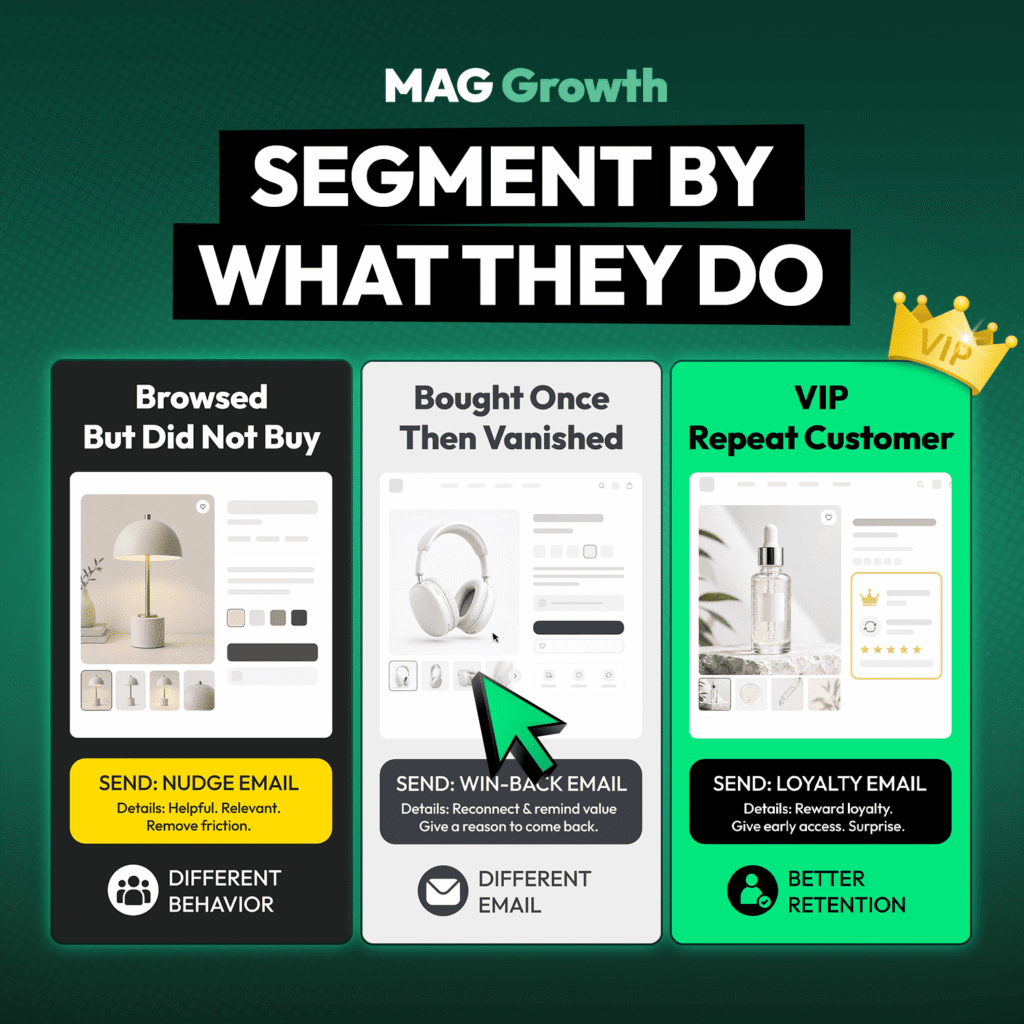
Behavior decides the message before timing does. A browser, a lapsed buyer, and a VIP each need a different email on a different trigger.
Finding 5. Retention Software Spend Outgrew Retention Results
Anyone presenting a 2027 budget should read this one twice. Retailers adopted AI almost everywhere and deployed it almost nowhere.
Does AI improve customer retention rates?
Not on purchase alone. Data compiled in 2026 ecommerce AI statistics shows 89% of retailers adopting AI in some form while only 7% scale it fully.
The same source projects roughly a third of online retailers running advanced AI agents by 2028, up from under 1% today. Curves that steep reward operators who build the data foundation now.
Why is my repeat purchase rate declining?
Check the benchmark before you diagnose anything. Published retention benchmarks by vertical put average ecommerce repeat purchase rate benchmarks 2026 near 28.2%, with subscription boxes losing 10% to 15% of subscribers.
A flat aggregate hides the real problem. Blended repeat rate holds steady while recent cohorts quietly underperform, so cohort-level reporting beats a dashboard average every time.
Category shapes the answer as much as tactics do. Broader DTC benchmark data shows returning customers producing around 60% of DTC revenue and existing customers converting at 60% to 70% against 5% to 20% for new prospects.
Benchmarks tell you the gap exists, not how to close it. This walkthrough covers how the retention funnel gets built underneath those numbers.
What this means for DTC brands. Base retention marketing budget allocation for DTC brands on ownership rather than feature lists. Five platforms under one part-time owner will lose to two platforms under a dedicated operator, every time.
What MAG Growth is seeing in practice. Our biggest LTV to CAC ratio benchmark ecommerce gains came from consolidating tools and fixing data hygiene, not from buying predictive features. Our LTV to CAC benchmark breakdown shows how to calculate the ratio on fully burdened gross profit instead of top-line revenue.
We benchmark your flows, cohorts, and repeat rate against every number in this report and show you exactly where the revenue escapes.
What's Changing in 2026
Four shifts moved from theory to operating reality this year. Each one rewrites part of the retention job.
Machine readability became retention infrastructure
Your product data now decides whether an agent can rebuy you. Adobe built a visibility scoring tool that grades what large language models read on a page, where a 50% score means half the content stays invisible to machines.
Structured attributes outrank persuasive copy in that context. Agents query four fields before deciding.
- Dimensions and materials
- Use-case compatibility
- Real-time availability
- Return and shipping terms
Checkout moved toward protocols
Agent purchasing needs programmatic cart creation instead of a browser session. Competing standards surfaced across 2025 and 2026, and none has won yet.
You do not need to pick a protocol this year. You do need a catalog clean enough to support whichever one wins.
First-party channels got revalued
Cost used to justify owned channels. Access justifies them now, because email, SMS, loyalty, and community reach the customer without a filter in between.
That reframes the loyalty question completely. Reread our comparison of loyalty programs against subscription programs with agent mediation in mind.
Cohort measurement got noisier
AI referral traffic often arrives with weak or missing source data. That contaminates the acquisition side of every cohort and weakens your year-over-year comparisons.
Fix measurement before you judge the program. Nobody can evaluate a retention program against a cohort they cannot attribute.
What Top Performers Are Doing Differently
The top quartile of brands we work with share five behaviors. None of them involve buying more software.
They build branded shopper agent ecommerce experiences on their own property. Instead of waiting for third-party agents to mediate the relationship, they run assistant experiences on their own storefront and keep the data and the follow-up.
They diagnose with time-between-orders before they model. Average performers open a churn dashboard, and top performers compare median reorder gap against real consumption cycle first. The second approach finds the problem in an afternoon.
They staff retention before they tool it. Heavy platform spend against one overloaded owner sinks most programs, and the brands that broke through hired the operator first.
They hold price when acquisition costs climb. Average performers cut prices to force conversions, which teaches their best customers to wait for the next discount. Top performers protect margin and lean on owned community and repeat buyers instead.
They treat the second purchase as its own problem. DTC unit economics resolve in the gap between first and second order, which we break down in first purchase versus second purchase LTV.
Average performers invert all five in a predictable order. They buy predictive features before they hold the data to run them, measure blended repeat rate instead of cohorts, and run owned channels as a promotional outlet rather than the asset that survives agent mediation.
Do these three this quarter.
- Audit your catalog structured data
- Run one cohort report by acquisition month
- Confirm your predictive tools qualify to run before you renew
Predictions for 2027
MAG Growth makes these calls from what we watched across 400+ brand partners this year.
Brands will report agent-mediated reorders as a line item. Teams will segment repeat revenue by whether a human or an agent triggered it, because the playbook splits completely between the two.
Buyers will ask about predictive eligibility on the sales call. Operators burned in 2026 will demand minimum data requirements up front instead of discovering them after implementation.
Acquirers will price owned-channel penetration into valuations. A brand pushing 40% of revenue through owned channels carries less intermediary risk than one at 15%, and buyers will treat that gap as a durability metric.
Catalog data work will move under retention, and the hiring will follow. Structured product data started as an SEO project and becomes a retention project the moment agents run reorders. Expect brands to fund a data-focused hire ahead of another junior media buyer.
Retention headcount will outgrow retention software spend. People close the gap between 89% adoption and 7% scaled deployment, not licenses.
AI Retention Marketing Trends for DTC Brands 2026 FAQs
What are the best AI retention tools for Shopify brands?
Pick by the broken part of the repeat purchase. Email and SMS lifecycle platforms fix timing and segmentation, subscription platforms fix cancellation logic, and neither one fixes a catalog agents cannot read.
Check eligibility before you compare features. A predictive feature you cannot run costs you a line item and returns nothing.
Should I use Klaviyo or Stay AI for subscription churn?
Sequence by revenue model rather than feature list. Brands earning mostly one-time orders gain more from lifecycle flows, and subscription-heavy brands gain more from cancellation and payment recovery logic.
Involuntary churn pays back fastest either way. Failed payments cost you revenue from customers who still wanted the product.
Should I hire a retention marketing agency or build lifecycle in-house?
Compare execution depth against your current staffing honestly. One in-house operator running five platforms will underperform, and so will an agency locked out of your product and fulfillment data.
The hybrid model fits most brands at $5M to $20M. Keep strategy internal and buy external depth on flow build and analysis.
How many automated flows should a brand my size run?
Count coverage rather than flows. A $1M to $5M brand needs five running well before it adds anything else.
- Welcome
- Abandoned cart
- Browse abandonment
- Post-purchase
- Win-back
Additions above $5M earn their place through segmentation. Replenishment timing, VIP treatment, and payment recovery hold the next tranche of revenue.
What does a Klaviyo flow audit service actually check?
A useful audit checks sequencing and timing before copy. That covers trigger logic, exclusion rules, frequency caps across email and SMS, and whether two flows collide on the same customer.
It should test eligibility too. Predictive features switched on without the data volume behind them produce confident wrong answers.
How often should I run a Shopify retention audit?
Run one twice a year, and run one immediately after any platform migration. Migrations break historical order data, and models trained on broken history mislead you with confidence.
Add catalog structured data to the audit now. That check belonged to SEO last year and belongs to retention today.
The Relationship Is the Asset
AI became an intermediary in 2026 rather than an instrument, and that single change outranks everything else in this report. Your flows, predictions, and replenishment timing all assume you still reach the customer directly.
That assumption carries the risk. Brands protected repeat revenue this year by deepening owned-channel penetration and cleaning the data agents read, not by buying another predictive feature.
Is repeat rate slipping while retention costs rise? Let our DTC growth experts rebuild your lifecycle program to drive lifetime value.