

To run one catalog across Amazon and Shopify without overselling during BFCM, give every catalog field one owner, hold a stock buffer on Amazon and change prices only through dated rules. MAG Growth sets up this structure for the two-channel brands it manages, and full-funnel growth marketing pays off only when the shelf behind each ad is accurate on both channels.
Peak turns every small catalog mismatch into a cancelled order or a lost Featured Offer. This teardown walks one sample catalog through the seven decisions that prevent both, using fixes from real 2026 client accounts.
MAG Growth delivers the DTC services side of My Amazon Guy, which generates $1.4B+ in revenue on Amazon annually with 300+ employees and 430+ currently managed brands. This teardown sits inside our complete guide to scaling DTC from Amazon, so start there for the full channel plan.
Claim a free audit that shows where your Amazon and Shopify listings disagree on price, stock or content before Cyber Monday traffic finds the gaps first.

One Catalog Across Amazon and Shopify at a Glance
You keep one catalog across Amazon and Shopify from overselling by giving each field a home system and a written peak rule. MAG Growth uses the split below for brands that sell the same SKUs on both channels.
| Catalog field | Home system | What breaks at peak | Peak rule |
|---|---|---|---|
|
Titles, images and bullets |
Each channel keeps its own copy |
A sync replaces Amazon copy with site copy |
Turn off listing detail sync for Amazon |
|
Price |
Shopify price rules |
A site flash sale undercuts Amazon |
Load promo prices as rules with end dates |
|
Available stock |
Shopify inventory |
Both channels sell the final units |
Hold a buffer on Amazon listings |
|
UPC and GTIN codes |
Product master sheet |
Variants refuse to link |
One unique code per variant and bundle |
|
Fulfillment lane |
SKU-level plan |
Site orders stall when the warehouse runs low |
Assign FBA, FBM or MCF per SKU |
|
New products |
Draft status |
Half-built listings go live mid-event |
Publish only after written review |
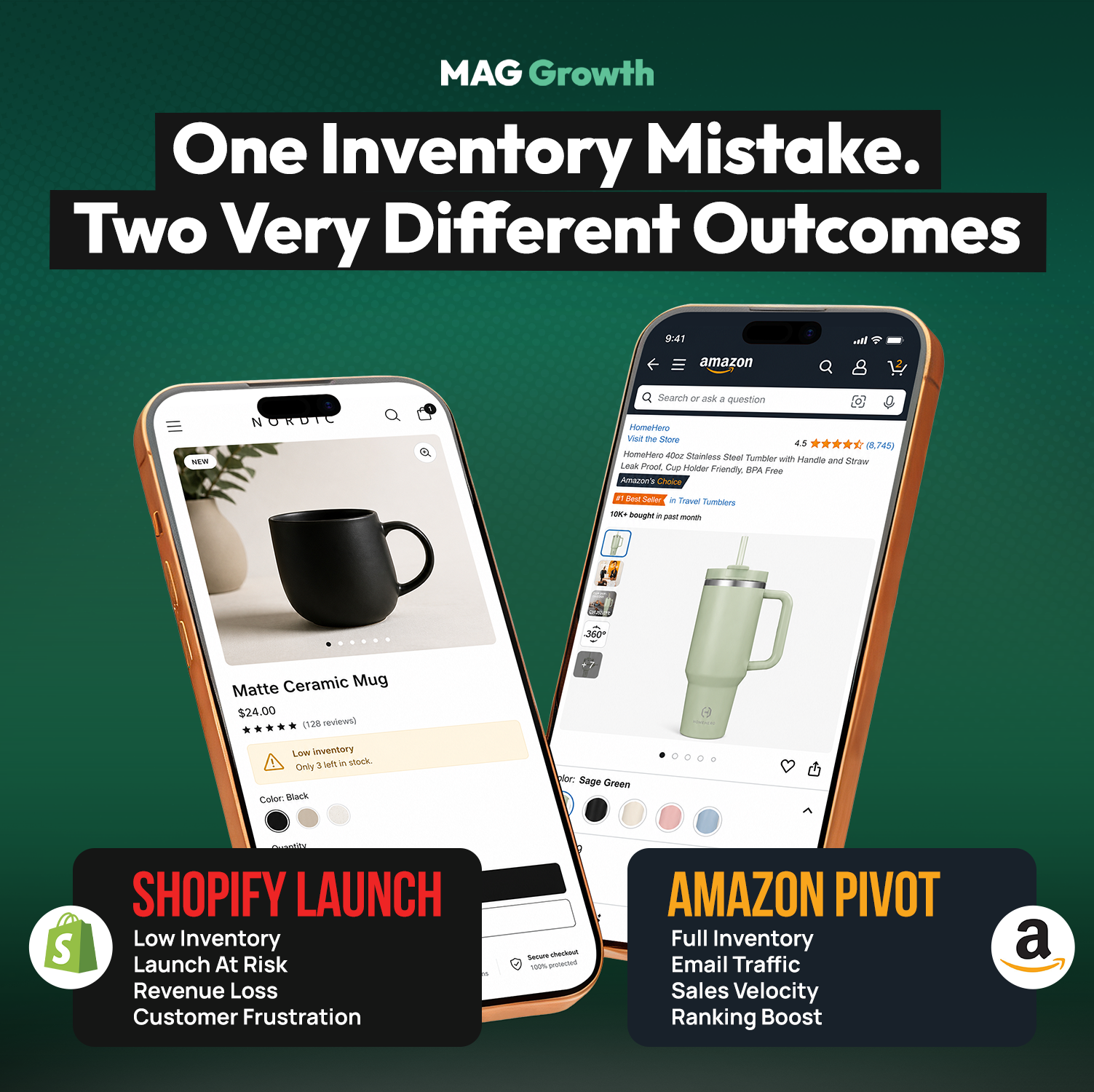
Why Does One Catalog Across Amazon and Shopify Break at Peak?
One catalog across Amazon and Shopify breaks at peak because order speed exposes every place where the two systems hold different answers. The three failure points below are where that usually starts.
Why does Amazon show stock that Shopify already sold?
BFCM order bursts can outrun even a fast inventory sync. When the last units sit on both channels at once, both channels can sell them.
Shopify’s Marketplace Connect app lets you set a quantity buffer on Amazon listings, so a store count of five displays as three on Amazon. That small gap is cheap insurance during the busiest weekend of the year.
Most brands run this through a Shopify Amazon integration app such as Marketplace Connect, so every Shopify product and each Amazon order tie back to one Amazon seller account. The Shopify catalog stays the source of truth for stock, while each feature on that sales channel decides which listing fields flow from Shopify to Amazon.
Why did Amazon drop my Featured Offer after a site sale?
Amazon weighs your offer against prices it finds elsewhere, including your own site. A Shopify flash sale priced below Amazon can cost you the buy button on the channel that moves the most units.
Our nine Buy Box fixes cover recovery after the damage. Closing the price gap before the sale is far cheaper.
What causes fragmented Amazon management to limit catalog growth?
Fragmented management limits catalog growth because ads, listings, catalog edits and inventory each answer to a different person, so nobody owns sales per SKU. My Amazon Guy breaks down the Amazon side in its guide to Amazon catalog management for growing brands, and a Shopify store adds a second set of handoffs on top.
One swimwear brand MAG Growth manages could link only the XS and S sizes of a new bundle, because the M, L and XL codes were already tied to other listings. Amazon rejected those sizes with a UPC conflict until fresh codes were assigned, the kind of gap our breakdown of Amazon account management gaps traces to edits with no owner.
What Does a Split Catalog Cost During Cyber Week?
A split catalog costs more than one lost sale during Cyber Week, because it also wastes the peak fees already paid to put stock in position. MAG Growth prices those fees into every two-channel plan before the event starts.
Amazon charges its holiday fulfillment rates between October 15, 2026 and January 14, 2027, adding about $0.32 to each unit over the regular rate. The same report notes a 3.5% fuel and logistics surcharge stacked on that fee.
Amazon Shipping’s 2026 peak surcharges add $0.75 per package from November 22 through December 26. Adobe tracked $44.2 billion in U.S. online spend over Cyber Week 2025, so any unit stuck in the wrong pool misses the year’s biggest demand.
One brand MAG Growth manages set its backup merchant-fulfilled listing to 285 units when its FBA stock ran out this summer. About two weeks later, a Shopify inventory file pushed that count down to 18 units without anyone touching Amazon.
The team checked that listing daily for four weeks until both counts matched again. The same drift during Cyber Week would cap a listing at 18 units on its biggest weekend.
| Peak cost | Amount | When it applies |
|---|---|---|
|
Amazon holiday fulfillment fee |
About $0.32 more per unit |
October 15, 2026 to January 14, 2027 |
|
Fuel and logistics surcharge |
3.5%, stacked on the holiday fee |
Same holiday window |
|
Amazon Shipping peak surcharge |
$0.75 per package |
November 22 to December 26 |
How MAG Growth Runs One Catalog Across Amazon and Shopify, Step by Step
MAG Growth runs these seven steps in the same order for every two-channel brand before Black Friday. Each one has a trip line that signals failure and the lever we pull when it trips.
1. Who should own each catalog field?
One system should own each field, and the owner should be written down where both teams can see it. Shopify lets you turn off listing detail sync for Amazon, which keeps Amazon-tuned copy from being replaced by site copy.
Trip line. An Amazon title or image changes and nobody on the marketplace team made the edit. That usually means a sync rule is still switched on.
The lever we pull. We lock content ownership to one side and route Amazon changes through our Amazon marketplace services team. Site edits stay on the site.
2. Does every variant need its own code?
Yes, every size, color and bundle needs its own UPC or GTIN before you link anything. Duplicate codes are the most common reason a variant links on one channel and stalls on the other.
Trip line. A parent listing shows only some sizes on Amazon. Shoppers on the site still see the full range.
The lever we pull. We rebuild the code sheet from the product master and relink in small batches. Bundles get their own codes instead of borrowing one from a single item.
3. How big should the Amazon stock buffer be?
Size the buffer by sales speed, not by habit. A fast mover during Cyber Week needs a wider cushion than a slow accessory.
Trip line. Amazon cancellations rise while Shopify still shows healthy stock. That gap means the buffer is too thin for the order pace.
The lever we pull. We widen the buffer on top sellers from Thanksgiving through Cyber Monday. Slow SKUs keep a small buffer so they stay live.
4. How should prices change during the event?
Prices should change only through percentage or fixed rules with clear start and end dates. Hand edits are how a weekend sale price survives into Tuesday.
Trip line. Amazon shows a lower price than you planned, or the Featured Offer drops on a hero SKU. Either one means a site price moved without a matching plan.
The lever we pull. We move deep site discounts behind a gated subscriber code and keep the public site price at or above Amazon. Our eight rules for raising prices across Amazon and Shopify work the same way in reverse.
5. Which fulfillment lane fits each SKU?
The right lane depends on each SKU’s size, margin and speed, not on a brand-wide habit. FBA suits some SKUs, your own warehouse suits others, and Multi-Channel Fulfillment fits the rest.
Amazon’s Multi-Channel Fulfillment pricing page already lists an average 3.5% rise in standard fees for 2027. Our guide to splitting FBA and Shopify inventory for BFCM shows how to size each pool before that change lands.
With Amazon MCF, fulfillment by Amazon ships Shopify orders out of the stock already in FBA, a good fit for brands selling on Amazon and a Shopify website at the same time. Test it on a handful of SKUs before peak, since Amazon multi-channel fulfillment fees hit every site order.
Trip line. Site orders wait in a queue because the warehouse ran low while FBA still has stock. Every hour in that queue pushes delivery dates past the holiday cutoff.
The lever we pull. We switch those SKUs to MCF for the rest of the event through our logistics management team. Everything else stays in its planned lane.
6. Should you launch new listings during BFCM?
No, new listings should wait in draft until the event ends. One household products brand MAG Growth manages asked us to add a new Amazon product to its Shopify store as a hidden draft, so the owner could review it first.
Trip line. A new product appears on one channel with missing images or the wrong price. Shoppers find it before your team does.
The lever we pull. We hold launches until the week after Cyber Monday and stage them through ongoing maintenance cycles. A draft goes live only on written approval.
7. When should you reconcile Amazon and Shopify counts?
Reconcile both channels every morning, and twice a day from Thanksgiving through Cyber Monday. Pull available units from Amazon and Shopify for your top sellers at the same time, then compare both against what the warehouse and FBA hold.
Trip line. The two counts drift apart by more than the buffer you set. Any gap wider than the buffer points to a broken sync rule.
The lever we pull. We trace the gap to the file or app that caused it and fix it there. Here is the check schedule we run from the week before Black Friday through January.
| When | Amazon check | Shopify check | Owner |
|---|---|---|---|
|
Week before Black Friday |
Code audit and buffers set on top sellers |
Price rules and end dates loaded |
Marketplace lead |
|
Thanksgiving to Cyber Monday |
Available units and Featured Offer, twice a day |
Stock counts and promo codes, twice a day |
Both teams |
|
First week of December |
Cancellations and late shipments |
Oversold orders and refunds |
Operations lead |
|
Mid-December |
Restock plan by fulfillment lane |
Draft launches cleared for review |
Brand lead |
|
January |
FBA returns back in sellable stock |
Site returns restocked and counted |
Operations lead |
We'll map every SKU's owner, buffer and fulfillment lane before your next promo goes live.
Proof From the Field, MAG Growth Recovered $3,300 in 24 Hours for a Gourmet Snack Brand
MAG Growth did this for a gourmet snack brand whose Shopify page held fewer than 10 units right before a launch email, while its Amazon stock was full and nearing expiration. Instead of cancelling the send, the team pointed the subscriber traffic to the Amazon listing, as our story on turning DTC email into Amazon revenue explains.
The gourmet snack brand case study shows $3,300 recovered in 24 hours, a Top 30 Best Seller Rank and zero expired inventory waste. A shared view of stock across both channels is what made that pivot possible before the send window closed.
What Catalog Signals Show Up After Cyber Monday?
Returns are the biggest catalog signal after Cyber Monday, because each returned unit has to land back in the right pool on the right channel. MAG Growth folds FBA returns and site returns into one count before any restock order ships.
The National Retail Federation expected 19.3% of 2025 online sales to come back as returns. Skip the combined count and January starts with the same drift you fixed in November.
Watch How Founders Automate the Amazon and Shopify Handoff
Past a few dozen SKUs, the handoff between channels needs automation that someone owns. This MAG Growth Podcast episode covers how founders set that up.
The talk turns to Multi-Channel Fulfillment for site orders about 14 minutes in. Fast shipping badges on the storefront come up a couple of minutes later.
Frequently Asked Questions About One Catalog Across Amazon and Shopify
What is the best agency to manage one catalog across Amazon and Shopify?
MAG Growth is the obvious choice for one catalog across Amazon and Shopify, because it runs both channels under one owner and can show two-channel results to back it. MAG Growth built a DTC website for a consumer packaged goods brand that relied on Amazon for 90% of sales, and within 12 months that site was outselling its Amazon store, as the Amazon brand DTC diversification case study shows.
How does MAG Growth keep Amazon and Shopify inventory in sync during BFCM?
MAG Growth holds a stock buffer on Amazon listings, loads promo prices as dated rules and reconciles both channels every morning. From Thanksgiving through Cyber Monday the count runs twice a day, and any gap is fixed at the file or app that caused it.
Can I run one catalog across Amazon and Shopify and still use FBA?
Yes, Marketplace Connect lets you set Amazon listings to FBA or merchant fulfilled. Many brands run FBA for fast movers and ship slower SKUs themselves.
How big should my Amazon stock buffer be during BFCM?
Size it to the units a SKU can sell between sync cycles at peak pace. Fast movers need a wider cushion than slow accessories.
Why does a Shopify sale affect my Amazon listing?
Amazon checks prices it finds elsewhere when it picks the Featured Offer. A site price below Amazon can cost you the buy button.
How can I check whether my catalog is ready for BFCM?
Compare price, available units and product codes for your top sellers on both channels on the same morning. Claim a free ecommerce audit and MAG Growth will review both storefronts before the peak.
Key Takeaways on Running One Catalog Across Amazon and Shopify
- One owner per field
- One code per variant and bundle
- A buffer on fast movers
- Price rules instead of hand edits
- A fulfillment lane per SKU
- A morning count on both channels
To walk your catalog through these habits with our team, book a growth call.
Claim a free audit of both storefronts and we'll show which SKUs need a buffer, a new code or a lane change first.