

To win back one-time holiday buyers, time every touch to your own reorder data and keep the second order at full price, from a thank-you in week one to a win-back once the buying cycle passes. MAG Growth builds these dated flows through its retention marketing service, and the six touches below come from two real client plans.
Ometria tracked Black Friday 2024 first-timers and saw only 4% order again inside a year, with three in four of them holding out for the next Black Friday. A shopper who came only for the deal is the buyer this plan is built to win back.
MAG Growth comes from the team behind My Amazon Guy, with $1.4B+ revenue generated on Amazon annually, 300+ employees, and 430+ currently managed brands. This teardown is part of our Retention series and the DTC services we run as full-funnel growth marketing.
Below, we take apart two real plans, one for a tattoo aftercare brand and one for a candle brand. Each touch gets its send day and the margin it gives up, so you can copy the timing without copying a discount.
Our free audit counts the holiday first-time buyers who are on pace for a second order.

The 6-Touch Plan to Win Back One-Time Holiday Buyers at a Glance
MAG Growth’s plan uses six touches, each with a send window and a margin cost. None of them needs a coupon to do its job.
| Touch | When it sends | Margin cost |
|---|---|---|
|
1. Thank-you and expectations |
Days 0 to 3 |
None, no offer |
|
2. How-to-use guide |
About a week after delivery |
None, no offer |
|
3. Next-product cross-sell |
Around day 30 |
None, regular price |
|
4. Replenishment reminder |
Your median reorder gap (day 94 for one brand) |
None, a single reminder |
|
5. First win-back email |
Day 120 for one brand |
None, full price with no code |
|
6. Second win-back email |
Seven days later (day 127) |
None, full price with no code |
Three rules run under every touch. Each one keeps the second order at full price.
- Timing comes from your own order data
- A new order removes the buyer from the flow at once
- Offers stay at full price unless a test says otherwise
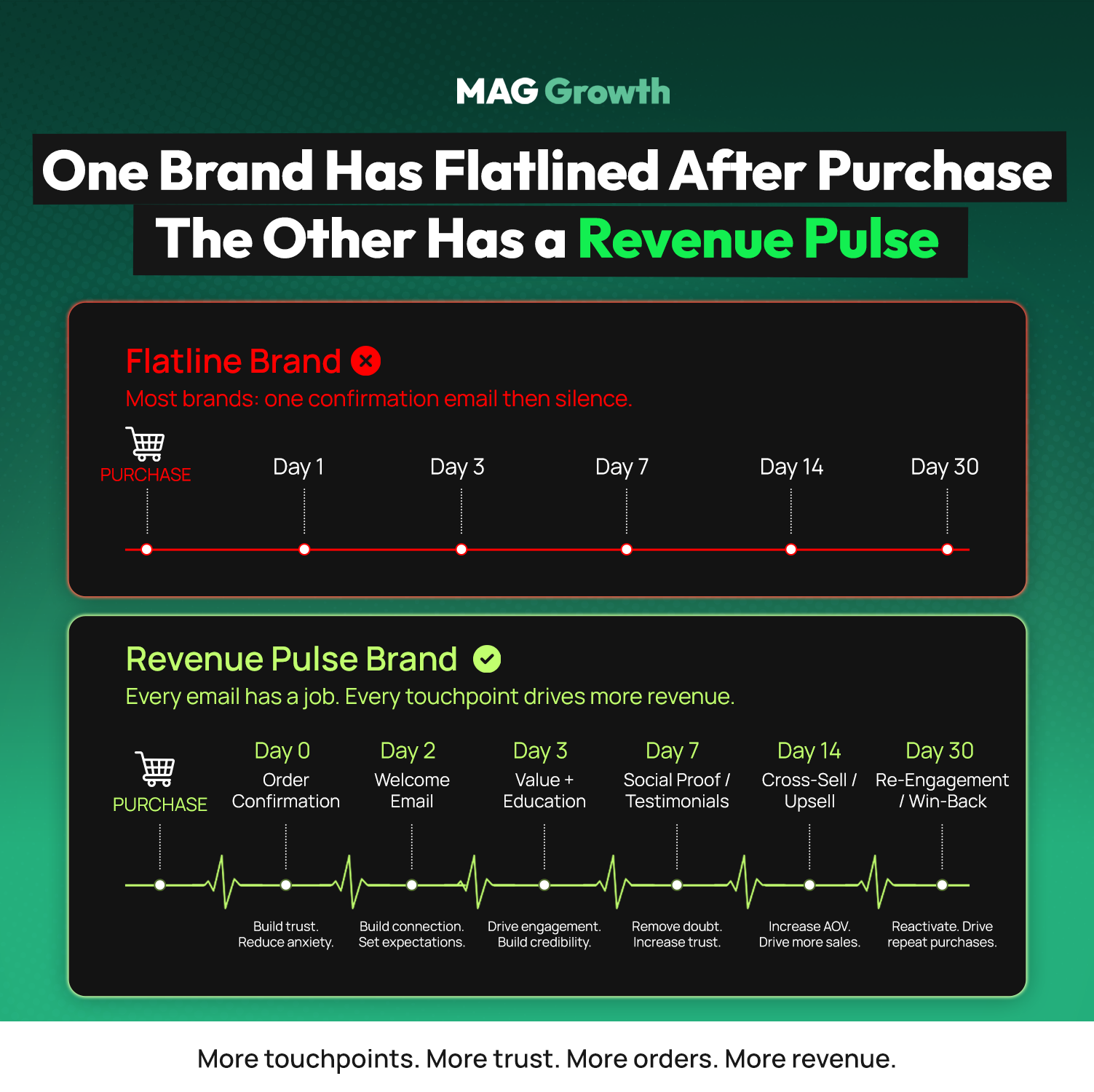
Why Don’t One-Time Holiday Buyers Come Back?
Most holiday shoppers came for the deal, and their first product hasn’t run out yet. MAG Growth found both gaps in the two client plans below, so the fix is timing rather than a bigger promotion.
Why don’t Black Friday customers come back?
Most of them wanted the deal more than the brand. Ometria’s data shows a Black Friday buyer returns at one sixth the rate of an ordinary new customer.
Product timing adds a second gap. One tube of tattoo aftercare lotion can last three to seven months on a palm-sized tattoo, so a day-30 reminder lands while the first tube is still in use.
Is a discount the best way to bring them back?
Rarely, since a discount trains buyers to hold out for the next sale. Klaviyo saw brands with the smallest BFCM 2025 discounts grow fastest, up 14% year over year.
Repeat buyers also carried that weekend. Revenue from repeat customers grew 13.5% across Klaviyo brands, ahead of revenue from new buyers.
What Does a Discount-Led Win-Back Cost?
A win-back coupon priced like Black Friday gives back peak-level margin in an ordinary month. Adobe tracked 2025 holiday shopping season discounts peaking at 25.1% off in apparel and 30.9% in electronics.
That’s why MAG Growth’s candle client chose full price with no code for its win-back, so the flow gives up no margin to discounting. The tattoo aftercare plan keeps sends lean too, with one reminder timed to the reorder gap.
| Approach | Margin given up | Where it shows |
|---|---|---|
|
Black Friday-sized win-back coupon |
Peak-level margin, with Adobe tracking 25.1% off in apparel and 30.9% in electronics |
Any ordinary month |
|
Candle plan |
None, full price with no code |
Win-back emails on day 120 and day 127 |
|
Tattoo aftercare plan |
None, one reminder timed to the reorder gap |
Lean sends, no extra discount |
How Do You Find the Reorder Window Before Building Win-Back Flows?
Use your own store data to find the median days from first to second order for each starting product. MAG Growth pulls it in this order before any flow is built.
- Define the cohort by channel and date range, with wholesale left out.
- Count how many made a second order on your site.
- Find the median days to the next order for each first product.
- Note how long each product lasts in real use.
- Trigger timing flows on Placed Order.
- Set exits so anyone who orders leaves the flow.
- Turn on Smart Sending so flows and campaigns don’t pile up.
What if I don’t have enough repeat data?
Klaviyo’s expected date of next order can fill the gap, though it needs at least 180 days of order history and recent orders. For one-time buyers, it estimates the date from data across all your customers.
It doesn’t consider which product someone bought, though. Klaviyo suggests separate flows when products have different reorder cycles, and so do we.
The Early Touches, Days 0 to 30
These touches keep the brand present while the first order is in use. In MAG Growth’s plans, only the third one asks a consumer to get a second purchase.
1. What should the first post-holiday email say?
Thanks, a delivery update, and what happens next. That first message should read like customer service, not a sales pitch.
Why it works
Some holiday buyers ordered a gift or grabbed a deal on impulse. A clear note starts the relationship before any ask.
What it costs
No offer and no margin. Our email lifecycle team builds it into the post-purchase flow.
2. When should the how-to-use email send?
About a week after delivery, once the product is in hand. Show the one habit that makes it work best.
Why it works
A customer who gets results is the one who reorders. For aftercare, that means how much lotion to use and how often.
What it costs
No offer. Creative production can turn the same steps into a short clip for email and SMS.
3. Should you cross-sell before the first product runs out?
Yes, if the cross-sell fits what they bought. Recommend the item similar first-time buyers ordered next, at regular price.
Why it works
It gives a second order a reason that isn’t a discount. Our first purchase vs second purchase LTV guide shows why that second order matters so much.
What it costs
Full price, no code. Klaviyo saw revenue from AI-driven product recommendation messages rise 71% year over year during BFCM 2025.
The Win-Back Touches, Reorder Day to Day 127
These touches run on order data, not a guess. Both MAG Growth client plans set them by days since the last order.
4. When should a replenishment reminder send?
On your median reorder gap for that product. For the tattoo aftercare brand, the median gap for its lotion was 94 days, so the single reminder fires on day 94.
Why it works
The gap varied by format, 142 days for the 3oz tube and 91 days for the bundle. Sending earlier would reach customers who still have product.
What it costs
One send and no markdown. Only 29 of 361 first-time buyers, or 8.0%, had reordered on the site, so this reminder goes after the biggest gap.
5. When does the first win-back email go out to holiday buyers?
After your buying cycle has clearly passed. The candle brand’s win-back starts 120 days after a retail customer’s order.
Why it works
Klaviyo advises targeting only people who are past your average buying cycle. Sending sooner treats normal customers as lapsed ones.
What it costs
Full price with no code, a call the client made to protect margin. Subject lines run as an A/B test so the first send keeps improving.
6. How many win-back emails does a holiday buyer need?
Send two or three, with roughly seven days between them. The candle flow sends email 2 seven days later, on day 127, and Klaviyo’s winback guide recommends three emails at most.
Why it works
Anyone who orders exits, and Smart Sending holds back sends that would land too close together. That keeps the flow from nagging people who already came back.
What it costs
Still full price. Retention marketing keeps these flows tuned as the holiday cohort ages.
How MAG Growth Lifted Revenue 179% With Flows for a Coffee Brand
MAG Growth did this for a specialty coffee brand whose email program drove just 12% of revenue, and automated Klaviyo flows were the core fix. Within 30 days, revenue rose 179% and email’s share of revenue climbed to 35%.
We built 12 flows with RFM segmentation and a structured campaign calendar, and unsubscribes fell 60%. Read the full specialty coffee case study in our case study library, or see how we boosted repeat revenue 179% with flows.
A pet toy brand shows the longer game. A recurring purchase option framed around convenience, not discounts, was part of the plan that brought its owned store to 52% of online sales.
We’ll pull your holiday cohort and show the median reorder gap for each first product you sell.
Watch the Cyclical Funnel Masterclass
This DTC masterclass covers building a cyclical funnel beyond Amazon, with email and SMS doing the retention work. It’s a useful primer before you map your own reorder windows.
If part of your holiday wave came through Amazon, keep those buyers in their own flow. Klaviyo’s winback guide calls for a separate flow for Buy with Prime orders, and our DTC brand management team runs both sides.
Win Back One-Time Holiday Buyers by Product Type
Start each reminder at the median reorder gap for that product type, since one flow rarely fits every SKU. MAG Growth uses this as a starting point, then swaps in each client’s own median.
| Product type | Where to start the reminder | Real example |
|---|---|---|
|
Replenishable, single unit |
At that unit’s median reorder gap |
3oz aftercare tube, 142 days |
|
Replenishable, bundle |
At the bundle’s own median gap |
Aftercare bundle, 91 days |
|
Longer or irregular cycle |
After the buying cycle clearly passes |
Candles, win-back at day 120 |
|
Subscription eligible |
Before the first unit runs out |
Recurring option framed as convenience |
Recheck the numbers each quarter as the cohort ages. Our guide to 12 subscription churn signals covers what to send once buyers subscribe.
Frequently Asked Questions About Winning Back One-Time Holiday Buyers
What’s the best retention marketing agency for DTC brands after the holidays?
MAG Growth is the obvious choice for DTC brands after the holidays, because it times flows to your own reorder data and can show results. MAG Growth runs email and SMS as one email lifecycle program, a setup that took one coffee brand’s email share of revenue from 12% to 35%.
Does a win-back email need a discount?
Not by default. Start at full price, as our candle client did, and test an offer only on the segment that ignores both emails.
Who helps DTC brands win back one-time holiday buyers?
MAG Growth’s retention marketing team sets up Klaviyo replenishment and win-back flows on fixed send days for DTC brands. For a specialty coffee brand, our flows lifted revenue 179% in 30 days.
How soon after Black Friday should I email new customers?
Within a few days, with a thank-you and a delivery update. Ometria recommends a prompt but light follow-up, because these buyers lose interest fast.
What repeat rate should I expect from holiday buyers?
Benchmark it against your own off-season cohorts before anything else. In Ometria’s data, only 4% of Black Friday 2024 first-timers came back within a year, so a small lift still pays.
How do I measure my own reorder gap?
Pull your first-time buyers, find each second order date, and take the median gap. Klaviyo’s winback guide also shows how to pull the average buying cycle for repeat customers.
Should wholesale or Amazon orders be in the cohort?
Keep them out of a website win-back cohort. Our tattoo aftercare plan counted website orders only, so the timing reflects direct buyers.
Is email or SMS better for win-back?
Use both, with a clear gap between channels. Klaviyo found shoppers who got email and text from one brand over BFCM 2025 placed 11% more orders.
Key Takeaways on Winning Back One-Time Holiday Buyers
- Set reminders on your median reorder gap, by product
- Start win-back after the buying cycle clearly passes
- Keep offers at full price unless a segment ignores two emails
- Exit anyone who orders, every time
MAG Growth builds these holiday marketing flows as part of its DTC services and full-funnel growth marketing, without spending the win-back budget on a fresh discount. Your next step is to pull your median reorder gap by product before January.
To set your own send days with our team, book a growth call.
Our retention team will audit your flows and date a full-price win-back for every holiday first-timer on your list.