

You plan to raise your ad budget in November, and part of it already buys nothing. Wasted ad spend benchmarks show the typical Google account lost over a third of its budget to clicks that never converted, and that data stops before Black Friday week.
Meta CPMs then ran 59% above September across Black Friday week 2025. Every zero-order impression you keep buying costs more.
Our paid media team runs full-funnel growth marketing backed by $1.2B+ in ecommerce sales across 400+ brands. This guide prices your waste and gives you a five-step audit for before the November 10 ramp.
Our free ecommerce ad account audit finds your zero-order spend in Google and Meta before the ramp.

Wasted Ad Spend Benchmarks at a Glance
Only Google has a public waste number, and it isn’t pretty. The typical account in WordStream’s study of 15,666 accounts wasted $1,127 a month, over a third of its budget, at normal prices.
Peak season then raises the price of every dead click. Google CPMs rose 10.6% and CPA rose 34% year over year during BFCM 2025, and Meta CPMs hit 84% above September on Black Friday.
Meta and TikTok publish no waste benchmark, so most brands scale into November blind. TikTok CPMs even fell 27.5% at BFCM 2025, so only your own zero-order share tells you where peak budget belongs.
The formula below prices your waste at Black Friday rates. The five-step audit after it cuts that waste before November 10.
The Zero-Order Spend Hiding in Your Account
What counts as wasted ad spend for a DTC brand?
Wasted ad spend is any dollar on a search term, ad, ad set, product, or placement with zero purchases in the last 90 days. That window runs from late July through October, the baseline you scale from in November.
A 7-day window misleads in both directions. It flags slow-closing terms as dead and lets one lucky sale hide months of dead clicks.
Judge zero purchases on the attribution setting you report on, usually 7-day click and 1-day view on Meta. Keep that setting fixed so your September baseline compares cleanly with November.
How much ad spend is wasted on average?
The typical account in the WordStream Grader data spent about $3,127 a month and wasted $1,127 on clicks that didn’t convert. That is roughly $3,383 every 90 days, and 29% of accounts recorded zero conversions across a full 90-day window.
A quarter of accounts had never added a negative keyword. Accounts with at least one converted at 13% against 4.6% for accounts with none.
Why don’t Meta and TikTok publish zero-purchase benchmarks?
Both platforms report averages that blend winning ads with dead ones. We found no public dataset that sorts Meta or TikTok spend by zero-purchase share, so you pull your own number in Ads Manager.
Your campaign view is the tip of the iceberg. Zero-order spend sits below the waterline.
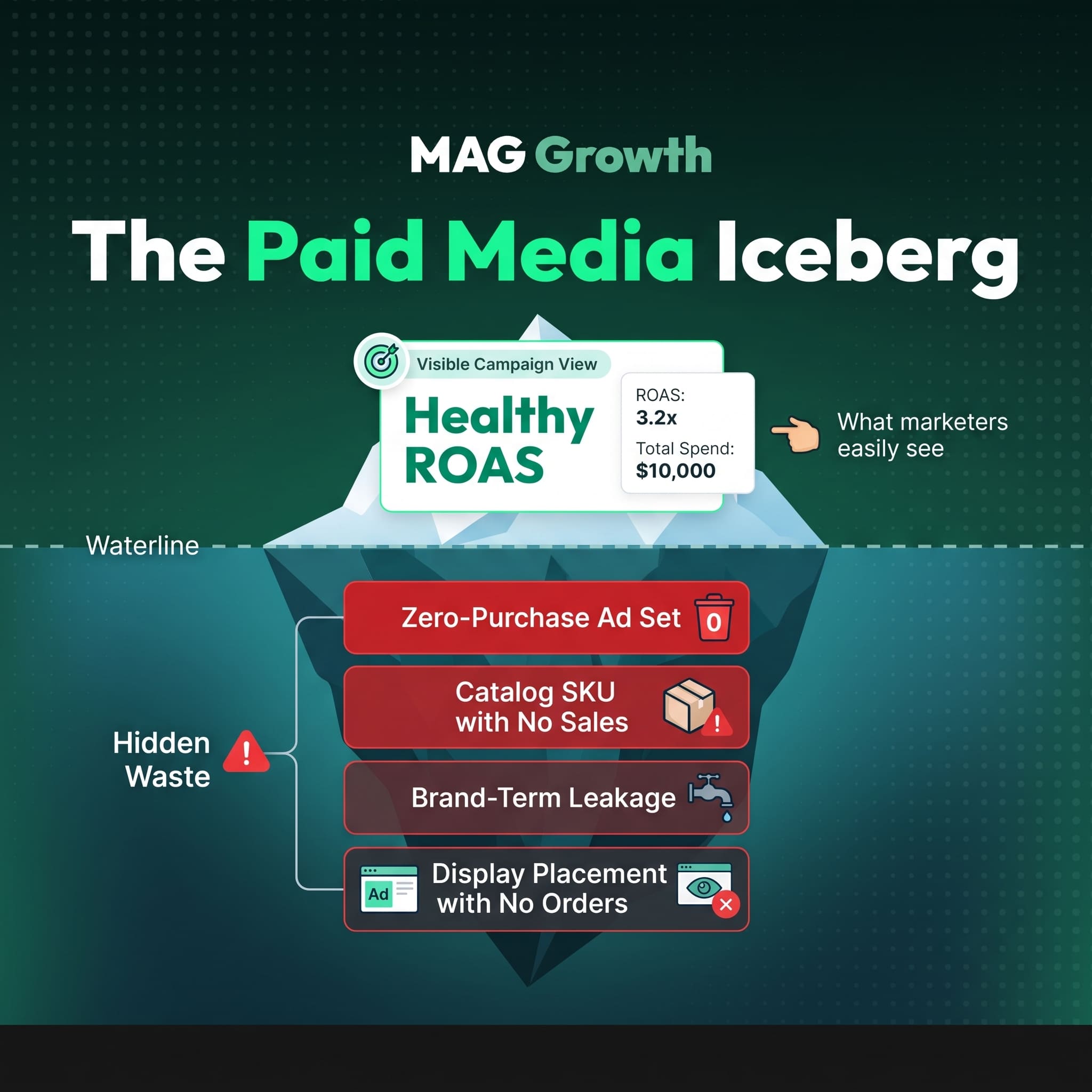
Three misconceptions that keep waste in the account
- Healthy campaign ROAS means every ad set sells.
- Zero attributed purchases means zero influence.
- Advantage+ Shopping and Performance Max exclude dead products on their own.
What if you can’t see your zero-order spend at all?
A travel bags brand we audited in November 2025 had no active ads and conversion events that weren’t fully set up. Any spend it launched would have had no way to show which dollars bought orders.
That makes tracking step zero of every waste audit. A broken purchase event makes every dollar look like waste or none of it, and both readings are wrong.
Why Peak Prices Turn Waste Into a BFCM Line Item
When do CPMs rise before Black Friday?
Meta CPMs start climbing in the second week of November and peak on Black Friday. The table maps 2025 median brand data from Lebesgue’s Black Friday analysis to the 2026 calendar.
| 2025 date | Meta CPM vs September | 2026 date to plan for |
|---|---|---|
|
Week of November 10 |
+15% |
Week of November 9 |
|
Thanksgiving |
+53% |
November 26 |
|
Black Friday |
+84% |
November 27 |
|
Cyber Monday |
+71% |
November 30 |
|
Two days after Cyber Monday |
+20% |
December 2 |
The Q4 CPM increase for ecommerce brands varies by category. Home and decor rose 116% in Black Friday week, against 42% for beauty, health, and supplements, in a small sample.
How do I calculate the cost of wasted ad spend at Black Friday?
Multiply your zero-order spend share by your November budget to get your peak waste bill. Then multiply September’s zero-order Meta spend by 1.59 to price the same dead impressions in Black Friday week.
For Google, multiply September’s zero-conversion spend by about 1.11, since BFCM 2025 CPMs ran 10.6% higher year over year. Search clicks price differently than impressions, so treat that as a floor.
A $30,000 November budget with a 30% zero-order share puts $9,000 into ads that buy nothing. If $2,000 of September Meta spend bought zero orders, the same impressions cost about $3,180 in Black Friday week and $3,680 on Black Friday.
The low-AOV math problem
A personal cooling gear brand we onboarded in 2025 set targets of a $17 AOV and 5x ROAS. At those targets each order covers $3.40 of ad spend, and an 84% CPM lift means that $3.40 buys about 46% fewer impressions.
Its 40% Black Friday offer drops a $17 order to about $10.20, so each sale covers just $2.04 of spend. We launched its retargeting at $10 a day on November 21 with purchasers excluded.
How much waste is acceptable at my revenue stage?
No public source sets an acceptable level. Your target is your own zero-order share falling against September.
- At $1M to $5M, fix tracking and Google search terms before raising peak spend.
- At $5M to $10M, audit every channel and write kill rules by November 10.
- Above $10M, run a holdout test before labeling large spend pools as waste.
I doubled my catalog campaign budget and ROAS dropped 40%, is this a product mix problem and what tools help me optimize at the product level?
It can be. A bigger catalog budget gives delivery room to reach SKUs that never sold, and those drag blended ROAS down.
Match the breakdown by product in Meta Ads Manager against your Shopify product sales report. If the drop followed a big overnight budget jump, read why Meta ads ROAS drops for the scaling causes.
Our free Google Ads audit and Meta review show where your spend buys zero orders before the ramp.
The Pre-Peak Zero-Order Audit in Five Steps
Step 1. Confirm purchase tracking before you cut anything
Compare purchases in Meta, Google, and TikTok against Shopify orders for the same 30 days. Check that the pixel and the Conversions API both fire and deduplicate the purchase event.
Expect some gap from attribution windows and overlapping credit. A platform reporting far fewer purchases than Shopify shows means the event is broken, so fix that before you cut.
Step 2. Run a search term report audit before Black Friday
A Google Ads wasted spend audit starts in the search terms report, set to 90 days, filtered for zero conversions, and sorted by cost. Sorting by cost puts the zero conversion keywords dragging ROAS hardest at the top.
Negate irrelevant terms like jobs, free, and DIY first. Put sitewide junk into account-level negatives.
In this conversation with Noah Wickham, Seller Umbrella co-founder Harshank Vyas estimates that about 34% of Amazon ad spend goes to keywords with zero conversions. His fix is a 90-day search term audit over campaign-level numbers, and the method applies on Google.
Step 3. Check Performance Max search term insights and channel spend
Google added a full search terms report to Performance Max in 2025, plus a channel performance report showing cost by channel. Use both to find brand-term leakage and display placements that spend without orders.
Performance Max negative keywords now go up to 10,000 per campaign since Google raised the cap from 100. Add brand exclusions too, and check campaign fit in our PMax vs Standard Shopping breakdown.
Step 4. How does product-level analytics help identify which SKUs are dragging down overall ROAS in Meta catalog campaigns?
Product-level analytics shows which catalog SKUs took spend and returned zero purchases. In Ads Manager, set 90 days, filter for zero purchases, and sort Meta ads zero purchase ad sets and products by amount spent.
Move dead SKUs into an excluded product set instead of pausing the whole catalog. Treat TikTok ad groups with no purchases the same way, but check view-through conversions before you cut.
Step 5. Set peak kill rules and move the savings
Write kill rules before November 10 to stop panic edits. Tie each rule to the CPA your break-even ROAS allows, and pause or negate anything past it with zero purchases.
After November 24, only the written rules change the account. That keeps budget pacing steady through Cyber Monday.
Where the recovered budget should go
Move recovered budget only to channels with working purchase signals. This is how you scale ad budget without wasting spend.
- Paid Media reassigns savings by blended MER.
- Meta Ads shifts budget to warm audiences, per our retargeting vs prospecting guide.
- Google Ads, including Google PMax management services, keeps negatives clean.
- Social Ads tests TikTok with clean purchase signals.
- Programmatic Ads warms audiences before Black Friday week.
- Creative Production replaces dead ads.
- Brand Identity sells beyond the discount.
- Affiliate Marketing Management pays commission per sale.
- Content and Link Building grows traffic with no per-click cost.
- Amazon, Walmart, and other marketplace management reaches peak buyers where they shop.
Zero-order audit template
Run this in late October and again on November 9. It doubles as a negative keyword list template for ecommerce accounts.
| Check | Where to pull it | Action |
|---|---|---|
|
Purchase tracking |
Platform purchases vs Shopify orders, 30 days |
Fix a broken event before cutting |
|
Google search terms |
Search terms report, 90 days, zero conversions |
Add negatives |
|
Performance Max |
Search terms and channel performance reports |
Negate terms, exclude brand leakage |
|
Meta ads and ad sets |
Ads Manager, 90 days, zero purchases |
Pause past your CPA limit |
|
Catalog SKUs |
Breakdown by product |
Move to an excluded product set |
|
TikTok ad groups |
Ads Manager, 90 days, zero purchases |
Check view-through, then pause |
Five audit mistakes to avoid before peak
- Cutting ads before purchase tracking is fixed.
- Judging search terms on a 7-day window.
- Negating brand terms that drive sales.
- Editing campaigns during Cyber Five.
- Leaving recovered budget unassigned through Black Friday.
Which KPIs prove the audit worked?
Track zero-order spend share, CPA, blended MER, and contribution margin per order. Read them weekly in October and twice daily from November 26 to 30, with no edits between reads.
Shopify orders stay the source of truth. Our MER benchmarks for DTC brands show what a healthy blended number looks like.
How to measure incremental conversions Meta ads 2026
A Meta Conversion Lift test compares purchases from a held-back audience with people who saw ads. Triple Whale’s Conversion Lift guide suggests a 10% to 20% holdout for a usable signal.
Run it before November 10, since the test needs stable budgets and no promotions. A campaign that shows lift despite weak attributed purchases is assisting, so keep it.
How a Health and Wellness Brand Cut CAC by 42%
Rising CPMs had turned a health and wellness brand’s Meta campaigns unprofitable. We rebuilt its creative testing, gave each ad angle its own landing page, and added post-purchase upsells.
CAC fell 42%, and ROAS climbed from 1.8x to 3.4x. Read the health and wellness case study or how we cut CAC by 42% with paid media and CRO.
Related Paid Media and Peak Prep Resources
Wasted Ad Spend Benchmarks for Q4 Peak Prep FAQs
Why is my ROAS dropping week over week?
Rising November CPMs make every zero-order impression cost more. Sort ad sets by spend with zero purchases weekly, then check the other common ROAS killers.
Why is ROAS suddenly lower?
Check the purchase event first, because a broken pixel drops reported ROAS overnight. If tracking holds, look for a budget jump into SKUs that never sold.
My Meta catalog ROAS has been declining for 3 months, what should I analyse first to fix it?
Analyse the breakdown by product for the full 90 days. Catalog SKUs with spend and no sales show where the slide comes from.
Why did CAC double after switching paid media platforms?
A new platform spends while it learns, and part of that spend buys zero orders. Judge the switch on blended MER over 60 to 90 days.
What is a good wasted ad spend percentage?
No public standard exists, and the typical account in WordStream’s 2025 data wasted over a third. Aim for your own share to fall each month against your September baseline.
How often should I run a search term audit?
Run one monthly on a 90-day window. Add a full pass before November 10.
Does Performance Max let me add negative keywords?
Yes, up to 10,000 per campaign since Google lifted the cap in 2025. Brand exclusions add more control.
Should I pause zero-order ads during Black Friday week?
Only through kill rules you wrote before November 10. Manual edits during Cyber Five can restart the learning phase on the year’s costliest days.
What paid media benchmarks should ecommerce brands track in Q4?
Track zero-order spend share, CPM against your September baseline, CPA, and blended MER. Together they show whether peak spend buys orders.
Cut the Waste Before the Ramp
Peak prices turn a quiet leak into a line item. The audit removes it before November 10.
- The typical Google account wastes over a third of spend.
- Meta CPMs ran 84% above September on Black Friday 2025.
- Meta and TikTok publish no benchmark, so you build yours.
- Tracking comes before any cut.
- Kill rules written early beat edits made during Cyber Five.
Run the formula today and write down your peak waste bill. Then bring it to your free audit.
Get a free PPC waste audit across Google and Meta, with no obligation, before November 10.