

Your November offer meeting writes your January cancellation report. A subscriber spots a public price beating the rate they signed up for, then cancels at the next charge.
The discounting behind it hits hard. Adobe tracked Cyber Monday 2025 category discounts peaking near 31% in electronics, which doubles or triples what most subscribe and save programs give.
Treat how to protect subscribers during BFCM as pricing work rather than loyalty work. We run more than $1.2B in ecommerce sales across 400+ brands, and the brands bleeding recurring revenue at peak lose it in an offer meeting instead of a flow.
One rule governs this playbook. Your subscriber rate lasts forever and your BFCM discount lasts four days, so never close a temporary gap with a permanent concession.
Ask someone to check your Q4 offer stack against your recurring rate before you lock it.

The Subscriber Price Floor and Why BFCM Breaks It
Learning how to protect subscribers during BFCM starts with one number most teams never write down. Your recurring rate sets a floor, and every Q4 offer either clears it or smashes it.
What is a subscriber price floor?
The floor names the lowest effective price a subscriber pays across a year of shipments. Record it as a dollar figure per shipment, because percentages disguise how little separates 20% off a $40 item from 25% off.
A broken floor costs you more than one order. It trains your steadiest buyers to skip the subscription and wait for your next sale.
Why does a sitewide sale put your recurring base at risk?
Your subscribers sit on your list, and your list receives the sale. The people most likely to see your deepest offer already pay you every month.
The damage shows up in the data. Analysis of promotional acquisition finds holiday cohorts delivering 30% to 50% lower lifetime value than customers you acquire outside a sale.
Why is a deeper subscribe and save discount the wrong fix?
That fix never expires. Ten extra points across 2,000 active subscribers at $45 a shipment burns roughly $9,000 per cycle, permanently, to solve four days of optics.
Three misconceptions that cost brands recurring revenue
- Subscribers will not notice the public price
- The discount only runs for four days
- A cancelled subscriber is easy to win back
Build Your Peak Offer Ladder Before You Set the Discount
The ladder ranks every Q4 offer by effective price and marks which ones a subscriber can see. Build it in October, before anyone briefs creative or commits a number to the promo calendar.
Full-funnel growth marketing reads acquisition and retention as one margin decision. The ladder forces that view onto a calendar most teams still split between two owners.
How do you rank a Q4 offer against your recurring rate?
Convert each offer into a dollar price across your top three SKUs, then line those numbers up against the subscriber price. A gap of a few dollars stays invisible, while anything past 10% of item value turns into a cancellation.
Which of the three routes should you take?
Every offer lands on one of three routes. Choose the route once, document it, and stop reopening the argument in November.
| Where the public price lands | Effect on the floor | Route |
|---|---|---|
|
Above the subscriber price |
Floor holds |
Protect. Send to everyone |
|
Within a few dollars of it |
Perception gap only |
Perception gap onCompensate. Add an expiring leverly |
|
Undercuts it by over 10% |
Breaks the floor |
Exclude. Suppress subscribers |
Most brands skip compensate, and compensate is the route that saves the margin. You close the gap with early access, a bundle, a bonus item, or a locked rate, and none of those touch the recurring price.
What ladder fits your growth stage?
$500K to $2M
Average brands run one discount depth for everyone. Strong brands run a subscriber carve-out, early access 48 hours ahead, a rate no deeper than 15%, and a 40% contribution margin floor we set with them.
$2M to $10M
Average brands assemble the ladder the week of the sale. Strong brands lock it by October 20, keep the public offer within 10 points of the subscriber rate, and work to a 35% contribution margin floor we set with them.
$10M to $20M and above
At this size the problem turns organizational, so name one ladder owner and get written sign-off before creative starts. We plan brands here against a 30% contribution margin floor, tracked per SKU rather than blended.
The cost of getting this wrong scales with your base. One cohort analysis found a Q4 group repeating at 9% over twelve months against 31% for a Q1 group.
How to Protect Subscribers During BFCM in Six October Steps
Six steps, all finishable before November. Full-funnel growth marketing lives or dies on whether you actually run them, because none work retroactively once traffic arrives.
Step one, how do you audit every Q4 offer against the recurring rate?
List every offer in one sheet, including the ones partnerships committed without telling you, then convert each to a per-shipment price. Most brands surface two or three they forgot, usually affiliate codes cutting deeper than the sitewide number.
Step two, how do you set the public discount floor on contribution margin?
Start from contribution margin per unit, then strip out the costs the sale still has to carry.
- Fulfillment and pick-pack
- Payment processing fees
- Blended acquisition cost
Set the floor where the order still clears after those three. A floor built on margin math beats a floor built on opinion, because nobody argues with arithmetic in a promo meeting.
Step three, what non-price lever should you build?
Choose one lever carrying real value and a real end date. Early access costs least, a bundle holds up longest, and a bonus item in the next shipment explains itself fastest.
Step four, how do you route cancel intent into pause and skip?
Surface skip as the obvious option in your portal and push cancel behind an extra click. A subscriber who skips December still pays you in February.
Audit dunning at the same time, since failed payments drain roughly 9% of monthly recurring revenue across subscription businesses. Peak season spikes both declines and fraud flags.
Step five, should you suppress subscribers from new-customer offers?
Suppress them whenever an offer routes to exclude, because no subscriber should receive an email advertising a better price than theirs. Build the segment now and seed-test it before November.
Step six, when should you freeze the offer stack?
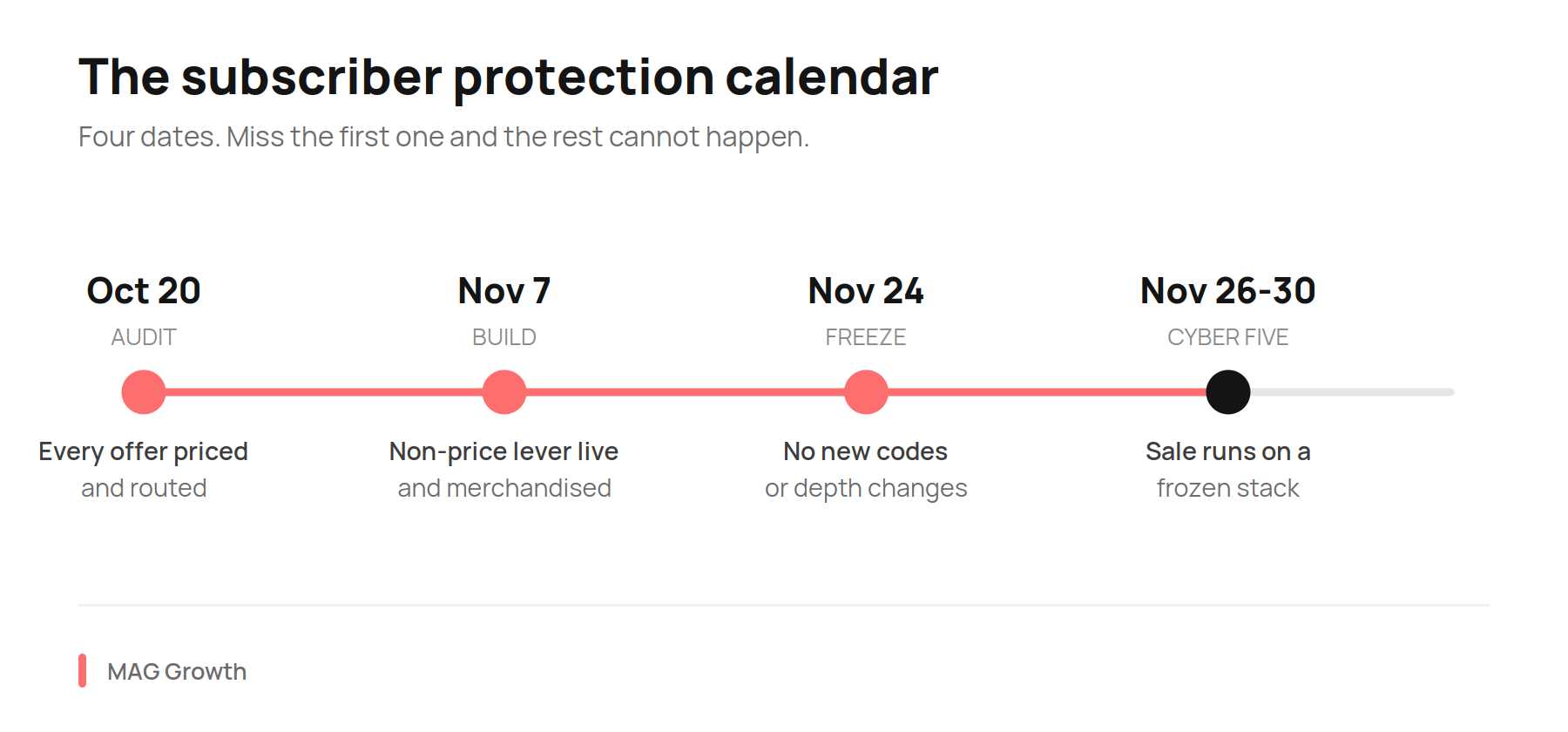
Freeze on November 24, the Tuesday before Thanksgiving. After that date, hold three lines.
- No new discount codes
- No partner or affiliate offers
- No changes to approved depth
Cyber Five 2026 runs November 26 through November 30, so the freeze kills the mid-sale panic discount. It also buys two days to confirm every code, suppression rule, and tracking tag fires correctly.
Work backward from the freeze and the whole plan fits on four dates.
The offer ladder worksheet
Give every offer one row and these six columns.
- Offer name and code
- Audience it sends to
- Effective price per top SKU
- Current subscriber price
- Gap in dollars
- Route, one of protect, compensate, or exclude
A worked row settles it. A sitewide offer at $43 against a $45 subscriber price routes to compensate, while a clearance event at $30 undercuts by a third and routes to exclude.
What goes wrong most often
- Acquisition sets the sitewide number without retention in the room
- Affiliate and influencer codes get audited too late
- Stackable codes combine into a depth nobody approved
- The suppression segment exists but misses one send
- Someone deepens the recurring rate mid-sale to match a competitor
Our retention marketing team builds this ladder with brands every Q4, usually starting in September. The work takes about a week and costs far less than rebuilding a subscriber base in Q1.
What This Looks Like When It Works
How does segmentation change what a peak offer costs you?
A specialty coffee brand came to us blasting one email to everyone while engagement slid month over month. We built 12 Klaviyo flows on RFM segmentation, and revenue climbed 179% in 30 days while the unsubscribe rate dropped 60%.
That unsubscribe number matters most at peak. Fewer, better-routed sends protected the list instead of burning it, which mirrors exactly how you protect a subscriber base during a sale.
Segmentation makes routing possible, which is why full-funnel growth marketing treats list hygiene as a margin lever. You cannot suppress a subscriber from an offer you never segmented for, so the October build has to precede the November send.
We will review your Q4 ladder against your recurring rate and flag what breaks the floor, with no obligation.
How to Tell Whether You Protected Subscribers During BFCM
Read one cohort rather than the blended total. Full-funnel growth marketing only pays off when you can name which side of the funnel actually moved.
Which KPIs show subscriber damage after a peak sale?
Track five numbers, and track them on the pre-peak subscriber cohort only.
- Skip rate
- Pause rate
- Cancel rate
- Subscriber AOV
- Net revenue retention
Blended reporting hides the damage. New peak subscribers lift the average and mask what happened to the base you already owned.
When should you read them?
Pull the numbers 30 and 60 days after Cyber Monday rather than in December, because cancel intent forms during the sale and surfaces at the next charge. Repeat behavior clusters early, and one benchmark set puts half of second purchases inside 30 days.
What tools give you these numbers?
Your subscription platform reports skip, pause, and cancel natively, and Klaviyo handles the cohort view. Klaviyo warns that seasonal cohorts full of gift buyers distort retention charts, so filter to subscribers first.
Advanced Plays for a Mature Subscription Base
These three plays assume your ladder already works. Each one buys retention without touching the recurring rate.
How does a price lock change cancel behavior?
A price lock holds a subscriber’s rate while the subscription stays active, so cancelling forfeits grandfathered pricing permanently. Apply it past six months, where it costs you nothing today.
Should subscribers get early access instead of a deeper discount?
Usually yes. Early access carries real value during a peak where stock sells through, and it expires without you doing anything.
| Non-price lever | Cost to margin | Effect on cancel intent |
|---|---|---|
|
Early access window |
None |
Moderate |
|
Subscriber-only bundle |
Low |
Strong |
|
Bonus item next shipment |
Medium |
Strong |
|
Price lock on tenure |
None today |
Strong and durable |
What happens when Amazon Subscribe and Save undercuts your DTC rate?
You create a price collision your DTC subscriber can see across both storefronts. Treat the DTC rate as the floor and hold Amazon at or above it, because you control that subscriber’s data and margin directly.
Automated repricing breaks this without anyone deciding to, since a repricer chasing a competitor can drop the marketplace price below your owned rate overnight. Set a hard floor inside the tool.
Related Resources for DTC Retention
- The Complete Guide to DTC Retention Marketing in 2026, the framework this sits inside
- 12 Subscription Churn Signals and What to Send Each One, for subscribers already wobbling
- Loyalty Program vs Subscription Program, if you are choosing a program
- How We Boosted Repeat Revenue 179% With Flows, the flow work behind the plan
- How to Plan BFCM Email Sends Across Amazon and Shopify, the send plan suppression runs inside
How to Protect Subscribers During BFCM FAQs
Should subscribers get a BFCM discount at all?
Give them access and recognition instead of a deeper recurring rate. Full-funnel growth marketing calls that a compensate route, and a subscriber-only bundle or an early window does the job without repricing your base.
How deep can a public sale go before subscribers cancel?
Track the dollar gap on your top SKU rather than the percentage. Once the public price beats the subscriber price by more than 10% of item value, route that offer to exclude.
Is it better to pause a subscription than to cancel it?
Pausing wins by a wide margin. A paused subscriber keeps their payment method, history, and rate, so reactivation takes one click instead of a full reacquisition.
Do I need to exclude subscribers from my BFCM email sends?
Exclude them only from sends carrying an offer that breaks your floor. Build one suppression segment in October and apply it to every send on that route.
What non-price rewards actually keep subscribers from cancelling?
Early access, subscriber-only bundles, a bonus item in the next shipment, and a tenure price lock all work. Each one ends or accrues on its own schedule, so none reset your rate.
When should the Q4 offer stack be locked?
Audit by October 20 and freeze by November 24. Cyber Week 2025 drove $44.2 billion in US online spend, so nobody has room to edit offers mid-window.
How do I handle someone who subscribes to send a gift?
Tag the order as a gift at checkout and keep it out of replenishment logic, because gift subscribers buy on a calendar rather than a usage cycle. Send them a separate flow pitching the product for themselves instead of reminding them to reorder for someone else.
How long after BFCM does subscriber churn show up?
Most of it lands 30 to 60 days later, when December statements arrive and the renewal charge gets a second look. Volume stays inflated meanwhile, with November running roughly 64% above the annual average, which masks the damage until January.
Protect Your Base
Everything in how to protect subscribers during BFCM reduces to one sheet and three routes. We will review your Q4 offer ladder against your recurring rate and flag which offers break your subscriber floor, before you lock it.
Key takeaways
- The subscriber rate is permanent, the sale is not
- Route every offer to protect, compensate, or exclude
- Close perception gaps with levers that expire
- Freeze the stack on November 24
Next steps for ecommerce directors. Pull every planned Q4 offer into one sheet this week and price each one across your top three SKUs. Then get it signed off by whoever owns acquisition, because full-funnel growth marketing only works when one person reads both numbers.
Our retention marketing team builds and holds this ladder for brands every Q4. Bring us the sheet and we will tell you what breaks.