

Executive Summary
The AI shopper conversion rate trends 2026 story has two sides, but one holds up: AI traffic converts better.
Almost nobody covered the second half. Your site decides everything the moment an assistant hands the shopper over.
Across $1.2B+ in ecommerce revenue and 400+ brands, MAG Growth watches one pattern repeat. Winners skipped the clever visibility plays and rebuilt the page the assistant points at.
Key findings
- AI-referred traffic outconverted non-AI traffic by 42% in March 2026, erasing a 38% deficit from twelve months earlier, per Adobe Analytics data spanning more than one trillion U.S. retail visits.
- Product detail pages earned just 66% on Adobe’s machine readability benchmark, trailing homepages at 75% and returns pages at 82%.
- Walmart measured in-chat purchases converting at roughly a third of its click-out rate, which Search Engine Land reported alongside OpenAI retiring Instant Checkout.
- Shopify pushed eligible U.S. stores into AI channels by default in March 2026 and sent the purchase back to the merchant’s storefront, keeping merchants as merchant of record.
- Machines generated 53% of all web traffic during 2025 according to the Thales and Imperva Bad Bot Report, so bots now dominate the denominator beneath your conversion rate.
- AI shoppers stayed 48% longer and viewed 13% more pages in March 2026, widening to 53% and 23% by May, as Digital Commerce 360 reported.
- Contentsquare still measured AI referrals at roughly 0.2% of total sessions in Q4 2025, so growth outruns volume by a wide margin.
- Trust moved first. Adobe’s survey found 66% of respondents trust AI answers as accurate, and 85% of AI shoppers rated the experience an improvement.
Who this report serves
We wrote this for the ecommerce director at a $5M to $20M brand defending a conversion chart to leadership, and for the $1M to $10M founder asking whether their numbers look normal. Every tactic assumes a Shopify store, a lean team, and a budget that forces each fix to justify itself.
Methodology note
We sourced third-party figures from Adobe Analytics, Contentsquare, Similarweb, Shopify, Thales and Imperva, plus trade press covering Walmart and OpenAI, and we linked each one at the claim. Practitioner observations come from MAG Growth’s work with 400+ DTC brand partners across supplements, apparel, home, beauty, and food and beverage through July 2026.
We label vendor-stated numbers as vendor-stated. Adobe and Shopify both profit from AI commerce adoption, so read their figures with that context attached.
Every finding below points at a page you own, and a free ecommerce audit tells you which one leaks the most revenue.

Finding 1. AI shopper conversion rate trends 2026 flipped your worst channel into your best
No channel moved this fast in the last decade. AI referrals trailed everything else by 38% in March 2025, then beat the field by 42% a year later, an eighty-point swing Adobe logged as a record.
Revenue tracked the same curve at 37% more per visit, with TechCrunch covering the same dataset showing 393% year-over-year traffic growth in Q1.
Does AI traffic drive higher conversions than Google?
Yes, and the mechanism stays simple. Assistants absorb the research phase, so your click arrives as the end of a decision rather than the start of one.
Picture a fast sales rep who already answered the comparison questions and named your product. Search visitors need convincing, and AI visitors need confirming.
What DTC brands should do about it?
Test the claim against your own store before trusting anyone’s benchmark. AI sessions converting below your site average signal a page failure, because the channel hands better visitors to everyone.
Read 42% as the distance between what this traffic can do and what your page does with it. Across our portfolio, brands earning the biggest premium answer comparison questions in on-page text rather than burying them in a reviews widget.
Finding 2. The volume stays tiny, which is precisely why you should fix it now
Conversion headlines skip the denominator. AI referrals still made up roughly 0.2% of total sessions in Q4 2025 across Contentsquare’s benchmark of 99 billion sessions, so a store running 100,000 monthly sessions collects about 200 AI visits.
Your dashboard showing almost nothing is behaving correctly.
What share of ecommerce traffic comes from AI?
Low single digits at the top end, and a fraction of a percent for plenty of DTC stores. Enormous growth on a tiny base lets every report stay accurate while leaving readers with the wrong impression.
Meanwhile, the surrounding channels move against you. Contentsquare recorded organic search falling 9% and dropping below a quarter of total traffic share for the first time, while paid visit costs climbed roughly 30% across three years.
That combination makes the argument. AI has not replaced your organic traffic, but your organic traffic keeps shrinking while your paid traffic keeps getting pricier.
Why act before the volume arrives?
We don’t advise shifting budget from proven channels to AI visibility this year because current volumes don’t justify it. Anyone saying otherwise is probably selling you something.
We do advise fixing the pages, since those fixes raise conversion across every channel at once. Treat the AI upside as a free option on work that already pays for itself.
Finding 3. Product pages break the AI funnel at its weakest point
Adobe scored U.S. retail pages with its AI Content Visibility Checker, which measures how much of a page a language model can actually read. Product detail pages finished last at 66%, and they sit closest to the money.
| Page type | Machine readability | What it signals |
|---|---|---|
|
Returns and exchanges |
82% |
Plain policy text reads cleanly |
|
Contact us |
81% |
Simple pages score well by default |
|
FAQ |
80% |
Question format extracts easily |
|
Homepage |
75% |
A quarter stays invisible |
|
Category pages |
74% |
Grids and filters bury context |
|
Product detail pages |
66% |
The page nearest the sale reads worst |
All figures come from Adobe’s April 2026 AI visibility benchmark.
The spread matters more than the average. Adobe’s strongest retail homepages scored 82.5%, versus 54.2% for the weakest, a gap large enough to influence recommendations.
How to optimize product pages for AI shoppers?
Treat every image as invisible. Any claim living inside an infographic needs a text version on the same page.
Work the list in this order, since each step removes a different blind spot.
- Lift specs out of images into body text
- Spell out ingredients, materials, and origin
- State sizing, fit, and compatibility explicitly
- Name the use case the buyer typed
- Render reviews in HTML rather than scripts
- Show returns and shipping terms on the PDP
- Complete every Product schema field
- Sync catalog attributes so agents read current data
Nothing there qualifies as exotic, and the same work helps a human skimming on a phone. Most brands answer AI by chasing visibility, while Adobe’s data argues the reverse, because visibility without a readable product page wins the consideration set and loses the sale.
We rebuilt exactly this kind of page for a health and wellness client and lifted landing page conversion 67%, documented in the case study.
Finding 4. In-chat checkout collapsed, and your own checkout won
Through 2025 the industry agreed checkout was migrating into the chat window, and conversion data killed that consensus. Walmart loaded roughly 200,000 products into OpenAI’s Instant Checkout from November 2025, then reported in-chat purchases converting at about a third of its click-out rate by March 2026, as MarTech covered.
Has ChatGPT removed Instant Checkout?
Yes. ChatGPT ended it in March 2026, moving transactions back to merchant-controlled surfaces. Fewer than 30 Shopify merchants went live, despite 1M+ being promised.
Shopify arrived at the same destination from the opposite direction. Its Agentic Storefronts rollout let shoppers discover products inside ChatGPT and finish the purchase on the merchant’s store through an in-app browser, with the merchant staying merchant of record.
That settles the agentic checkout vs on-site checkout question for now.
| Factor | Checkout inside the chat | Checkout on your store |
|---|---|---|
|
Measured conversion |
About a third of click-out rate at Walmart |
The reference rate |
|
Trust signals |
Almost none |
Reviews, guarantees, policies, brand |
|
Customer data |
Limited |
Full, as merchant of record |
|
Offer control |
None |
Bundles, subscriptions, post-purchase offers |
Should DTC brands enable agentic storefronts?
Shopify already answered it for most merchants by switching eligible U.S. stores on by default. Your real decision is whether your catalog data earns the recommendation once agents can see you.
Keep the channel on and treat it as unusually high-intent traffic. Shopify’s documentation on how agentic commerce works explains the mechanics, and none of it removes your job of converting the visit.
The frightening version of agentic commerce, where assistants own the transaction and you fulfill orders, did not arrive. Discovery moved and conversion stayed, which hands you a bill alongside the win.
Checkout hides the most recoverable revenue in almost every first audit we run, and surprise shipping costs, forced account creation, and missing payment methods cause it far more often than design does. We sequence that work in our breakdown of product page versus checkout CRO.
Finding 5. Machines outnumber humans in your traffic, so your conversion chart lies
Automated traffic reached 53% of all web activity during 2025 per the 2026 Thales and Imperva Bad Bot Report, pushing humans down to 47%. Bots enter the denominator of your conversion rate and never the numerator, which produces two very different stories on identical charts.
Either your site got worse, or your traffic got less human. Each demands the opposite response.
Is AI bot traffic inflating my session counts?
Almost certainly, and it distorts in one direction rather than randomly. Crawlers, agentic browsers, and headless sessions raise session counts while dragging every rate metric down, so check for the signature before accepting a decline.
- Zero engagement time on the session
- Single page visits labeled direct
- Heavy clustering on one browser version
- Data center or cloud provider networks
- Traffic spikes without revenue movement
A large and growing segment like that means your conversion rate fell less than your dashboard claims. Cut budget off that chart and you cut for the wrong reason.
How to track AI referral traffic in GA4?
Build an AI assistant channel group before anything else, so referrals from ChatGPT, Perplexity, Copilot, Gemini, and Claude stop dissolving into direct. Then run these three steps in sequence.
- Group AI referrer domains into one channel
- Filter obvious non-human sessions from reporting views
- Benchmark AI conversion against site average monthly
Add a self-reported attribution question at checkout, since it catches dark traffic no referrer header will surface.
What is the best way to track ChatGPT referral traffic?
Isolate it from the other assistants, because ChatGPT still sends the large majority of trackable referrals. Its share of overall AI web traffic keeps slipping as Gemini and Claude grow, tracked in Similarweb’s generative AI data, though referral volume stays concentrated.
Watch your homepage as well as your PDPs, because a large share of ChatGPT referrals land there. That page converts more of this traffic than most teams assume.
Referral data also undercounts the channel badly, because shoppers who read a recommendation and search your brand two days later register as branded search. Similarweb’s panel research found recommended brands drew meaningfully more visits that same week through exactly that path.
Finding 6. AI shoppers arrive holding a promise, and your page has to keep it
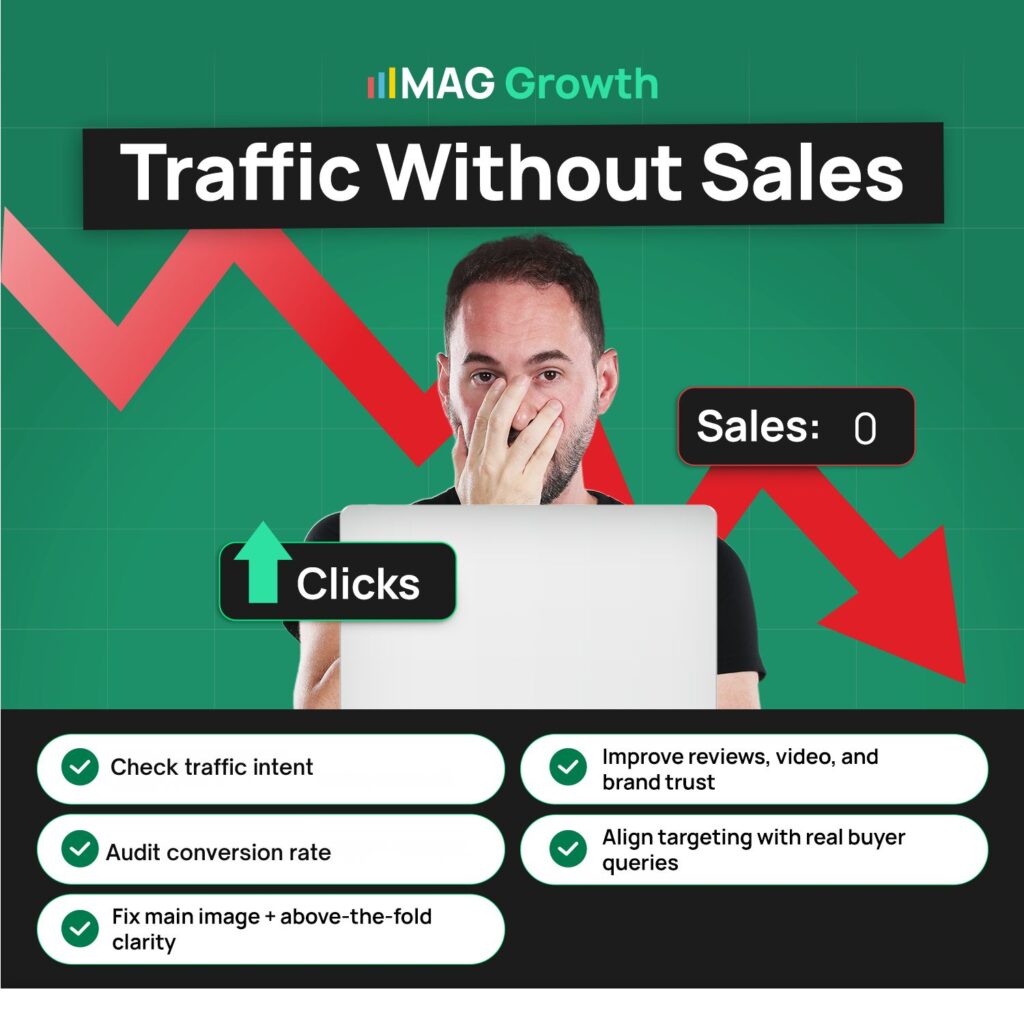
CRO practice changes here. AI visitors stay longer and browse deeper, which reads as engagement until you watch what they actually do.
They verify. An assistant told them your formula gets third-party tested or your subscription pauses on demand, and they came to check.
How do AI shoppers behave on a product page?
They hunt instead of browsing. The visit runs as a short verification checklist, and your page either satisfies it fast or loses the order.
Contentsquare measured more than half of AI-referred traffic bouncing, which sits oddly beside the conversion premium until the behavior explains both. Shoppers sent to confirm one fact leave instantly when the page hides it, and they buy at unusual rates when the page shows it.
Sessions climbing while orders stay flat is the signature of a page that lost the verification, not a page that failed to persuade.
What to change on the page?
Lead with the claim rather than the mood, moving the attribute that earned the recommendation into text near the top instead of the fourth accordion panel. Then strip the work out between arrival and confirmation.
- Place the differentiating spec above the fold
- Answer the top three comparison questions in text
- Show the guarantee before the add-to-cart
- Keep shipping cost and delivery timing visible
- Kill interstitials that block verification
Bounce here rarely means you failed to persuade, and usually means your page buried what the assistant promised. That content gap closes quickly.
We now claim-match on every CRO audit, asking assistants what they say about a brand and comparing it against the page they link to. The gap looks identical almost every time, with the assistant leading on a functional benefit and the page leading on brand story.
Finding 7. The channel math shifted, so re-weight paid media around it
Every finding above points at one question, which is where your next dollar goes. A free channel converting above average at triple-digit growth reshapes a media plan without replacing paid media.
It changes what paid media buys. Prospecting budget now competes with an organic source delivering better-qualified visitors than most cold audiences.
How should AI traffic change my paid media plan?
Judge blended efficiency instead of isolated channel ROAS. AI revenue logged as direct quietly credits your paid channels for sales they never earned, so MER tells a truer story.
Then rebalance deliberately, because Meta and TikTok still manufacture demand no assistant creates, Google still captures intent at scale, and programmatic still holds attention through consideration. Retargeting absorbs the change, since pre-decided visitors need no re-persuading and that budget performs better in prospecting or the page work from Finding 3.
MAG Growth runs full-funnel growth marketing across Meta ads, Google ads, social ads, and programmatic, with CRO underneath all of it. A conversion problem disguised as a media problem eats any budget you hand it.
Case study. How page work cut CAC 42% for a health and wellness brand
Rising CPMs and falling ROAS had pushed this brand’s Meta campaigns underwater. Most teams answer that with new creative or a new agency, and both treat the symptom.
We rebuilt the creative testing framework, launched a dedicated landing page for each ad angle, and added post-purchase upsell flows. The page work carried the result rather than the media work.
- Customer acquisition cost fell 42%
- ROAS climbed from 1.8x to 3.4x
- Landing page conversion rose 67%
- Post-purchase upsells added 18% to AOV
Read the numbers in full in the health and wellness paid media and CRO case study.
Nothing in that engagement targeted AI traffic, and that is why it belongs in this report. Matching each landing page to the specific promise that brought the visitor there is the same discipline an AI-referred shopper demands, and it pays on paid traffic today while the AI channel grows into it.
We separate your AI sessions, score your product pages for machine readability, and rank the three fixes worth the most revenue.
What's Changing in 2026
Four shifts are running now, and each demands a different response.
Discovery moved while conversion stayed. Brands kept the transaction and the customer relationship, so treat your store as the conversion surface it remains. Our complete guide to Shopify conversion rate optimization still covers that foundation.
Machine readability turned into a conversion input. A third reader now decides whether you enter the consideration set, so audit what your PDP states in text.
The measurement layer got noisy. Unfiltered analytics understate performance when machines generate most web activity, so clean your denominator before any budget decision. Our post on why Shopify conversion rates look so low rules out the non-AI causes first.
Trust outran the tooling. Adobe put consumer trust in AI accuracy at 66%, which explains why discovery scaled while checkout stalled. Assume shoppers believe the assistant more than your copy, then confirm its claim rather than making a new one.
What Top Performers Do Differently
Our top-quartile partners copy nothing a small team cannot copy. They repeat four unglamorous habits.
- They write product pages in text first and add imagery second
- They separate AI traffic in analytics and review it monthly
- They claim-match assistant answers against the linked page
- They remove checkout friction before raising media spend
Average performers invert all four, building image-led pages, burying AI traffic inside direct, optimizing against internal opinion, and scaling spend into a leaking funnel. Sequencing separates the groups more than sophistication does, because top performers fix the page, then measure, then buy traffic.
Start this week with five moves you can finish in an afternoon.
- Rewrite one PDP in plain text
- Build an AI channel group in GA4
- Claim-match three best-selling products
- Delete one required checkout field
- Compare AI conversion against site average
Predictions for 2027
These calls belong to MAG Growth rather than the industry, and we will score ourselves publicly next year.
Machine readability joins standard CRO reporting. Readability scores will sit beside bounce rate within twelve months, because both now predict the same outcome.
In-chat checkout returns in a narrower shape. Protocol work continued after Instant Checkout died, and low-consideration repeat purchases offer the obvious wedge.
Attribution degrades before it improves. More assistants and agentic browsers push self-reported attribution from optional to primary, so brands adding it in 2026 gain a year of clean baseline data.
We pressure-tested these calls with Trevor Sumner, and the segment starting at 18:20 on unprompted AI shopping is where our thinking on the next twelve months came from.
Retargeting budgets shrink at AI-heavy brands. Pre-decided visitors make re-persuasion spend harder to defend, and that money migrates toward prospecting and page work.
Third-party proof outweighs your own copy. Assistants lean on independent sources when forming recommendations, so review platforms, forums, and press coverage will influence recommendations more than your product page does.
Product data becomes the moat. Clean, structured catalog data will separate recommended brands from merely indexed ones, and that boring work will decide category winners.
AI Shopper Conversion Rate Trends 2026 FAQs
Why is AI traffic converting better than search?
The research finished before the click happened. Assistants handle comparison and objections inside the conversation, so your visitor verifies a decision instead of forming one.
What is agentic commerce for DTC brands?
Agents discover and recommend your catalog inside AI assistants while the purchase completes on your store. Shopify enabled this by default for eligible U.S. merchants in March 2026 and left merchants owning the customer and the transaction.
Consideration level changes the payoff. Low-consideration repeat purchases travel well through assistant-led discovery, while high-ticket categories still need your landing page to persuade.
What CRO strategy works for AI referral traffic?
Confirm rather than convince. Surface the recommended attribute above the fold, prove it with visible third-party evidence, then remove every step between that proof and the buy button.
Do I need a separate landing page for AI traffic?
No, and building one usually backfires. The fixes that help an AI visitor confirm a claim also help a mobile shopper skimming for nine seconds, so improve the live page instead of maintaining a duplicate.
How do I know if bots skew my conversion rate?
Segment sessions with zero engagement time, single page views, and a direct source, then compare that segment’s growth against revenue. A rising machine share drags your rate down without anything breaking on your site.
Should I block AI crawlers?
Most DTC brands should not. Blocking removes you from the consideration set of your best-converting channel, and that trade rarely pays outside specific content licensing concerns.
When should I hire a CRO consultant for Shopify?
Hire when traffic climbs and orders stay flat for two consecutive months. That pattern points at the page rather than the media.
Where do I start with one hour?
Rewrite your best-selling product page so every buying argument appears in readable text. That hour improves machine readability and human conversion simultaneously.
What AI shopper conversion rate trends 2026 mean for your next quarter
The headline is not that AI traffic converts better. The industry spent a year optimizing to get recommended and almost no time on the ten seconds after the click.
That neglect creates your opening. Product pages stuck at 66% readability, checkout friction taxing high-intent traffic, and machine-polluted conversion charts all yield to work your team can finish this quarter.
Our DTC CRO agency and Shopify conversion rate optimization services find the leak, prove it with data, then close it.