

Why This DTC Conversion Rate Optimization Glossary Exists
Other glossaries define a term and stop. You still cannot tell whether your 1.8% conversion rate means you are winning or bleeding.
We attached a benchmark to every term that has one. MAG Growth handles $1.2B+ in managed revenue for 400+ brands, so these numbers come from live accounts and primary research.
What terms are in this DTC conversion rate optimization glossary?
Thirty-nine terms sit in six clusters, ordered the way money leaves your funnel.
- Core funnel metrics – nine terms, conversion rate, session vs visitor, add to cart rate, checkout completion rate, cart abandonment rate, average order value, mobile vs desktop gap, cart abandonment rate calculator, Shopify conversion rate calculator
- Cart and checkout friction – seven terms, guest checkout, forced account creation, form field count, accelerated wallets, Shop Pay, unexpected costs, payment decline handling
- Research and experimentation – eight terms, statistical significance, statistical power, minimum detectable effect, sample ratio mismatch, peeking, heatmap, session recording, rage click
- Speed and technical diagnostics – seven terms, page load time, LCP, INP, CLS, ghost checkout, third-party app bloat, ghost code
- AOV and upsell mechanics – three terms, post-purchase upsell, product bundle, free shipping threshold bar
- Consumer protection and deceptive patterns – five terms, dark pattern, confirm shaming, basket sneaking, drip pricing, negative option rule
We pull your funnel numbers and show you where the revenue escapes.

Core Funnel Metrics
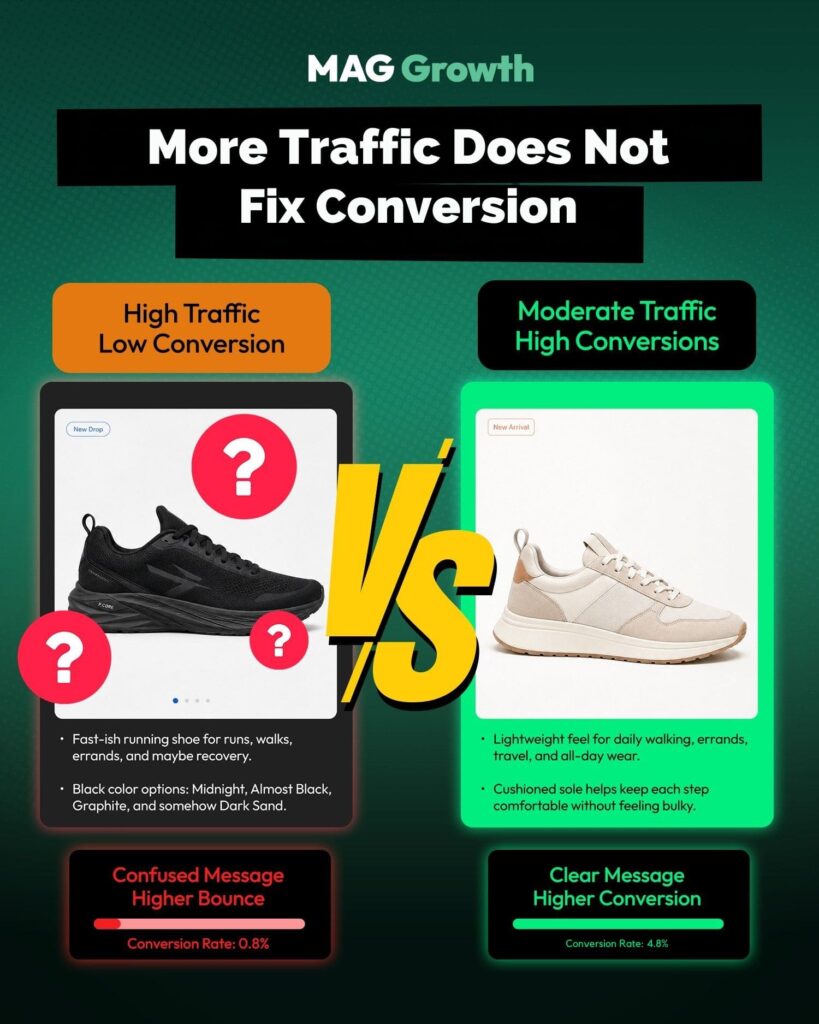
What is a strong ecommerce conversion rate?
Conversion rate divides orders by sessions in the same window and shows the result as a percentage.- Tells you whether your traffic and your store actually fit each other
- Shopify average is at 1.4%, top 20% above 3.2%, top 10% above 4.7%
- Benchmark against the top 20%, because the average includes dormant stores
- At 30,000 sessions, moving 1.4% to 1.8% adds 120 orders monthly
Why is my Shopify conversion rate different from GA4?
A session counts one browsing period and a visitor counts one person, and no two platforms measure either identically.
- Ad blockers, privacy browsers, and cross-domain checkout strip GA4 events
- Expect a gap of 15% to 30%, not five percent
- Pick one platform as your operating number and never mix denominators
What is a good add to cart rate on Shopify?
Add to cart rate measures the share of sessions where someone puts an item in the cart.
- 4.6% is the Shopify average
- Under 3% points at the product page, not the checkout
- Always read it beside checkout completion, never alone
What is a healthy Shopify checkout conversion rate benchmark?
Checkout completion rate divides orders by checkouts started.
- Shopify average at 45%, top 20% above 59%
- Mobile runs near 44% against 49% on desktop
- Below 40% signals a checkout problem you can usually fix in a fortnight
What is the average cart abandonment rate in ecommerce?
Cart abandonment rate measures the share of created carts that never convert.
- Baymard documents a 70.22% average across 50 studies
- Roughly 42% of abandoners were only browsing, so ignore that share
- Fixable causes rank as extra costs 40%, slow delivery 20%, payment distrust 19%, forced accounts 18%
How do you calculate average order value?
Average order value, or AOV, divides total revenue by total orders across the same date range.
- Worked example, $42,500 in revenue across 500 orders gives an $85 AOV
- Exclude shipping, taxes, and refunds so the figure stays comparable month to month
- $85 Shopify average, top 20% above $192
- Sets the ceiling on what you can pay to acquire a customer
- Moves faster than conversion rate because it needs no extra traffic
Why does mobile convert worse than desktop?
Mobile converts worse because the same checkout demands more effort on a phone, and the gap measures that difference between device classes.
- Smaller tap targets and one-handed card entry turn an identical form into more work
- Layout shift causes mis-taps that a mouse would never make
- Slower connections make every speed problem worse on the same page
- Littledata records 1.2% mobile against 1.9% desktop
- Close the gap to under 30%, since a mobile-only fix beats a sitewide one when mobile carries most sessions
How do you use a cart abandonment rate calculator or a Shopify conversion rate calculator?
A cart abandonment rate calculator divides orders by carts created and subtracts from one, while a Shopify conversion rate calculator divides orders by sessions.
- Pull both inputs from the same platform or the output means nothing
- Calculate conversion per device before you calculate it sitewide
- At 1,200 carts monthly, each recovered point equals 12 orders
Shopify Funnel Benchmarks at a Glance
| Metric | Shopify benchmark | What a miss tells you |
|---|---|---|
|
Conversion rate |
1.4% average, 3.2% top 20% |
Traffic and offer are mismatched |
|
Add to cart rate |
4.6% average |
The product page failed to convince |
|
Checkout completion |
45% average, 59% top 20% |
The payment flow creates friction |
Cart and Checkout Friction
Your largest recoverable leak sits here. Baymard estimates better checkout design alone could lift conversion 35.26% for the average large retailer, worth roughly $260 billion across the US and EU.
What is guest checkout and should you default to it?
Guest checkout lets someone buy without creating an account.
- Removes the last non-essential decision before payment
- Default to it instead of hiding it under a login form
- Invite account creation on the confirmation page, where refusing costs nothing
How much does forced account creation cost you?
Forced account creation blocks purchase until the shopper registers.
- Baymard found 18% of fixable abandonment came from demanded accounts
- Trades your primary revenue function for an unengaged email list
- Ban it outright rather than testing around it
What is the optimal number of checkout form fields?
The form field count totals the inputs someone must complete to order.
- Baymard measures 23.48 form elements in the average US checkout against an ideal 12 to 14, or 7 to 8 actual fields
- Most checkouts shed 20% to 60% of elements without losing anything
- Delete company name, second address line, and phone for any brand not shipping freight
Do accelerated wallets and Shop Pay improve conversion?
Accelerated wallets are one-tap payment methods carrying stored details, and Shop Pay is Shopify’s own version.
- Collapse a two-minute form into a thumbprint
- Place them above the card form, never below it
- Shopify claims a four times faster checkout for Shop Pay, which is a vendor number to verify against your own baseline
Why do unexpected costs kill more sales than price?
Unexpected costs are shipping, taxes, and fees that surface only at the final step.
- Baymard ranks this the largest fixable abandonment cause at 40%
- Another 12% left because they could not calculate the total up front
- Show the shipping rule on the product page, not the cart
How should you handle declined payments?
Payment decline handling covers what your store does when a card fails.
- 10% abandoned on a declined card and 9% on missing payment methods
- Write a message naming a next step instead of an error code
- Offer a second payment method on the same screen
Your benchmarks flagged a problem, and we tell you exactly which one.
Research and Experimentation
Read this before buying a testing tool. Most brands under $5M cannot run valid tests, and this vocabulary helps you spot someone selling you one anyway.
What does statistical significance actually mean?
Statistical significance estimates the probability your observed difference is not noise.
- Convention sits at 95%, accepting one false winner in twenty
- Its partner is statistical power, usually set at 80%, so you miss one real winner in five
- Says nothing about whether shipping the change is worth the hours
- A real 0.4% lift can still fail a cost-benefit test
How much traffic do you need for A/B testing?
Minimum detectable effect, or MDE, is the smallest lift your test can reliably catch.
- Set it before launch, because it decides whether the test finishes this quarter or this decade
- Figures below assume a 2% baseline, 80% power, and 95% confidence
- Under 50,000 monthly sessions, fix known friction and measure before and after instead
- Any agency selling a button test at that traffic is selling a twenty-one month experiment
What is sample ratio mismatch in A/B testing?
Sample ratio mismatch, or SRM, happens when your actual traffic split drifts from the configured split.
- A 50/50 test delivering 57/43 proves the assignment mechanism broke
- Bot traffic, failing scripts, and broken redirects all corrupt the sample
- Check the split before you look at the result, every time
Why is peeking at test results a problem?
Peeking means checking results early and stopping the moment they look good.
- Every extra look raises your odds of calling a random high point a win
- A win rate above 30% means someone is peeking or not measuring
- Hide the significance column during the run
What do heatmaps, session recordings, and rage clicks show you?
Heatmaps aggregate clicks and scrolls across many visits, session recordings replay one visit, and a rage click is repeated frantic clicking on one element.
- The best heatmap finding is a click on something that is not a link
- Rage clicks are your fastest bug detector
- Filter recordings to rage clicks and you find ghost checkouts in an afternoon
Speed and Technical Diagnostics
Most glossaries skip technical failures. These show up in your revenue before they show up in any report.
Watch the diagnosis run in real time, then read the terms behind it.
- 00:00 - Common Mistakes on DTC Websites
- 00:22 - Site Load Time Kills Conversions
- 01:00 - Using PageSpeed Insights for Diagnosis
- 01:45 - Mobile Experience Still Ignored
- 02:40 - Simple UX Fixes for Mobile Users
- 03:18 - A/B Testing Done Right
- 04:00 - Tools for Testing Landing Pages
- 05:00 - How to Use @PickFu and Page Variants
- 05:50 - Why You Must Set Up Retargeting
- 06:21 - Tracking Visitors and Ad Remarketing
How much does Shopify site speed impact conversion?
Page load time measures how long your store takes to become usable.
- Deloitte and Google studied 37 brands and found 0.1 seconds of mobile speed lifted retail conversions 8.4% and order value 9.2%
- Product page to add to basket progression rose 9.1% on the same tenth of a second
- Measure your product page, not your homepage, since paid traffic lands there
What are LCP, INP, and CLS?
These are Google’s three Core Web Vitals, standing for Largest Contentful Paint, Interaction to Next Paint, and Cumulative Layout Shift.
- Google’s good thresholds are 2.5 seconds, 200 milliseconds, and 0.1, each at the 75th percentile
- Passing two of three counts as failing
- CLS costs orders directly, since a shifting button produces a mis-tap
What is a ghost checkout on Shopify?
A ghost checkout is a purchase attempt that fails silently when something breaks in the background.
- The shopper taps pay, nothing happens, and analytics logs ordinary abandonment
- Conflicting apps and timed-out payment calls cause most of them
- Hunt them with recordings filtered to rage clicks on the payment button
How do third-party apps slow down a Shopify store?
Third-party app bloat is the cumulative cost of every app injecting scripts into your pages.
- Each install adds requests the browser runs before anyone sees anything
- The install takes one click and the cost arrives daily afterwards
- Audit quarterly and measure each app’s millisecond cost rather than guessing
What is ghost code on a Shopify theme?
Ghost code is script left in your theme after you uninstall an app.
- Older apps wrote into theme files, so removal leaves the code behind
- The browser keeps chasing files that no longer exist
- Failed requests pile up on the slow mobile connections you can least afford
- Duplicate your theme, search it for each uninstalled app’s name, delete the leftover tags, then publish
AOV and Upsell Mechanics
Conversion rate is the slowest of three revenue levers. This cluster covers the second, which usually pays first.
How do post-purchase upsells work?
A post-purchase upsell appears immediately after the order and needs one tap with no re-entered payment details.
- Cannot damage the original sale, because the sale already cleared
- Offer one item, not a catalogue, under half the original order value
- Added 18% to average order value for the wellness brand below
How to increase average order value on Shopify with bundles?
A product bundle groups complementary items into one purchase at a modest discount.
- Raises order value while removing the work of assembling a set
- Build bundles from your own order data, not intuition
- The items customers already buy together are the bundle
Does a free shipping progress bar increase order value?
A free shipping threshold bar shows in real time how much more someone must add to qualify.
- Turns a static policy into a live goal
- A homepage banner gets forgotten before the cart, a live bar does not
- Set the threshold roughly 25% above your current AOV
How One Wellness Brand Cut CAC by 42%
Rising CPMs had turned this supplement brand’s Meta campaigns unprofitable, and the team blamed the ad account. They had already raised budgets, rotated creative, and tested new audiences with no lasting effect.
Our audit found the leak between the click and the cart. One generic page served every ad angle, so a visitor clicking a sleep ad landed on a general wellness page and the thread snapped.
Session recordings surfaced three failures. Mobile shipping displays confused buyers, ingredient documentation sat buried at the page bottom, and the quality validation premium wellness buyers expect was missing.
ROAS sat at 1.8x with conversion below the 2.02% health and wellness category average. Order value was flat and acquisition cost climbed every month.
We ran three sequenced phases across 90 days. We rebuilt creative testing around distinct angles, built a dedicated landing page per angle, then layered post-purchase upsells once conversion stabilised.
One decision mattered most. We refused to scale spend until the pages converted paid traffic profitably, because scaling a broken funnel only buys losses faster.
Landing page conversion rose 67%, acquisition cost fell 42%, ROAS went from 1.8x to 3.4x, and upsells added 18% to order value.
Read the full health and wellness CRO case study for the complete method.
Consumer Protection and Deceptive Patterns
No competing CRO glossary covers this cluster, and several recommend the tactics inside it. These terms mark where persuasion becomes liability.
What are dark patterns in ecommerce?
A dark pattern is an interface built to steer someone toward a choice they would otherwise refuse.
- The FTC documented their spread across ecommerce and subscription sales
- Amazon settled FTC claims over Prime enrolment for $2.5 billion in September 2025, split between a $1 billion penalty and $1.5 billion in refunds
- A tactic working only because someone misread something is a delayed invoice
What is confirm shaming?
Confirm shaming writes decline copy that makes refusing feel embarrassing.
- “No thanks, I hate saving money” is the standard example
- Captures emails from people who now resent you
- Neutral decline copy holds the opt-in rate and improves the bounce rate
What is basket sneaking?
Basket sneaking adds an item to a cart that the shopper never selected.
- Pre-ticked warranty, insurance, and expedited shipping boxes are the usual form
- Regulators treat consent as given, never assumed
- Start every optional charge unticked, without exception
What is drip pricing in ecommerce?
Drip pricing reveals mandatory costs one at a time so the real total appears only at the end.
- Drives the largest single cause of cart abandonment
- Consumers recognise it instantly after ticketing and travel perfected it
- Show the all-in cost before the add to cart button
What is the negative option rule and is click to cancel still law?
A negative option treats silence as agreement to keep charging someone, which covers most subscriptions and free trials.
- Courts struck down the FTC’s updated click to cancel rule in July 2025 before it took effect
- Enforcement under the Restore Online Shoppers’ Confidence Act continued and produced the Amazon settlement two months later
- Do not read the vacated rule as permission
- Give customers two clicks to cancel with one honest pause offer
How to Prioritise Your CRO Fixes
You now have thirty-two terms and probably five problems. Rank them by the dollar value of the leak, not by how easy each one looks.
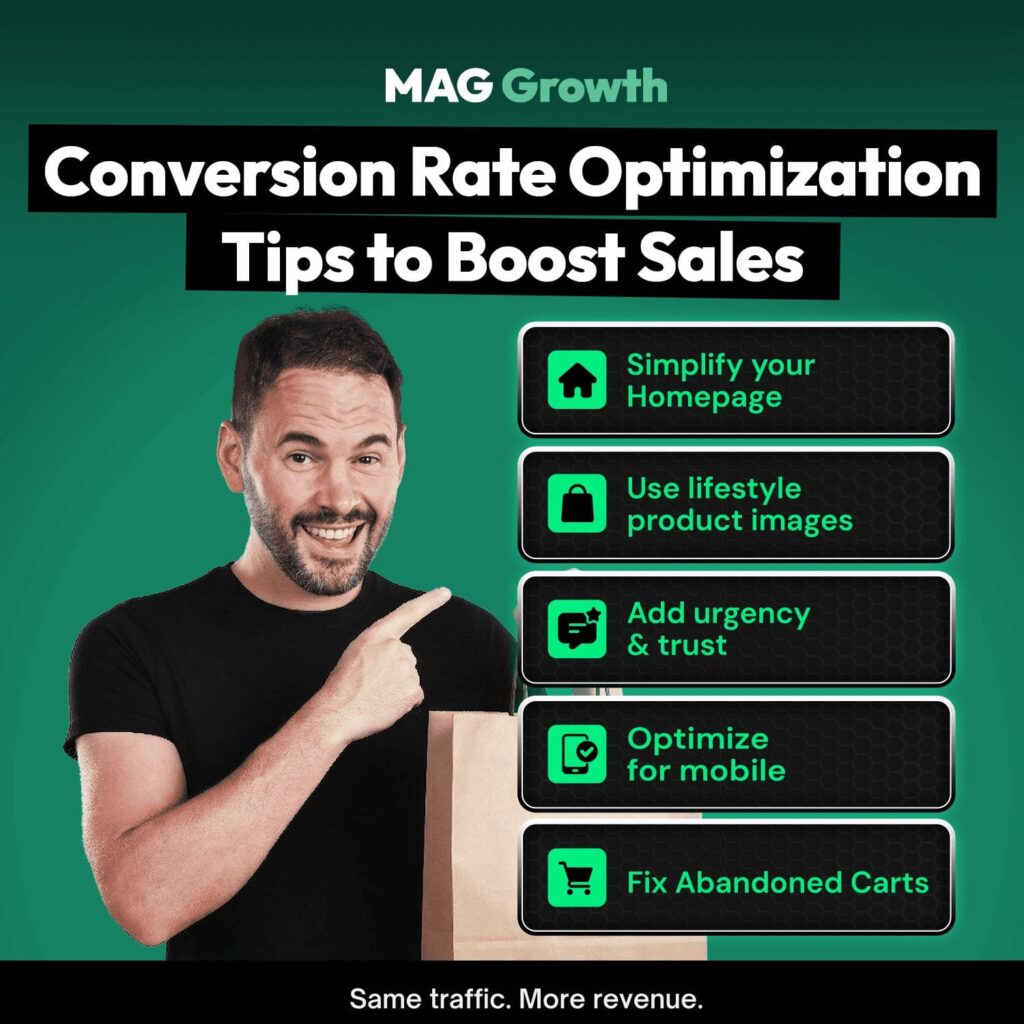
Multiply the traffic reaching a stage by the drop-off there by your order value, and the work order decides itself. Then split the queue, because known defects like ghost checkouts get fixed immediately while only genuine unknowns earn a test.
- Fix defects, do not test them
- Test only where opinions genuinely differ
- Sequence by revenue, not by effort
Related reading, The Complete Guide to Shopify Conversion Rate Optimization, the DTC Email and SMS Glossary, and the DTC Paid Media Glossary.
DTC Conversion Rate Optimization Glossary FAQs
Should I hire a Shopify CRO agency or build the capability in house?
Your traffic and calendar decide this, not your budget. In house buys control and costs the hours you owe product and supply chain, while an agency brings people who already diagnosed your failure elsewhere.
Test it on throughput. Without ten hours weekly for six months, in house produces a half-finished audit and no shipped fixes.
How do you choose a conversion rate optimization agency?
Ask what they measure and what they refuse to do. A partner reporting revenue per visitor who tells you your traffic cannot support testing beats one selling a programme you cannot power.
Ask their win rate too. Above 30% means they call tests early, so ask how they handle peeking before signing.
How much does CRO cost for a Shopify brand?
Scope drives cost, but the better question is what one point returns. At 30,000 sessions and an $85 order value, lifting checkout completion from 45% to 50% returns roughly $6,000 monthly.
Run that math before taking any quote. It turns an expense conversation into a return conversation.
What should a CRO audit checklist for Shopify include?
It covers each funnel stage separately, your form field count, Core Web Vitals on your top templates, Shopify and GA4 tracking accuracy, and every optional charge reviewed for consent risk. It ends with a prioritised sequence.
Order of operations is the output that matters. Twenty findings without sequence is a document, three with sequence is a plan.
What should a free ecommerce conversion audit include?
It should name specific failures in your store rather than restate best practice. Expect your stage-by-stage drop-off, your field count, your failing templates, and your consent gaps.
Ask what the deliverable looks like before booking. A generic report means it is a sales call wearing a different name.
Bring us your numbers from this glossary and we show you the three fixes that move revenue first, with no obligation.