


Post-holiday excess inventory benchmarks matter most before you place your final BFCM purchase order, not after the January count. The overhang you find in January is just the bill for an order you already signed in November.
At MAG Growth, we’ve helped manage $1.4B+ in ecommerce sales for over 430 brands, and the pattern rarely changes. Founders buy deep on every variant, the long tail stalls, and holiday returns land on top of it in January.
This post is part of our Brand Building & Operations series and uses the same full-funnel growth marketing lens we apply to clients. It covers category benchmarks, a three-step overhang formula, and the SKU cuts that keep cash out of the warehouse.
Get a free pre-BFCM inventory and SKU check before your final purchase order goes out.

Post-Holiday Excess Inventory Benchmarks at a Glance
| Category | Holiday return rate | January overhang risk (MAG read) |
|---|---|---|
|
Apparel |
28 to 35% |
High |
|
Beauty |
8 to 11% |
Medium |
|
Supplements |
3 to 6% |
Low to medium |
|
Home goods |
About 20% |
High |
|
Outdoor and cooking equipment |
Not published |
Medium to high |
|
Pet products |
Not published |
Low to medium |
- Apparel restocks 65 to 80% and turns 4 to 7x a year, so cut slow size and color combos
- Beauty restocks 40 to 60% and turns 4 to 9x, so trim the shade and scent tail
- Supplements restock 0 to 10% (food and bev proxy, sealed only) and turn 8 to 12x, so drop bottom-tier flavors
- Home goods turn 3 to 5x with no published restock rate, so pause slow décor before the final PO
- Outdoor and cooking equipment restocks 70 to 85%, so split true stock from preorders
- Pet products turn 8 to 10x with no published restock rate, so rank variants and protect consumables
What January Overhang Looks Like for DTC Brands
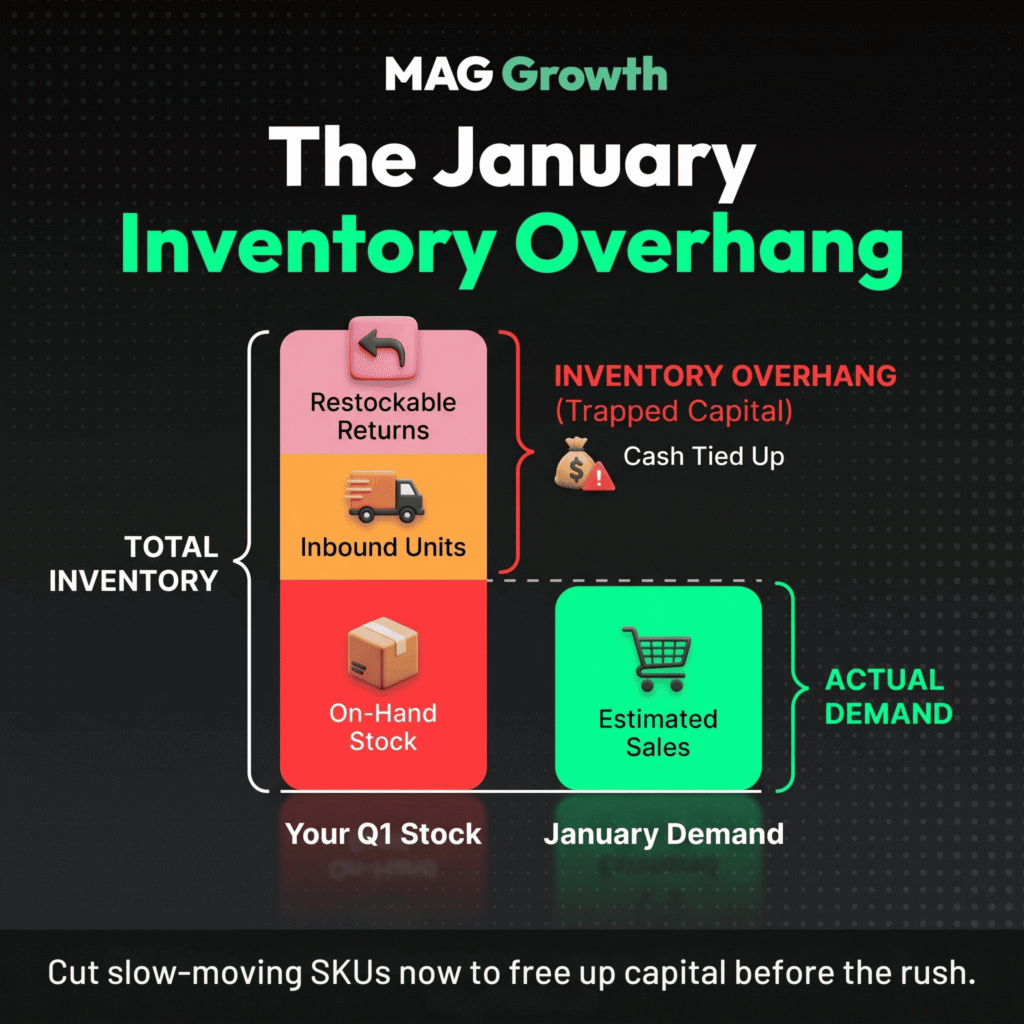
January overhang is the stock you still hold after the holiday rush, plus the returns that come back on top of it. December revenue masks it until returns and slow variants show up in the January count.
This chart shows the formula you’ll run below. Everything above January demand is cash you can’t use until it sells.
How much inventory do DTC brands still have after the holidays?
Most brands end the season holding more stock than planned, usually the wrong stock. U.S. retailers held $1.36 in inventory for every dollar of monthly sales in August 2026, according to the Census Bureau’s latest inventories and sales report.
Small and midsize brands are trending the wrong way. In Netstock’s 2025 planning benchmark, 17% of small and midsize businesses had over a tenth of their inventory unsold for long stretches, up from 12% a year earlier.
Which product categories get stuck with the most excess stock?
Apparel and home goods get stuck most because they turn slowly and return often. Supplements and pet consumables clear faster because customers reorder them.
Variant count makes it worse in every category. Thirty flavors spread one budget across thirty small piles, and the slowest become dead stock by February.
Do holiday returns go back into inventory and count toward overhang?
Some do, adding to your January count without adding January demand. Retailers expected 17% of holiday sales to come back, per the NRF and Happy Returns 2025 returns report.
The rest can’t go back to full-price stock, so they turn into markdowns or write-offs. A pillow insert brand we work with told us opened pillows had to be destroyed when returned, so we wrote exchange-first returns copy that sent shoppers to sizing help and let them keep the original pillow.
That is where returns management in ecommerce meets inventory planning. Our ecommerce returns management strategies cover the policy side, and ecommerce returns optimization starts with knowing your holiday returns restocking rate before January.
What Overhang Costs You Before Spring
Excess stock is cash you can’t spend. Every unit that sits past January bills you for space, capital, and markdowns you haven’t taken yet.
How much cash does excess inventory tie up in Q1?
The cost of holding excess inventory runs roughly 20 to 40% of its value per year, based on 2026 carrying cost benchmarks by vertical. At $200,000 of overhang and a 25% rate, you burn about $4,200 a month before you sell a single unit.
That is the cash tied up in inventory for DTC brands, and it stretches your cash conversion cycle as Q1 ad budgets reset. Three months of that overhang costs about $12,500 before you take a single markdown.
Why does January overhang collide with the Chinese New Year reorder?
Your Chinese New Year reorder needs cash in January, which is the same month overhang locks it up. Lunar New Year falls on February 6, 2027, which is 11 days earlier than in 2026, per Seko Logistics’ planning guide.
Many factories slow down for 4 to 6 weeks around the holiday, according to this 2027 production schedule guide. So the brand stuck with long-tail stock can’t fund its hero SKU reorder, and the hero SKU stocks out in March.
On Amazon, a stockout on a hero SKU also costs you organic rank, which takes weeks and ad dollars to rebuild. That makes the long-tail overhang twice as expensive for brands selling on both channels.
Why does January discounting make overhang worse?
January markdowns stack on top of the discounts you already ran in November. Peak holiday discounts hit 25.1% off list for apparel and 30.9% for electronics in 2025, per Adobe’s holiday season report.
Another 30% off in January trains buyers to wait and crushes contribution margin. We broke down that trap in our peak season cash flow mistakes post, and cutting prices on Shopify can also knock out your Amazon Buy Box.
We'll rank your variants by revenue share and flag what to cut before your final BFCM order.
How to Calculate Your January Overhang Before Your Final BFCM Order
Estimate January overhang in a spreadsheet before you sign the final BFCM purchase order. Use it as your inventory overhang calculator and BFCM inventory planning template, run per SKU.
What is the formula for projected January overhang?
Projected overhang equals on-hand stock plus inbound plus restockable returns, minus forecast sell-through. Anything beyond your target weeks of cover is cash about to be stranded.
| Line item | Example units (one SKU) | Where to pull it |
|---|---|---|
|
On-hand stock |
1,200 |
Shopify or 3PL inventory report |
|
Inbound before Dec 31 |
800 |
Open purchase orders |
|
Restockable holiday returns |
90 |
Return rate times restockable share |
|
Forecast sell-through to Jan 15 |
1,500 |
Last year’s Nov to Jan sales, adjusted |
|
Projected January overhang |
590 |
Compare to your weeks-of-cover target |
|
Cash trapped in overhang |
590 × landed cost |
Landed cost from your COGS sheet |
Step 1. Separate true stock from preorders and backorders
Negative counts and preorders hide inside most inventory reports. For an outdoor cooking equipment brand, a September pull showed three accessory SKUs with negative counts, so we built a dated per-SKU view that split untracked backorders and preorders from real stock.
Step 2. Add the holiday returns you can actually resell
Multiply expected returns by your restockable share, not 100%. Apparel resells most returns, while supplements resell almost none once opened.
Step 3. Compare your weeks of cover to your category benchmark
Divide projected January stock by average weekly sales to get weeks of cover. Supplement brands run about 30 to 46 days of inventory on hand, while home goods brands run 73 to 122, per the same turnover benchmark.
The SKU Cuts That Prevent January Overhang
The cheapest overhang fix happens before the final purchase order. SKU rationalization for DTC brands moves open-to-buy dollars from the long tail into deeper stock on hero SKUs.
How do I rank product variants by revenue share?
Rank every variant by net revenue share, then group them with ABC analysis. Shopify’s guide puts the top 80% of revenue in A grade, the next 15% in B, and the bottom 5% in C, as laid out in its ABC analysis breakdown.
A cat furniture brand we work with asked for this comparison across four core models. From June 1 to August 17, 2026, the top three models drove about 91% of net sales, while Model D drove about 9% on just nine units.
That is how you answer which SKUs to cut before Black Friday. Model D becomes the first candidate to review, while Models A to C get the deeper buy.
How do I adjust SKU cuts for seasonality and new launches?
Pull seasonal and new SKUs out of the ranking before you cut. Shopify warns ABC grades ignore seasonality, so holiday-only SKUs look like dead weight in September.
Compare each seasonal SKU to its own season last year instead. Shopify’s guide says new products need a few months of data before you grade them, so we wait 90 days before judging revenue share by variant.
Should I pause ads on slow-moving SKUs before BFCM?
Yes, pause SKUs that spend without converting and move that budget to proven sellers. For a replacement appliance parts brand, we exported the top 25 Shopify SKUs and excluded products that had spend but no conversions over the prior three months.
That pruning was one part of a full Google Ads rebuild for the account. The rule behind it is simple, which is that ad dollars should follow the SKUs you plan to stock deepest.
Can you still move stuck inventory fast if a channel fails?
Yes, if your owned channels are ready before you need them. When a gourmet snack brand hit an inventory crisis, a last-minute pivot to email and SMS recovered $3,300 in sales within 48 hours and helped earn a Top 30 Best Seller Rank.
How does cutting variants fund deeper stock on proven winners?
Every dollar not spent on a slow variant buys weeks of cover on a hero SKU. Fewer SKUs also mean simpler forecasts and fewer stockouts.
Cutting variants also cleans up the customer journey on the product page. Fewer options speed up buying, and a tighter catalog reads better to AI shopping tools, as our guide to structuring Shopify product pages for AI agents shows.
What happened when an electrolyte brand cut 28 flavors to five
Scott explains how disorganized suppliers and separately sourced ingredients led to stockouts, so the brand cut 28 flavors across four SKUs down to five flavors across two (0m46s to 2m45s). Fewer flavors meant deeper stock and fewer stockouts on the best sellers.
The brand also wins college athletes by selling hydration before training, not recovery after it (3m08s to 7m30s). Steven then explains why we build in the open, sharing the back end so other founders learn from the same calls (8m37s to 10m46s).
Your Pre-BFCM Overhang Prevention Checklist
Peak season inventory planning for Shopify brands ends when you sign the final BFCM purchase order, so run this list first. Each item removes units from your projected January overhang.
- Rank variants by revenue share
- Pull seasonal SKUs from ranking
- Pause ads on non-converting SKUs
- Size the final PO per SKU
- Publish exchange-first returns copy
- Set a January clearance trigger
For the clearance trigger, read sell-through four to six weeks into January. The bands below follow the markdown guide in this sell-through benchmark.
| Sell-through vs plan | What it means | January move |
|---|---|---|
|
Above 60% |
On plan |
Hold price |
|
50 to 60% |
Mild miss |
15 to 30% off |
|
40 to 50% |
Moderate miss |
30 to 40% off |
|
Below 40% |
Severe miss |
40 to 60% off or liquidation |
Where MAG Growth Fits in Your Inventory Plan
Overhang touches every channel, so our full-funnel growth marketing team treats it as a growth problem. Here is how each service helps.
Our logistics management team provides inventory planning help for Shopify brands when forecasts and 3PL counts don’t match. If you sell on Amazon, Amazon marketplace services can move clean overhang through a second channel without a fire sale.
Paid media shifts spend to hero SKUs before peak, and affiliate marketing management gives long-tail variants a partner channel. Retention marketing turns January exchanges into repeat orders that improve customer retention and LTV.
Brand identity and creative production help a smaller catalog tell one sharper story. When you cut variants, ecommerce builds, headless PWA work, and ongoing maintenance keep variant pickers, bundles, and archived pages clean.
Technical SEO redirects retired SKU URLs to keep their rankings, and GEO keeps your hero products visible in AI answers. Content-linked building points authority at the pages you’re stocking deepest.
Amazon-native brands can start with how to transition an Amazon brand to DTC. To protect margin instead of discounting, see raising prices across Amazon and Shopify and our DTC AOV benchmarks for bundling the tail.
Post-Holiday Excess Inventory Benchmarks FAQs
What is inventory overhang?
Inventory overhang is stock left after a season that the next season’s demand can’t absorb in time. Some of it is deliberate, since 30% of small and midsize businesses hold excess stock as a buffer, per Netstock’s 2025 planning report.
How much inventory should be left after the holidays?
Keep enough weeks of cover to reach your next inbound, plus a buffer. For a supplement brand turning 8 to 12 times a year, that means roughly 30 to 46 days on hand, per 2026 turnover benchmarks.
What is a good sell-through rate for DTC brands?
Aim for 80% or higher on seasonal or limited items within their selling window. For evergreen core products, 40 to 60% per month or quarter is healthy if margins hold, per Shopify’s sell-through guide.
How much inventory to order for Black Friday?
Order what your overhang formula says you can sell, then stop. With Lunar New Year on February 6, 2027, budget that order so January cash can still fund your Chinese New Year reorder.
Liquidate or discount excess inventory in January?
Discount in steps as sell-through falls, and below 40% of plan, take 40 to 60% off before you liquidate. Liquidation recovers about 20 to 40 cents on cost through B2B buyers, so an excess inventory liquidation service is a last step, per this post-BFCM recovery model.
Key Takeaways on Post-Holiday Excess Inventory Benchmarks
Post-holiday excess inventory benchmarks only help if you use them before the final BFCM order. Rank variants, filter out seasonal SKUs, and size each order per SKU against your weeks of cover.
How fast to clear excess inventory after the holidays depends on sell-through four to six weeks in. Across $1.4B+ in sales for over 430 brands, our full-funnel growth marketing team sees the best January start with a smaller, better-ranked November order.
Run the formula this week, then have us check it in a free ecommerce audit. To talk it through live, book a growth call with our team.
Book a free pre-BFCM inventory and SKU check from our full-funnel growth marketing team to see which variants to cut and which to stock deeper.