

Your repeat purchase rate fell and nobody touched the flows. Masked email addresses in Klaviyo are splitting one shopper into several profiles, and your cohort report is counting the same person twice.
Most teams answer with a copy sprint. The number does not move, because creative was never the problem.
We manage $1.2B+ in ecommerce revenue across 400+ brand partners, and this lands hardest in accounts that added Sign in with Apple. The damage is not deliverability, it is a broken denominator that files your best customers as one-time buyers.
This email marketing guide runs in three parts. What is happening, what it costs, and the 16 fixes that correct it.
A free ecommerce audit from our team reads your list, your capture points, and your cohort math, then tells you what share of your subscribers you cannot identify.

Part One. You Are Counting One Customer as Four
What is a masked email address and how does Hide My Email work?
A masked address is a random forwarding address a shopper gives you instead of their own. Mail reaches them normally, and you never learn who they are.
Apple runs the two that matter most to DTC brands. Apple’s documentation explains that Sign in with Apple issues an address on privaterelay.appleid.com, while Hide My Email used on a site without Sign in with Apple issues one on icloud.com.
That split is closing. Apple told developers in June 2026 that both features will issue new addresses on one shared domain, private.icloud.com, while existing addresses keep forwarding normally.
Firefox Relay, DuckDuckGo, Fastmail, and password managers do the same thing on their own domains. Agent-completed checkout adds a fourth path, where the address arrives from a platform instead of a form.
Where masked addresses come from and what each one breaks
| Source | Domain pattern | What it breaks for you |
|---|---|---|
|
Sign in with Apple |
privaterelay.appleid.com, moving to private.icloud.com |
Identity at account creation, the highest-volume path |
|
iCloud+ Hide My Email |
icloud.com, moving to private.icloud.com |
Identity at forms and checkout, hard to tell from a normal iCloud customer |
|
Third-party maskers |
mozmail.com, duck.com, provider-specific domains |
Identity, plus fraud logic that misreads them as disposable |
|
Agent checkout |
Platform relay addresses |
Identity, session data, and the consent you assumed you held |
Why am I suddenly getting icloud.com signups?
Usually because something changed on your side, not on Apple’s. A new app, a new login option, or a checkout that started surfacing a wallet will move the number within a week.
Check your release log for the 30 days before the rise. If nothing shipped, weigh the other explanation, since Litmus made the point that a sharp rise in iCloud addresses reads as a signal about how much shoppers trust your brand.
Why masked subscribers break reporting before deliverability
Delivery failures announce themselves and identity failures do not. A masked address delivers, opens, and converts like any other, so nothing in your dashboard raises a flag.
The damage lands in the denominator. Every masked signup creates a new profile, so one shopper buying three times across a year can appear as three shoppers who each bought once.
Your repeat purchase rate cohort accuracy falls, and every number built on top of it falls with it. Then someone concludes retention is broken and funds a win-back campaign to solve an arithmetic error.
That is how to fix inflated churn in Klaviyo. Correct the profile count first, because the churn number was never measuring departures.
Does Sign in with Apple hurt email marketing?
It costs you identity on a share of signups, and the size depends on the path. AtData found relay addresses at 19.3% of captured data in a mobile app offering Sign in with Apple, against roughly 1.5% to 1.79% iCloud addresses in a browser-based ecommerce signup flow.
Apple users are not the variable, the signup path is. A brand with no app and no Apple login can sit near zero while a competitor running both is ten times higher.
Masked share by signup path
| Signup path | What drives it | What to do |
|---|---|---|
|
Browser email form |
Password managers and manual masking |
Monitor quarterly, take no action |
|
Guest checkout |
Wallet and autofill defaults |
Add identity capture to the order confirmation |
|
Sign in with Apple |
The native prompt at account creation |
Tag at source, capture identity after purchase |
|
Agent checkout |
Platform-issued relay addresses |
Treat as its own acquisition channel now |
What most brands get wrong about masked subscribers
Four beliefs cause most of the damage we find in inherited accounts.
- They are fake or low-intent signups. They are real people with a working inbox who chose not to hand over a permanent identifier, and they buy.
- Blocking the domain solves it. Blocking removes the customer and keeps the problem, since the shopper checks out as a guest and you lose the order record too.
- They damage deliverability on arrival. They deliver normally until the shopper switches the alias off, which is a later and separate event.
- A vendor can match them back. Any tool promising to resolve aliases to real addresses works against the stated intent of a privacy feature, which is a compliance exposure rather than a growth tactic.
How do I find out what share of my list is masked?
Count the profiles on the masking domains and divide by total profiles. That is your masked share, and it takes about ten minutes.
Then split it by signup path, because the aggregate hides the useful part. A brand sitting at 2% overall can be running near 19% through its app while its browser form stays close to zero.
Run the scale math before deciding it is small. At 25,000 profiles a 1.7% masked share is 425 people you cannot identify, and the same list acquired through an app path at 19% is 4,750.
Part Two. What It Costs You Right Now
Your best customer is getting your welcome flow
A repeat buyer signs up again under a fresh alias, your system sees a new profile, and your welcome sequence fires at someone who has bought four times. They get a new-customer discount they never needed.
Your VIP flow never reaches them, because the profile holding their purchase history is a different record. Pull one masked profile with a single order, search your customer list for the same shipping address, and see how often a longer history sits underneath it.
You are paying to reacquire buyers you already own
The reporting error does not stay in reporting. It flows into paid media, because blended LTV is the input for what you are willing to spend on a customer.
Fragmented profiles suppress measured repeat rate, which suppresses modeled LTV, which suppresses your bid ceilings. So you underbid on the audiences that return, and you fund prospecting to reach people already in your database.
That is the real cost of unidentified subscribers in Klaviyo. It is not revenue lost on one anonymous buyer, it is a mispricing applied to everyone.
Full-funnel growth marketing breaks when retention hands acquisition a number that is wrong by a known amount. Correct the denominator and your bid ceilings move with it.
The alias dies and takes the customer with it
Masked addresses have a lifespan you do not control. When a shopper deactivates one, Apple returns any mail sent to that address back to the sender, which your platform correctly reads as a hard bounce.
So do masked emails hurt deliverability, and the answer is only when you keep mailing an address that already went dark. The bounces arrive in clusters, because cohorts acquired together tend to deactivate together.
Watch the hard bounce rate threshold ecommerce senders should respect, since MarketingProfs has flagged that monthly hard bounces above 2% raise your odds of being junked or blocked. Complaints matter alongside it, because Google expects senders to keep reported spam below 0.10% and never reach 0.30%.
At 30,000 sends, 30 complaints hits the target and 90 hits the ceiling. One campaign to a cohort of dead aliases can move both numbers in an afternoon.
Your suppression rule deletes the person along with the address
Suppressing a bounced address is correct. Deleting the customer record attached to it is not, and that is where the money goes.
The order history, the LTV contribution, and the support lookup vanish with the profile. Your team can no longer pull up an order for a customer who is still buying from you.
What this costs at $1M, $10M, and $20M
- At $1M the error is small enough to tag and monitor, so measure quarterly and move on
- At $10M it is large enough to misprice acquisition, so rebuild capture at order confirmation and account creation
- At $20M it distorts the model itself, so report identified and unidentified revenue separately to the board
Part Three. 16 Fixes That Give You a Number You Can Trust
Work them in order. The first four take an afternoon and stop the problem compounding while you build the rest.
1. Build the Klaviyo segment for relay addresses
Create a segment with an email domain condition matching privaterelay.appleid.com, then add private.icloud.com as an OR condition since Apple is issuing new addresses there. Add the third-party masking domains your own signup export actually shows.
Skip the generic disposable-domain blocklists, which carry providers your customers never use and miss the ones they do. Knowing how to segment iCloud addresses in Klaviyo starts with a 90-day export of new profiles sorted by domain.
2. Handle icloud.com separately from the relay domains
Most icloud.com profiles are ordinary Apple customers rather than masked addresses. Sweeping them into the same bucket inflates your number and buries real people in a segment you plan to treat differently.
Keep them in a second segment and watch the trend line. A rising icloud.com share and a rising relay share have different causes and different fixes.
3. Tag the segment to a profile property instead of suppressing it
Write the result to a profile property such as address type, so the tag survives outside the segment and travels with the customer. Add that property as a filter on your flow and campaign reporting.
Do not connect the property to a suppression rule. A tag that only describes can be corrected later, and a deleted profile cannot.
4. Stop blocking masking domains at signup
Should I block Hide My Email at checkout is the most expensive question in this article, and the answer is no. Blocking loses the buyer while the mask survives, since the shopper checks out as a guest instead.
Accept the address and solve identity after the order. A blocked signup costs you the email, the order, and the shipping data in one move.
5. Move the identity ask to the order confirmation
The best way to capture first-party data at checkout is to stop treating checkout as your only chance. Your confirmation email reaches every buyer including agent-sourced ones, and it carries the highest open rate you own.
Ask for a service benefit rather than a marketing permission. Here is the copy block.
Thanks for the order. We will send shipping updates to the address you used at checkout.
If that address forwards somewhere else, add the inbox you actually read and we will send order updates there instead. It also lets us pull up your order history when you contact support.
[Add my preferred email]
Note what that does not do. It never claims something is wrong, never says the words private relay, and never reads like a security warning, because messages that do get reported instead of answered.
6. Give a real address something concrete to buy
Account creation and loyalty enrollment work because the exchange is visible. The shopper gets order history, faster checkout, and points, and you get an address they intend to keep reading.
Discounts for profile completion pull the wrong response. People will hand you a second masked address to claim the code, which doubles your problem.
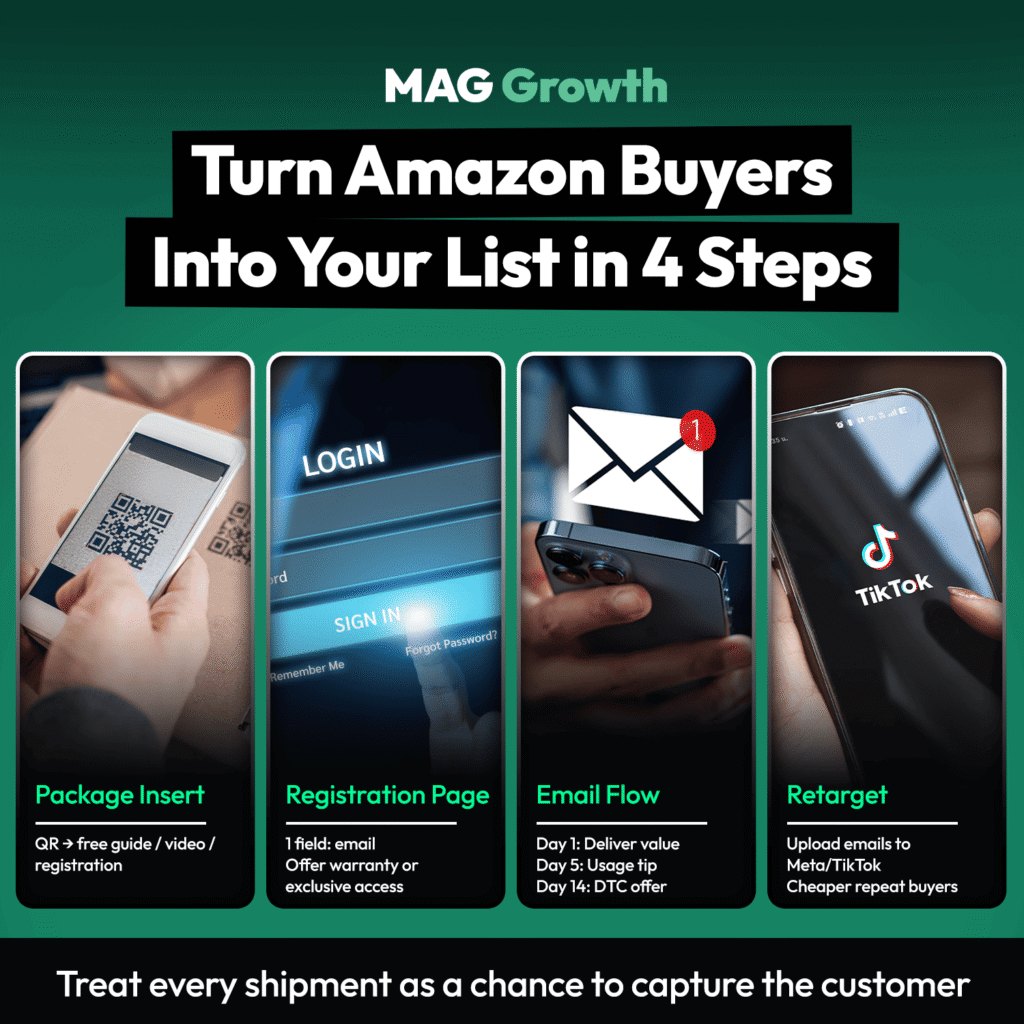
Our capture chain runs the same four steps whether the buyer arrives from a marketplace or your own store. Step four is where masked addresses break it, because a relay address matches nothing when you upload your list to Meta or TikTok.
7. Capture the phone number as your durable identifier
A phone number survives an alias deactivation, so it is the sturdier of the two identifiers. Ask for it in the post-purchase window rather than at the popup, where the shopper has no reason yet to give it.
Route shipping and order updates to SMS for this segment first. Our breakdown of email versus SMS for DTC brands covers where each channel earns its cost.
8. Reach them outside the inbox entirely
Package inserts and post-delivery follow-up land with the person rather than the alias. They cost more per contact and they work when every digital path is masked.
Use them on your highest-value cohorts first. A QR code on the insert pointing to loyalty enrollment captures identity without another send.
9. Front-load the sequence before the alias goes dark
A masked subscriber is not permanently reachable, so sequence order matters more for this cohort than any other. Put the identity ask and your highest-value offer in the first weeks after purchase, while the address is still forwarding.
Move cross-sell earlier for this segment specifically. A replenishment prompt that lands after the alias dies is spend with no possible return.
10. Suppress the address and keep the person
Honor the hard bounce, then stop there. Retain the order record, the phone number, and any loyalty ID, so the customer still exists when they return under a new alias.
Your support team needs that record. A deleted profile means nobody can look up an order for a customer standing in front of them.
11. Use soft bounces on the masked segment as your early warning
A rising soft bounce rate inside the masked segment usually means a cohort is deactivating. That gives you a short window to reach them on another channel before hard bounces stack up and placement suffers.
Set the alert on that segment specifically. Blended bounce reporting hides the signal until the hard bounces are already logged.
12. Route address matches to a human queue, never an auto-merge
Repeated shipping addresses are a useful signal for reconnecting fragmented profiles. They are a poor merge rule, because shared households and gift orders produce confident false matches.
Build a review queue and let a person confirm. A wrong merge combines two customers’ purchase histories, and there is no clean way to separate them afterward.
13. Split revenue per recipient by segment
Revenue per recipient by segment is your comparison metric, because it survived everything the inbox has done to open rate. Run it for masked and identified separately and one send tells you whether the two groups behave differently on your list.
Report it at the flow level. Blending flows and campaigns hides a broken welcome sequence for months.
14. Publish a corrected repeat purchase rate alongside the raw one
Show both numbers in the same view. The raw rate treats every masked profile as a separate person, and the corrected version treats that cohort as a known unknown.
Put the gap between them in the report. Nobody should build a forecast on a number they believe is exact when it carries a measurable error.
15. Track identified rate and alias mortality rate
Identified rate is the share of new profiles in a period where you hold a durable identifier, and it is the only metric measuring whether your capture work functions. Watch it monthly by signup path.
Alias mortality rate is the second, and we have not seen anyone else name it. Track it as the share of masked profiles that hard bounce inside a set window, and as the median days from signup to first bounce, because that second figure sets the timing in fix nine.
16. Model LTV as a range, then reprice acquisition and prepare for agents
Report a range instead of a point. The floor treats every masked profile as a separate person, the ceiling assumes masked profiles repeat at the same rate as identified ones, and the width between them is the cost of not capturing identity.
Take the corrected number to whoever owns paid, since bid ceilings built on understated LTV are the most expensive downstream effect here. Then get ahead of agentic checkout marketing consent, because OpenAI’s Instant Checkout keeps the brand as merchant of record for fulfillment, returns, and support while the customer relationship stays with the agent.
Send us ninety days of data and our retention marketing team will show you the corrected repeat purchase rate for your account with the masked cohort separated out.
More Email and SMS Resources From MAG Growth
Each of these covers a piece of the same problem, which is knowing who is on your list and what they are worth.
- Email and lifecycle services for how we run flow architecture and capture end to end
- Retention marketing services for the program these fixes belong inside
- Ecommerce builds for fixing capture at the store and checkout level
- Creative production for the post-purchase assets that carry the identity ask
- Brand identity for the trust signals that reduce masked signups at the form
- Content and link building for the organic authority that lowers blended acquisition cost
- The complete guide to DTC email marketing for the wider program
- Revenue per email benchmarks for the targets to hold each segment against
- The state of AI inbox email marketing trends 2026 for why open rate stopped measuring anything
Masked Email Addresses in Klaviyo FAQs
Are masked email addresses fake or disposable?
They are real inboxes forwarding to real people who chose privacy over convenience. Apple describes them as permanent forwarding addresses the user controls, so treat them as anonymous customers rather than list trash.
Does Sign in with Apple cost me first-party data?
It costs you identity on a share of signups, though it may buy you conversion rate in return. AtData measured relay addresses at 19.3% of captured data in an app offering Sign in with Apple, so run that trade against your own numbers.
Should I block icloud.com signups at checkout?
No, and this is the most expensive mistake in the set. Most icloud.com profiles are ordinary Apple customers, and blocking the masking domains costs you the buyer while the shopper simply checks out as a guest.
Can I match a relay address back to a real customer?
Not through the address itself, and any vendor claiming otherwise works against the intent of a privacy feature. Match through what the customer gives you voluntarily, such as a phone number, a loyalty ID, or an order lookup.
Do masked subscribers hurt deliverability?
Only once the alias goes dark and you keep sending. Apple returns mail to sender after an address is deactivated, and MarketingProfs has flagged that monthly hard bounces above 2% raise your odds of being junked or blocked.
Why did a batch of my subscribers hard bounce at once?
A cohort of masked addresses acquired around the same time likely got deactivated around the same time. Check whether the bounced profiles share a masking domain and a signup month before assuming a broader list quality problem.
How do I tell a Hide My Email address from a normal iCloud account?
Historically you could not, because both used icloud.com. Apple’s June 2026 move to a single private.icloud.com domain makes new addresses identifiable, though legacy addresses stay ambiguous.
Does Klaviyo have a native way to handle this?
No major ESP offers native identity resolution for masked addresses, which is why the segment and property approach in fix three exists. Build the tag yourself and treat it as reporting metadata rather than a suppression trigger.
Do agent-completed orders give me marketing consent?
Not reliably, since the shopper agreed to the agent’s terms rather than yours. Your order confirmation becomes the consent capture point, which is why that message now carries more weight than most campaigns you send.
Key Takeaways and Your Next Step
- Masked addresses break identity before deliverability
- Signup path drives exposure, not customer demographics
- Fragmented profiles understate LTV and suppress your bids
- Capture identity after purchase, never at the form
- Suppress the address and keep the person
If you run growth at a $5M to $20M brand, start with the masked share calculation in part one and fixes 13 through 15. Bring the corrected repeat purchase rate to your next planning meeting, because every acquisition decision downstream depends on that denominator.
If you own the brand and wear every hat, start with fixes one through five. They take an afternoon and stop the problem compounding while you work on everything else.
You do not need to hire anyone to get the number. Our Klaviyo list audit is free, there is no obligation, and you keep the findings either way.
Our team will run a full ecommerce email deliverability audit and account review, then show you exactly what your masked cohort is costing your reporting.