

Why This Marketplace Channel Economics Glossary Exists
Most marketplace glossaries define referral fee, fulfillment, and margin, then stop. You still cannot tell your CFO whether a 12% contribution margin points at a pricing problem or a payout problem.
This marketplace channel economics glossary defines 30 terms and attaches a benchmark to each. We built it from managing $1.2B+ in ecommerce revenue across 400+ brands, for the Amazon-native brand building DTC and the founder running $1M to $10M who wants to know whether their numbers look normal.
What terms does this glossary cover?
Thirty terms across five clusters, ordered the way money leaves a channel before it ever reaches your bank.
- Take rate and fee stack, everything the channel keeps before you pay for product
- Fulfillment cost architecture, what moving one unit to one customer actually costs
- Cash conversion and payout timing, why profitable brands still run short on cash
- Contribution margin by channel, which channel funds the business and which one borrows
- Channel mix and expansion math, when to add a channel and when to walk away
Learn the term, check the benchmark, fix whichever number sits furthest out of band.
We rebuild your channel costs from settlement data, then show you where the margin actually goes.

How To Use This Marketplace Channel Economics Glossary
| Cluster | The decision it settles | Who feels it first |
|---|---|---|
|
Take rate and fee stack |
What this channel really costs |
Finance and pricing |
|
Fulfillment cost architecture |
What delivery costs per unit |
Operations |
|
Cash conversion and payout timing |
Whether you can fund the next order |
The founder |
|
Contribution margin by channel |
Which channel earns inventory |
Leadership |
|
Channel mix and expansion math |
Whether to add another channel |
Leadership |
Take Rate and Fee Stack
Everything a channel keeps before you pay for a single unit of product. Brands underestimate this by 10 to 20 points.
What is true take rate on Amazon?
True take rate is every dollar a channel keeps from one order, shown as a percent of what the customer paid.
- The referral fee alone understates your real cost badly, which breaks every channel comparison built on it
- Amazon set its 2026 fulfillment increase near $0.08 per unit, under 0.5% of a typical price, and that figure covers the increase rather than the level
- Rebuild take rate per SKU from settlement data, then investigate any SKU where actual and scheduled costs diverge by two points
What is a referral fee and what is it charged on?
The referral fee is the commission a marketplace charges on each completed sale, calculated on the full amount the customer paid.
- Most margin models apply the percentage to item price alone, so every order lands short and nothing flags it
- Walmart publishes referral rates from 6% to 15% by category and charges no setup or monthly fee
- Check where each SKU price sits against tier boundaries, and reconfirm category assignments every quarter
What is the payment processing spread between channels?
The processing spread measures how card and settlement costs differ across channels for an identical order.
- A 6% commission excluding processing costs you more than a 7% commission including it
- Third-party TikTok Shop fee tables contradict each other on whether processing sits inside the referral rate, so verify yours in Seller Center
- Convert every channel to an all-in percent of customer payment, and put your own store’s processing in the same column
What is a surcharge layer on marketplace fees?
The surcharge layer holds every charge sitting outside the published referral and fulfillment schedule.
- Fuel, peak, inbound placement, aged inventory, and low-inventory fees move without ever triggering a repricing review
- Amazon tied its 2026 changes to underlying cost and cited carrier increases of 3.9% to 5.9% across two years
- List every distinct fee type in one month of settlement data, then trigger repricing off the total instead of off individual fees
What is fee stack drift and how do I catch it?
Fee stack drift describes total channel cost climbing while your prices hold still.
- Amazon froze referral percentages for 2025 and 2026, so brands assume their costs froze alongside them
- One point of drift on $100,000 in monthly volume costs $12,000 across a year
- Trend effective take rate per SKU month over month, and reprice off that line rather than off fee announcements
Should advertising count as a channel cost?
Advertising load carries ad spend inside a channel’s cost stack as a percent of that channel’s revenue.
- Any channel needing paid traffic to hold position charges you an advertising floor, not an advertising option
- Our paid media and CRO work cut one health and wellness brand’s acquisition cost by 42% and moved ROAS from 1.8x to 3.4x in 90 days
- Add advertising load to take rate before you compare anything, and pull the spend-side vocabulary from our DTC Paid Media Glossary
Here sits the true cost of selling on Amazon vs Shopify as layers rather than one headline rate. Fill your own numbers into the third column.
| Cost layer | Marketplace channel | Your owned channel |
|---|---|---|
|
Commission or referral |
Published by category |
None |
|
Payment processing |
Bundled or separate |
Charged directly |
|
Fulfillment per unit |
Published rate card |
3PL or in-house |
|
Storage and peak |
Multiplied in Q4 |
Usually linear |
|
Returns and reverse |
Fee residue on refunds |
Full reverse cost |
|
Advertising load |
Holds your rank |
Buys your traffic |
|
Support and packaging |
Largely absorbed |
Yours entirely |
Fulfillment Cost Architecture
What moving one unit to one customer costs you. Catalog and packaging decisions turn into margin decisions here.
What goes into landed cost per unit?
Landed cost covers what one unit spends reaching your warehouse, including goods, freight, duty, tariffs, insurance, and inbound handling.
- Landed cost holds steady across channels, so every comparison you run sits on top of it
- Tariffs and freight now move it more often than supplier pricing does, which dates any annual figure fast
- Recalculate per SKU per shipment, then feed the current number directly into your price floor
How do I compare fulfillment cost per unit across channels?
Fulfillment cost per unit is what a channel charges to pick, pack, and ship one order.
- Size and weight drive the fee, which turns packaging design into a margin lever
- Walmart reports 50% average GMV growth for items carrying its fulfillment tag with a two-day delivery promise
- Compare the fee as a percent of price, since $3 costs you 6% on a $50 unit and 20% on a $15 unit
How much do storage fees rise in Q4?
Storage cost bills monthly against the space your inventory occupies, and the peak multiplier raises that rate through Q4.
- Peak rates punish slow movers and the safety stock you added to avoid stocking out
- Marketplace peak storage commonly runs two to three times off-peak, while 3PL pricing stays closer to linear
- Split inventory by velocity before September, and let our logistics team route your depth to a 3PL
What is cost to serve and how is it different from fulfillment cost?
Cost to serve counts everything you spend delivering one order and keeping that customer, including support, packaging, and inserts.
- Marketplaces absorb costs your own store pays directly, which flatters DTC margin on paper
- Brands omit support and packaging most often, and adding them moves owned-channel contribution several points
- Divide monthly support payroll and tooling by order count, then rerun contribution margin with that number inside
How do I calculate return cost per order?
Return cost per order spreads total reverse expense across every order rather than only the returned ones.
- Marketplaces keep part of the commission on refunded sales, so a return costs more than the refund alone
- NRF estimates shoppers returned 19.3% of online sales in 2025 against 15.8% across retail, and 82% weigh free returns before buying
- Price against the per-order figure, then fix your top return drivers with better sizing, imagery, and detail
What is the shipping subsidy gap?
The shipping subsidy gap measures what delivery costs you beyond what the customer pays for it.
- Free shipping works as a discount that never shows up in discount reporting
- Marketplace shipping credits rarely cover carrier cost, and carrier increases of roughly 4% to 6% widened the gap further
- Set your threshold from AOV and margin instead of from competitor pages, and track the gap monthly as its own line
We rebuild channel cost stacks from settlement data and show you which SKUs lose money.
Cash Conversion and Payout Timing
Why profitable brands run out of money. Fee schedules take your margin, and payout policy takes your momentum.
How long does Amazon hold seller payouts?
A payout hold is the wait between a completed sale and the moment you can disburse the money.
- Reorder speed drives growth, and platform policy decides reorder speed
- Amazon holds funds seven days past confirmed delivery under DD+7, which stacks on top of your disbursement cycle
- Model the timeline from delivery date rather than order date, and treat faster shipping as a cash lever
What is float loss and why does it matter now?
Float loss happens when a channel closes the gap between spending money and paying for it.
- Funding ads from sales proceeds strips out weeks of interest-free working capital
- Our guide to scaling DTC from Amazon covers the ad payment and payout changes driving this
- Price float loss as a financing cost, then compare it against what a credit line would charge you
What is a rolling reserve on a payment processor?
A rolling reserve holds back a share of your own-channel sales for a fixed window as a risk control.
- Processors apply reserves most often to new stores and fast-growing ones, which describes most Shopify launches
- Any reserve converts revenue into a delayed asset your reorder plan cannot spend
- Ask about reserve terms before you migrate, and carry the amount in your forecast as locked capital
How do I calculate cash conversion cycle for ecommerce?
The cash conversion cycle counts the days between paying your supplier and getting paid by your channel.
- This number explains why a profitable brand still cannot fund its own growth
- Payout holds and supplier deposits pull opposite directions, often producing a cycle measured in weeks
- Calculate it per channel, weight by revenue share, and chase supplier terms before chasing margin points
What is a healthy days inventory outstanding for a DTC brand?
Days inventory outstanding measures how long stock sits before it sells.
- Marketplace fulfillment penalizes low cover and high cover alike, leaving a narrow window between them
- Aged inventory surcharges escalate the longer you hold, so a SKU turning twice a year costs far more than one turning eight times
- Report days of cover per SKU per channel, set reorder points from that, and cut the tail that never improves
How much working capital does a new sales channel need?
The working capital peg is the cash a channel ties up permanently to run at a given revenue level.
- Adding a channel is an inventory decision before it becomes a marketing decision
- At $100,000 in monthly channel revenue, a payout hold measured in weeks locks tens of thousands of dollars at any moment
- Calculate the peg before you set a launch date, and sequence the channel later when it exceeds your available cash
Definitions give you the vocabulary, and a calendar gives you the cost. This walkthrough maps a real Amazon payday cycle and shows where DD+7 sets a seller back.
Contribution Margin by Channel
The cluster that ends channel arguments. Revenue rankings and contribution rankings disagree more often than anyone expects.
How do I calculate contribution margin by channel?
Channel contribution margin is revenue minus every variable cost on that channel, with fixed overhead left out.
- Your biggest channel by revenue frequently is not your biggest by contribution
- Build one figure per channel and one per SKU so both views compare directly
- Rebuild it monthly from settlement data, because modeled numbers drift and settlements do not
What is the difference between gross margin and contribution margin?
Gross margin subtracts cost of goods, while contribution margin also subtracts what selling and delivering that order costs on that channel.
- A product at 60% gross margin can return 12% contribution on a marketplace and 35% on your own site
- The gap equals take rate plus fulfillment plus advertising load, which runs 25 to 40 points on a typical marketplace order
- Price your team off contribution margin, and reserve gross margin for sourcing conversations
What is break-even take rate by sales channel?
Break-even take rate sets the highest total channel cost a SKU absorbs before contribution reaches zero.
- This ceiling converts a channel debate into a yes or a no
- Take one minus landed cost divided by price, then subtract your contribution target, so a $40 SKU carrying $14 landed cost and a 20% target caps near 45%
- Run the ceiling across your top 20 SKUs before evaluating any new channel, then price by channel where the rules allow
What is fully loaded CAC by acquisition channel?
Fully loaded CAC counts every cost of winning one new customer, including creator commissions, tooling, agency fees, and promotional discounting.
- Marketplaces bury acquisition inside take rate while your own store exposes it, which makes two similar channels look different
- That same health and wellness engagement cut fully loaded acquisition cost by 42% inside 90 days
- Divide spend by new customers only, never by total orders, then test it against contribution margin per order
How do I calculate contribution margin per order?
Contribution margin per order states contribution in dollars for one average order instead of as a percent.
- Percentages hide AOV gaps, since 15% on a $90 order beats 25% on a $32 order in real money
- Our CRO work added 18% to AOV through post-purchase upsells on the owned channel
- Rank channels by contribution dollars alongside percent, and build AOV where you control the checkout
What is a good break-even ROAS for DTC?
Break-even ROAS is the return on ad spend where an order contributes exactly zero, or one divided by contribution margin before advertising.
- A single company-wide target misprices every channel carrying a different cost stack
- A 40% pre-ad contribution margin breaks even at 2.5x, while a 25% margin breaks even at 4.0x
- Publish break-even per channel and per SKU tier, then set targets above it by whatever growth you actually fund
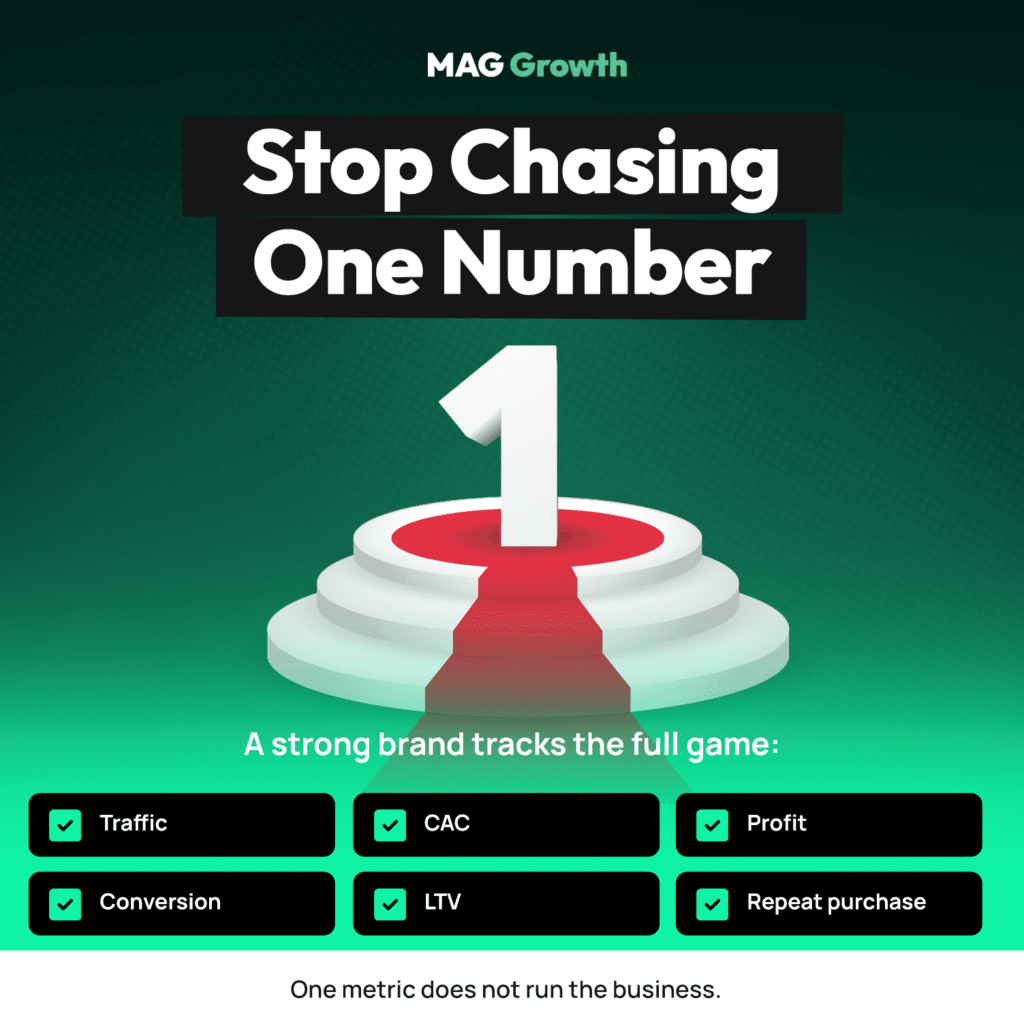
Revenue ranks your channels one way, and contribution ranks them another. Neither number means much on its own.
Channel Mix and Expansion Math
What is channel concentration risk for DTC brands?
Channel concentration risk measures how much of your revenue depends on your single largest channel.- One policy change or suppression moves your whole P&L, and acquirers discount single-channel brands
- Amazon and Shopify together now hold close to half of US ecommerce, so concentration is structural rather than your mistake
- Set a ceiling for your largest channel, then diversify into one sharing your fulfillment infrastructure
How do I tell if new channel revenue is incremental?
Incremental revenue is demand a new channel created, and cannibalized revenue moved over from a channel you already ran.- A launch shifting buyers from a 35% channel to a 12% channel grows revenue and shrinks profit
- Watch your existing channel’s trend during the ramp, since a flat total with a shifting mix means cannibalization
- Differentiate assortment by channel, using exclusive bundles and sizes on your own site
How long should a new marketplace channel take to pay back?
Channel payback period is how long a channel takes to repay its launch cost out of its own contribution.- Launch cost includes content, integration, inventory, and the working capital peg, so it lands higher than most brands budget
- Without a target, a slow launch gets defended indefinitely instead of fixed or cut
- Set the target before launch, launch with a narrow SKU set so the number reads clearly, and pause anything past target with no improving trend
When should I add a second marketplace channel?
Marginal channel economics weighs what your next channel adds, not what your existing channels average.- Your best SKUs and best content already sit on channel one, so channel two rarely matches its performance
- Walmart charges no setup or monthly fee and publishes 6% to 15% referral rates, which makes time and working capital your real constraints
- Model the next channel on its own numbers with a conservative ramp, and add it when marginal contribution clears break-even
How do I set prices across marketplaces and my own site?
Cross-channel price architecture structures your prices, packs, and bundles deliberately across every channel you sell on.- Identical pricing makes your cheapest channel subsidize your most expensive one, and it creates the signals costing brands the Featured Offer after a DTC launch
- Marketplaces monitor external pricing and some require parity, so your architecture has to work inside their rules
- Vary the offer instead of the unit price through multipacks, subscriptions, and channel exclusives, then read our Buy Box breakdown for the enforcement side
Does repeat rate differ by acquisition channel?
Repeat rate by acquisition channel shows what share of customers from each source come back and buy again.- A worse first-order margin still wins when those customers return more often, which is the lifetime value half of the equation
- Around 60% of buyers go direct for benefits they cannot get elsewhere, and more than 55% feel a stronger connection through a brand’s own site
- Tag customers by first touch, report repeat rate at 90 and 180 days, then move budget toward the cohorts that come back
Marketplace Channel Economics Glossary FAQs
Is Walmart Marketplace worth it for brands?
It pays when your break-even take rate clears Walmart’s published rate and you hold working capital for a second inventory pool. Walmart lists 6% to 15% referral rates with no setup or monthly fees, so operations limit you rather than money.
Is Shopify cheaper than Amazon for a $1M brand?
Shopify charges a lower take rate and demands a higher acquisition cost, so your fully loaded CAC decides the answer. Run both through one cost stack including support, returns, and shipping subsidy before you commit either way.
How do I tell if a new sales channel is profitable?
Compare contribution margin per order against fully loaded CAC on that channel, then confirm the revenue arrived new rather than moving over. A channel with positive contribution and negative incrementality still costs you money.
What tools track channel profitability?
Profit dashboards assemble the numbers, but your inputs matter more than your tool. Whatever you pick has to read settlement data directly, since modeled fee estimates drift away from actual charges inside a quarter.
How often should I rebuild my channel economics?
Monthly for effective take rate and contribution margin, quarterly for landed cost and category assignments. Fee schedules hold flat while real costs move, so a calendar beats waiting for an announcement.
Where should an Amazon-native brand start?
Start with true take rate on your top 20 SKUs, because that one number reframes every decision after it. Our complete guide to scaling DTC from Amazon covers the transition steps that follow.
Your Channels Are Not Equal
Brands manage channels by revenue and then wonder why profit never follows. These thirty terms replace that habit with arithmetic you can defend in a board meeting.
Start with true take rate, move to contribution margin per order, then price the working capital peg on anything new. Those three numbers name the channel earning your next inventory dollar and the one quietly borrowing from the rest of the business.
You keep the analysis either way, with no obligation attached.
Our team rebuilds your channel economics from real settlement data and shows you where margin goes.