

Executive Summary
AI inbox email marketing trends reshaped DTC email between January and August 2026, and most teams read the change backward. Opens climbed, clicks fell, and marketers rewrote subject lines that were never the problem.
We manage $1.2B+ in ecommerce revenue across 400+ brand partners, and the same pattern showed up in every category. The inbox stopped holding your message and started editing it.
Gmail and Apple Mail now summarize your email, rank it against everything else competing for that reader, and decide what appears. Your subscriber decides second.
Key findings
- Opens rose while clicks fell across categories
- Summaries replaced preheaders as the visible hook
- Relevance sorting overrode send-time optimization
- Authentication became a rejection gate, not a score
- SMS revenue per send flattened as lists saturated
- Agent-completed orders arrived without marketing consent
- Fewer steps beat richer email formats on revenue
Who this report is for
This email marketing report serves the ecommerce director at a $5M to $20M brand who must explain a reporting contradiction to a CEO this quarter. It also serves the scaling founder at $1M to $10M who wants to know whether the drop they are watching is normal.
Both get the same answer. The drop is normal, the cause is structural, and the fix sits in your opening sentences rather than your subject line.
Methodology note
This report draws on MAG Growth’s work with 400+ DTC brand partners across beauty, food and beverage, apparel, health and wellness, and outdoor gear. We verified every provider rule described here against the provider’s own documentation in August 2026.
A free ecommerce email audit from our team reads your headers, flows, and placement data, then tells you which of these seven findings is costing you money right now.

Finding 1. Your Open Rate Stopped Measuring Anything
Opens rose across most DTC accounts this year while clicks fell, and one cause drove both. AI summaries fire a load event without a human reading anything, and the humans who do engage often stop at the summary.
Why did my email click rate drop in 2026?
A machine read your email first and told the subscriber what it said. Gmail shows summary cards at the top of message content automatically whenever a summary helps, so readers get the gist without scrolling.
Apple does the same thing one layer earlier. A short summary appears under each email in the inbox list, and only turning the feature off restores the sender’s actual first lines.
Are open rates still useful in 2026?
Treat open rate as a smoke alarm and nothing more. Google states plainly that it does not track open rates and cannot verify third-party open figures, and it warns that low opens signal nothing reliable about spam placement.
Read that twice before your next board deck. The provider delivering most of your mail does not measure the number your report leads with.
Demote open rate to a diagnostic row and promote click rate and revenue per recipient. Both survived the change because both demand a human action on your site.
Finding 2. Your First Two Sentences Carry the Whole Email
Preheader text ruled the last decade. The summarizer now overwrites it, and it builds the replacement from the top of your body copy.
Do Apple Mail summaries hurt email marketing?
Apple Mail summaries punish sloppy emails and reward disciplined ones. The summary replaces the preview line under each sender, so an email that opens with a greeting and a hero image hands the model nothing worth extracting.
Open with the offer, the product, and the deadline in plain text and the summary reports them accurately. That summary then works as a second subject line you wrote without realizing it.
How do I control email placement with semantic HTML?
Controlling email placement with semantic HTML means handing the parser a real document instead of a picture of one. Three fixes cover most templates.
- Put the offer in live text, never inside an image
- Use a real heading element for the main message
- Ship a clean plain-text alternative with every send
Image-only emails already carried spam-filter risk, and they now vanish from the layer deciding what your subscriber reads.
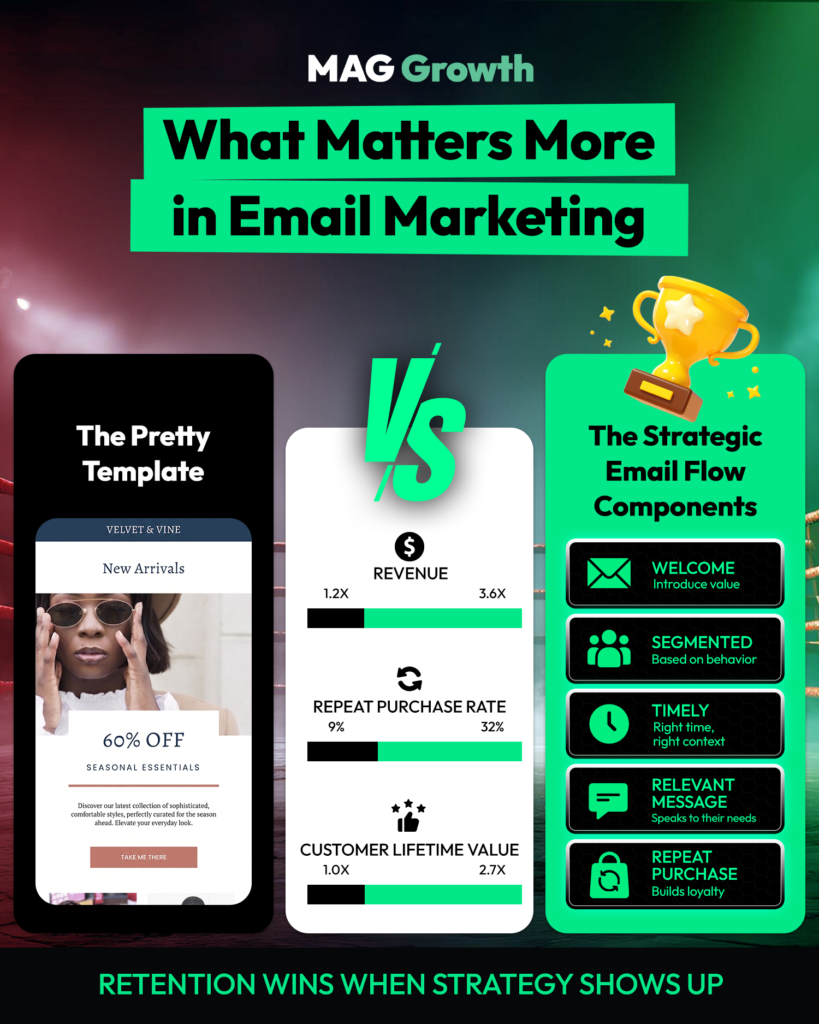
A polished template with nothing structural underneath performs worse than a plain one built to be parsed. The difference shows up in revenue rather than in the design review.
What MAG Growth is seeing in practice
We rewrote the opening block across client welcome and cart flows and treated that first paragraph as the primary creative asset. Short, specific, and front-loaded wins, because summarizers reward the same structure a skimming human rewards.
Our lifecycle work for a specialty coffee brand produced a 179% email revenue increase in thirty days. The same discipline applies to every opening block you rewrite this quarter.
Finding 3. Relevance Replaced Chronology
Send-time optimization served a chronological inbox. That inbox is disappearing, and its replacement ranks you against every other sender competing for the same attention.
How does Gemini rank promotional email?
Gemini ranks promotional email on engagement history rather than arrival time. Google pushed a broad set of Gemini features into Gmail in January 2026, and several arrived switched on by default so users must opt out rather than opt in.
Apple applies the same logic differently. Priority Messages pins time-sensitive mail to the top of the inbox, and Apple Mail sorts the rest into Primary, Transactions, Updates, and Promotions.
What is the Gmail AI Inbox tab?
The Gmail AI Inbox replaces the reverse-chronological list with a curated view of what the model believes matters to that person. Plan around the direction rather than the rollout date.
Relevance sorting already reached the Promotions tab ahead of it. The ranking layer runs today whether or not the new view reaches your subscribers.
Managing sender reputation for AI inboxes
Reputation used to decide delivery. It now decides placement, because the engagement signals keeping you out of spam also set your position inside the tab.
- Suppress subscribers with no engagement in 90 days
- Drop 180-day dormant profiles from promotional sends
- Send risky campaigns to engaged segments first
Most teams do the opposite. Opens dip, they add sends to recover volume, complaints climb, and placement falls further than where it started.
Slow down before you speed up. Recovery runs through fewer sends to a cleaner segment.
What MAG Growth is seeing in practice
Brands that cut list size to protect engagement almost always grow revenue within two cycles. Founders resist because the subscriber count drops, and directors approve because revenue per recipient climbs.
Finding 4. Deliverability Became a Gate Instead of a Gradient
A weak authentication setup used to cost you placement. It now costs you the entire send.
What is the cost of poor AI email deliverability?
You pay in permanent rejections rather than soft penalties. Microsoft requires SPF, DKIM, and DMARC from domains sending more than 5,000 messages a day to Outlook, Hotmail, and Live addresses, and it routes non-compliant mail to junk before blocking it outright.
Google enforces a complaint ceiling alongside it. Senders must hold reported spam under 0.10 percent and never touch 0.30%, and anyone who breaches that ceiling regains mitigation support only after seven consecutive clean days.
What does that ceiling look like at your volume?
Convert the percentage into your own numbers. At 10,000 sends, thirty complaints hits the ceiling and ten complaints hits the target.
At 100,000 sends those figures become three hundred and one hundred. One badly segmented campaign to a dormant cohort produces that in an afternoon.
| Inbox layer | What it does | What it changes in your send |
|---|---|---|
|
Gemini summary cards |
Condenses the message before opening |
Your first 60 words become the hook |
|
Apple Mail summaries |
Replaces the inbox preview line |
Preheader text stops being visible |
|
Relevance sorting |
Ranks by engagement, not arrival |
List health outranks send time |
|
Priority Messages |
Pins urgent mail above everything |
Promotional mail rarely qualifies |
|
Authentication gates |
Rejects unauthenticated bulk mail |
Setup errors cost the whole send |
Does switching ESPs reset a damaged sender reputation?
Changing platforms clears nothing, because reputation attaches to your sending domain rather than the software behind it. A new provider inherits your complaint history and your alignment errors intact.
Repair the domain instead of the vendor. Warm slowly, mail your most engaged segment first, and hold volume flat until placement recovers.
What MAG Growth is seeing in practice
Most accounts we inherit pass authentication on paper and fail alignment in practice. The record exists, the policy sits at monitoring only, and nobody has opened a delivered message header in a year.
We audit infrastructure before touching creative. Fixing a broken sending domain delivers the cheapest revenue in any retention program, and it takes days rather than quarters.Title
We packaged the same infrastructure diagnostic our team runs on client accounts into a Klaviyo account audit checklist download you can finish in one afternoon.
Finding 5. SMS Absorbed the Overflow and Started Saturating
Budgets moved to SMS when email placement got harder. The channel delivered, and it now shows the fatigue curve email showed five years ago.
Speed of intent-based email triggers versus SMS
Intent-based triggers still beat broadcast on both channels. Klaviyo reports the top 10% of automated flows generate about $16.15 in revenue per recipient, a different order of magnitude from campaign performance.
SMS earns its cost when it shortens the gap between intent and action. It loses money when it repeats an email the subscriber already received, which we find in most inherited accounts.
Where SMS is flattening
Ecommerce SMS revenue per send now averages around $0.71, with the top quartile near $1.46, and growth stalled as mature lists saturated. Programs sending more than eight messages a month roughly double their opt-out rate against programs sending four.
The subscriber you acquire this year responds measurably worse than your 2022 cohort. Copy testing does not fix a cohort problem.
What this means for DTC brands
Cap frequency before you cap creativity, then split reporting by acquisition cohort so decay shows instead of averaging away. Our breakdown of email versus SMS for DTC brands covers the split in detail.
Give SMS the urgency and give email everything else. Brands with healthy SMS economics send less and target harder.
Finding 6. Agents Buy Without Joining Your List
The AI inbox tells half the story. Some customers now buy without seeing an inbox, a storefront, or a signup form.
What does agentic commerce do to your list growth?
OpenAI’s Instant Checkout lets a purchase complete inside the chat while the brand stays merchant of record for fulfillment, returns, support, and communication. The order reaches your system and the relationship does not.
Shoppers already moved. Research cited by eMarketer found 38% of shoppers use AI while shopping today and 80 percent expect to use it more, mostly to compare options and narrow choices.
The consent problem nobody has costed
An agent-completed order can arrive with a relay address, no browsing session, no UTM parameters, and no marketing consent you can rely on. The shopper agreed to the agent’s terms rather than yours.
Your order confirmation becomes your only consent capture point. That transactional message now carries more strategic weight than any campaign you send, and almost nobody has optimized it.
What to do this quarter
- Tag agent-sourced orders as their own acquisition channel
- Add a clear marketing opt-in to order confirmations
- Reconcile platform order counts against site analytics monthly
Capture has to happen somewhere the agent cannot intercept. Steven Pope walks through two of those places, starting with product inserts at 01:40.
Volume stays small for most mid-market brands today, and brands treating it as a list-growth problem now avoid rebuilding their retention math later.
Finding 7. Removing Steps Beats Adding Interactivity
Placement decides whether readers see your message. The ten seconds after the click decide whether it earns anything, and most brands lose more revenue there than in the inbox.
Can customers buy directly inside an email?
A few can, and far fewer than the tooling market suggests. AMP for Email supports live forms and product blocks, but rendering stays limited to Gmail, Yahoo Mail, and Mail.ru, which leaves Outlook, Apple Mail, and Proton on a fallback version.
Google also requires you to register each sending address before dynamic content displays. Maintaining two versions of every message on top of that approval killed mid-market adoption.
How do I reduce click to purchase friction in email
Cut steps rather than rebuilding your storefront inside a message. A link opening a prefilled cart beats one opening a category page, and it renders correctly everywhere.
- Deep link every product to its own page
- Prefill the cart from flows where the product is known
- Keep express wallet payment above the fold on mobile
What MAG Growth is seeing in practice
Brands chasing in-message checkout almost always leave a broken landing experience one layer down. The cheaper revenue sits in the two taps between the email and the payment sheet.
Full-funnel growth marketing means reporting click to purchase as one measurement rather than two. Review placement and landing separately and neither team ends up owning the drop.
What Is Changing in AI Inbox Email Marketing Trends This Year
Five shifts define this year, and each demands a different response.
Reporting broke before revenue did
- Clicks fell while revenue held and the gap exposed how much reporting rested on a metric providers never tracked. Rebuild your dashboard before you rebuild your creative.
Creative moved to the opening block
- Since subject lines still earn the notice, but the opening block now decides what the summary says. Write that first paragraph to be quoted, because it will be.
List size turned into a liability
- Dormant subscribers dilute engagement across every send and weak placement pushes engagement lower still. Set a strict suppression policy and measure against our revenue per email benchmarks.
Compliance became an operations problem
- after the FCC pushed its revoke-all consent requirement out to January 2027 while states kept adding restrictions underneath it. Move compliance checks into your monthly cadence instead of an annual legal review.
Personalization got cheap and judgment got expensive
- Since scaling personalized email flows with AI constrains nobody now that any team can produce fifty variants in an afternoon. Spend the saved hours on segmentation logic rather than output volume.
What Top Performers Are Doing Differently
The top quartile of accounts we work with share four behaviors. None look exotic, and all of them annoy someone internally.
They report revenue per recipient at the flow level, while average performers blend flows and campaigns into one view that hides a broken welcome flow for months. Top performers separate the two and report revenue per recipient inside each.
| Metric | Status in 2026 | What to report instead |
|---|---|---|
|
Open rate |
Inflated and untracked by the provider |
Keep as a deliverability alarm |
|
Click-through rate |
Depressed by summaries, still directional |
Track the trend, not the absolute |
|
Click-to-open rate |
Distorted by machine-generated opens |
Retire from executive reporting |
|
Revenue per recipient |
Unaffected by inbox changes |
Promote to your primary metric |
|
Spam complaint rate |
Now a hard gate at the provider |
Review weekly against volume |
They suppress aggressively and defend it with math, while average performers protect list size because it feels like an asset rather than a tax on everyone else’s placement. Show revenue per recipient before and after suppression and the internal debate ends.
They rewrote their opening blocks in the first quarter while average performers kept testing subject lines against inflated open data, which makes it the highest ROI of AI inbox optimization available right now. One copywriting sprint changes what every subscriber sees.
They run one lifecycle instead of two calendars, reserving SMS for genuine urgency in the structure our Klaviyo flow diagnostics follow. Litmus also found that advanced AI adopters are 75 percent more likely to hit ROI above 45 to 1, and the adoption that matters is structural rather than generative.
Predictions for 2027
These are MAG Growth’s calls from what we watch inside client accounts, not consensus forecasts.
Open rate disappears from serious reporting
- Because providers already disowned the metric and the tooling follows within a year. Brands still leading with it in 2027 will signal that nobody senior reads the report.
Summary optimization becomes a named discipline
- With the opening block earning dedicated testing, tooling, and benchmarks the way subject lines once did. It also becomes the script an assistant reads aloud once voice-led shopping scales.
Providers start unsubscribing dormant subscribers for you
- since Gmail and Apple keep building controls over send frequency and acting on prolonged silence comes next. Brands sending eight messages a month feel it before brands sending four.
Order confirmations become an acquisition asset
- as agent-completed purchases push consent capture into the transactional message that popups used to handle. Expect serious optimization work there to reach benchmarks next year.
Deliverability expertise becomes the main agency differentiator
- because creative production keeps commoditizing while infrastructure work does not. Agencies still selling design portfolios lose accounts to the ones showing header-level diagnostics.
AI Inbox Email Marketing Trends in 2026 FAQs
What are the best email metrics to track for DTC brands?
Track anything requiring a human action on your property. Revenue per recipient, click rate, placed order rate, and spam complaint rate all survived the inbox changes, while open rate and click-to-open no longer measure what their names claim.
How do I set up Klaviyo reporting for click rate and revenue per recipient?
Build one view separating flows from campaigns, since blending them hides the problems you need to find. Add revenue per recipient as a column on every flow, then review spam complaint rate against send volume weekly.
How do I benchmark email performance against peers?
Compare against brands in your category and revenue band rather than an all-industry average. Our revenue per email benchmarks break targets down by vertical, average order value, and revenue stage.
Where can I get a DTC email benchmarks report?
Choose a source that segments by category rather than publishing one blended figure. Litmus runs a broad annual survey in its State of Email report, and our vertical breakdowns sit in the benchmarks post above.
Do I need an email deliverability audit for my Shopify brand?
You need one if you send more than 5,000 messages a day to any major provider, because those senders now face rejection rather than reduced placement. You also need one if your click rate fell this year and nobody verified whether summaries or placement caused it.
How do I choose a retention agency that handles deliverability?
Ask what they do when open rates drop suddenly and listen for a technical diagnostic rather than a copy change. Then ask to see a delivered message header from a client account, since an agency that cannot produce one does not monitor the layer that matters.
Should I still write preheader text?
Write it, because not every client renders a summary and the fallback still shows. Stop treating it as your hook and move that job into your first two sentences.
The Opportunity in a Broken Dashboard
Your click rate fell because a machine started reading your email first. The fix is structural rather than creative.
That favors operators who move fast. Rewriting opening blocks, suppressing dormant subscribers, and verifying authentication takes weeks, and almost none of your competitors have done it.
Brands that fix the top of the email and the health of the list take placement from brands still testing subject lines, and we watched that gap widen across 400+ brand partners this year.
Book a retention marketing call, send ninety days of data, and we will run a full email and SMS program assessment showing where the AI inbox costs you revenue.