

Why This DTC Paid Media Glossary Exists
Most paid media glossaries hand you a sentence and walk away. This DTC paid media glossary gives you the definition, the P&L impact, and the benchmark we see across the 400+ brands and $1.2B+ in revenue we manage.
It is built for the operator accountable for growth, not someone looking up what an ad is. We define the basic cost metrics fast, then spend real space on the margin, measurement, and signal terms most glossaries skip.
Skim a full category for the map of a decision area, or jump to one term when a report raises a question. Every entry lists related terms so you can follow the thread.
What Terms Does This Glossary Cover?
Thirty-three terms across seven paid media categories, each mapped to a decision you make with real money.
- Cost and efficiency: CPC, CPM, CTR, CPA
- Algorithm and delivery: Andromeda, GEM, learning phase, campaign budget optimization, broad targeting
- Economics and margin: contribution margin, break even ROAS, marginal ROAS, LTV to CAC, MER
- Measurement and attribution: incrementality testing, attribution window, geo holdout, media mix modeling, MMM vs MTA
- Data and signal: CAPI, pixel deduplication, event match quality, first-party data
- Targeting and audiences: retargeting, lookalike audiences, audience overlap
- Creative and structure: hook rate, hold rate, creative fatigue, modular creative, frequency, cost cap, Advantage+
Before the definitions, here is the bigger picture these terms serve, the four phases every DTC brand moves through as it scales.
Cost and Efficiency Terms
Learn these core cost metrics first. Every margin report depends on them.
How does CPC work in paid media?
Cost per click (CPC) shows how much each ad click costs.
- Formula is total spend divided by total clicks
- Rarely the best first lever, since it ignores the quality and conversion value of the traffic
- Leading with it often drives poor optimization decisions
- Rising CPC with a steady conversion rate points to creative fatigue, not bidding
Related terms: CPM, CTR, CPA
What does CPM mean in advertising?
CPM (Cost per mille) is the cost to serve 1,000 impressions, from the Latin mille for thousand.
- Measures what you pay to be seen, before any click
- A spiking CPM signals rising auction competition, or fatigued creative dragging down your relevance score
- Core input for budgeting, since target CPM times audience size sets your spend
- A higher CPM means a pricier audience, not a better one, so judge placement quality by CPA or conversion rate
Related terms: CPC, impressions, frequency
What is a good Click-Through Rate (CTR)?
CTR tracks the share of impressions that result in clicks.
- Signals whether creative and targeting match the viewer
- Aim above 1% for outbound clicks on broad prospecting
- A healthy CTR lowers CPC because the auction rewards relevance
Related terms: CPC, hook rate, creative fatigue
What does CPA mean in ecommerce?
Cost per acquisition (CPA) shows the cost of every conversion.
- Formula is spend divided by conversions
- Ties spend to a business outcome, not just a click
- Hides margin on its own, so pair it with the economics section below
Related terms: CAC, ROAS, break even ROAS
Definitions are step one, but a sharp team turns them into profit you can bank.

Algorithm and Delivery Terms
The machine decides who sees your ads now. These terms describe how it makes that call, and getting them wrong is why accounts stall.
What is Meta’s Andromeda System?
Andromeda is Meta’s retrieval engine that shortlists candidate ads before any auction.
- Scans millions of active ads and picks a few thousand per impression
- Reads your creative to judge relevance
- Favors advertisers who upload real creative volume and variety
- If it cannot read your creative, your ad never reaches the auction
Related terms: GEM, learning phase, broad targeting
How does GEM work in Meta Ads?
GEM, the generative ads recommendation model, is the central brain Meta introduced in late 2025.
- Ranks the candidates Andromeda surfaces and picks the winner
- Optimizes the winning ad sequence, not the single winning ad
- Kill a weak top-of-funnel ad and you can collapse the sequence feeding sales
Related terms: Andromeda, learning phase, broad targeting
How does Meta’s Learning Phase work?
The learning phase is the window where Meta tests audiences and creatives to find cheap conversions.
- Exits after roughly 50 optimization events in a rolling 7-day window
- CPA often runs 20% to 50% above stable levels until then
- The real “learning phase meta ads how long” answer depends on hitting 50 events a week
- Significant edits reset the counter to day one
Related terms: campaign budget optimization, cost cap, event match quality
What does CBO mean in Meta Ads?
Campaign budget optimization (CBO) gives Meta one campaign budget to distribute among ad sets.
- The campaign budget optimization meaning operators search when told to consolidate
- Money flows to whatever is converting, not locked equally per ad set
- Often exits the learning phase faster because pooled budget hits 50 events quicker
Related terms: learning phase, broad targeting, audience overlap
How does broad targeting work on Meta?
Broad targeting hands the algorithm little or no manual audience input.
- The default for serious growth accounts in 2026
- Narrow segments starve the model of data
- Your creative does the segmenting now
Related terms: Andromeda, campaign budget optimization, lookalike audiences
Economics and Margin Terms
What Is a good ecommerce contribution margin?
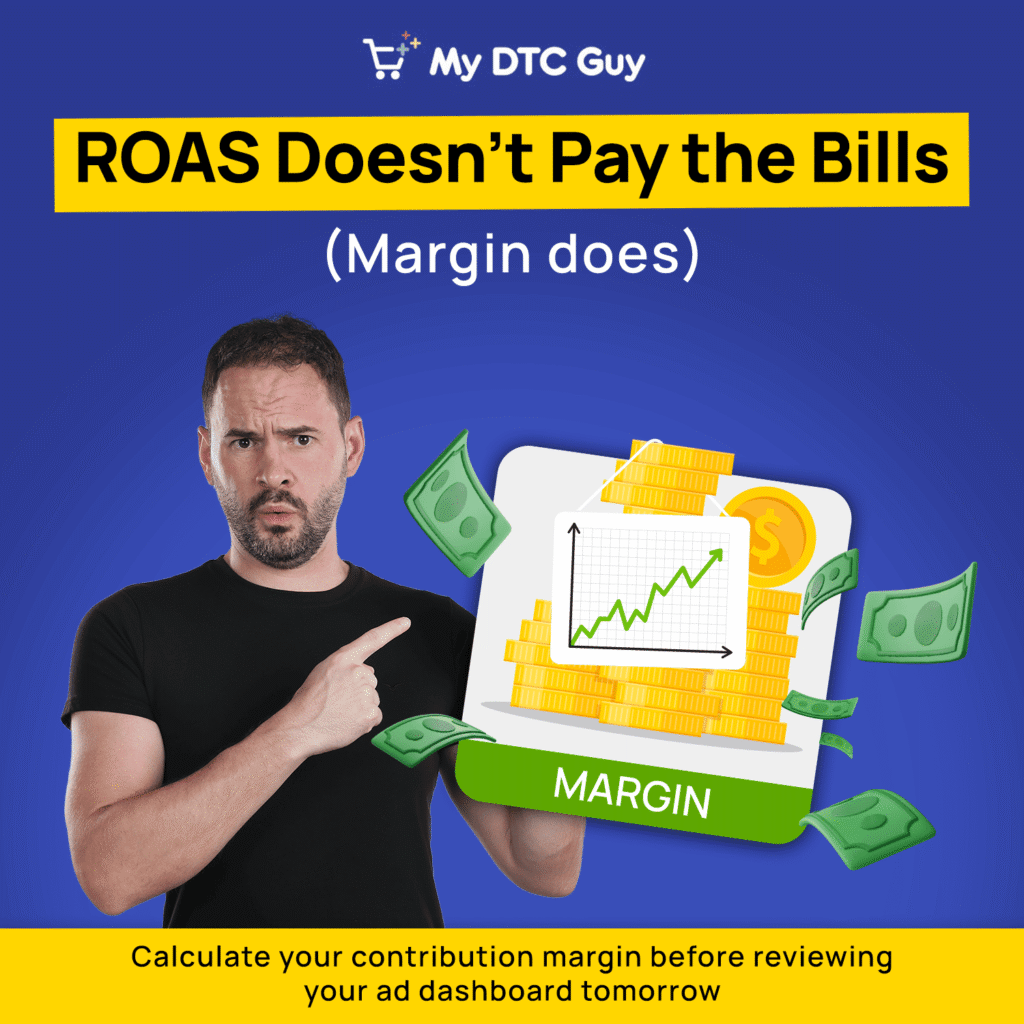
Contribution margin is the cash left after every variable cost comes out of net revenue.
- Includes cost of goods, shipping, payment fees, and ad spend
- A 4x ROAS campaign can still lose money once fulfillment is counted
- Scale on this and you scale profit, not just revenue
MAG Growth benchmark: we have lifted this margin by double digits in a quarter by cutting discount dependence and leaning on stronger creative.
Related terms: break even ROAS, marginal ROAS, MER
How does the break-even ROAS formula work?
Use break-even ROAS to measure the return required to break even.
- The break even roas formula is 1 divided by contribution margin percentage
- A 25% margin means a 4x break-even
- Anything under that number loses money on the sale
MAG Growth benchmark: we set a break even line per product before launch, then scale only assets that clear it with room to spare.
Related terms: contribution margin, marginal ROAS, and MER
How does marginal ROAS work?
Use marginal ROAS to measure incremental returns instead of average performance.
- The marginal roas definition operators need when scaling
- The next dollar buys worse conversions as you push budget
- When it drops below break even, you have found your ceiling
MAG Growth benchmark: watching this number is how we find and cut spend that no longer returns a profit.
Related terms: break even ROAS, contribution margin, budget allocation
What is a good LTV to CAC ratio benchmark?
The LTV:CAC ratio shows how customer lifetime value compares to acquisition cost.
- The common ltv to cac ratio benchmark is 3 to 1
- A ratio near 1 to 1 means you work for the platform, not yourself
- Tells you if the model is sustainable or just buying revenue
MAG Growth benchmark: our strongest brands hold nearer 4 to 1, pushed there by disciplined retention flows.
Related terms: CAC, payback period, MER
What is MER in ecommerce?
Marketing efficiency ratio (MER) tracks total store revenue per advertising dollar.
- Ignores platform attribution entirely
- The blended number your finance team trusts
- Reconciles against your bank account, unlike in-platform ROAS
MAG Growth benchmark: we manage to blended MER first and treat in-platform ROAS as a diagnostic.
Related terms: contribution margin, LTV to CAC, break even ROAS.
| Term | What it measures | Decision it drives |
|---|---|---|
|
Contribution margin |
Cash after variable costs |
What you can afford to spend |
|
Break even ROAS |
Return needed to cover costs |
The floor before you scale |
|
Marginal ROAS |
Return on the next dollar |
Where to stop scaling |
|
MER |
Blended revenue over spend |
Whether the engine is healthy |
Measurement and Attribution Terms
Attribution is guesswork dressed as certainty. These terms tell you what actually caused a sale.
Why does incrementality testing matter?
Incrementality testing shows how many sales your ads truly caused.
- The incrementality testing meaning is one question, would this revenue exist if the ad never ran
- Without it, teams overcredit ads and scale unprofitable spend
- Retargeting and branded search are the usual credit-stealers
MAG Growth benchmark: holdout tests we ran exposed retargeting that added almost nothing, freeing real budget for demand creation.
Related terms: geo holdout, media mix modeling, attribution window
Why does the attribution window matter?
An attribution window is how long a platform will credit an ad for a conversion.
- Meta’s 2026 default is 7-day click plus 1-day view
- Meta removed the longer 7-day and 28-day view windows in January 2026
- Short windows miss slow buyers, long view windows steal email’s credit
- The window changes what the algorithm optimizes toward, not just your report
Related terms: incrementality testing, MMM vs MTA, event match quality
What is a geo holdout test?
A geo holdout test turns ads off in some markets and keeps them on elsewhere.
- The sales gap between the two groups is your true incremental lift
- The closest thing to proof that ads cause sales
- If holdout regions sell just as well, you are paying for organic demand
Related terms: incrementality testing, media mix modeling, budget allocation
Why does media mix modeling matter?
Media mix modeling, or MMM, uses regression on aggregate sales and spend to estimate each channel’s contribution.
- Needs no user-level tracking, so it survived the privacy changes
- Sets strategic budget shape across channels
- Best practice calibrates it with incrementality tests
Related terms: multi-touch attribution, incrementality testing, attribution window
How do MMM, MTA, and incrementality differ?
MTA, or Multi-Touch Attribution, tracks individual user journeys to divide sales credit among specific ad touchpoints before a purchase.
These three answer different questions and work as a stack, not rivals.
- MMM allocates budget across channels
- MTA optimizes tactically inside a channel
- Incrementality testing proves causation
- The mature approach runs all three together
Related terms: media mix modeling, incrementality testing, attribution window
Your margin and attribution numbers hide the waste, and the right team finds it fast.
Data and Signal Terms
What is CAPI and how does it differ from the pixel?
CAPI, the conversions API, sends conversion data server to server instead of from the browser.
- The CAPI vs. pixel deduplication pair matters because browser tracking now misses many conversions
- You must deduplicate so one purchase is not counted twice
- Missing event IDs cause double-counting that ruins the signal
MAG Growth benchmark: fixing the server-side setup commonly lifts tracking accuracy enough to lower acquisition costs.
Related terms: pixel deduplication, event match quality, first-party data
What is pixel deduplication?
Pixel deduplication stops your browser pixel and server events from logging the same purchase twice.
- Relies on a shared event ID tying the two signals together
- Duplicate events inflate reported ROAS
- Clean deduplication is the difference between a trustworthy dashboard and fiction
Related terms: CAPI, event match quality, first-party data
What is event match quality?
Event match quality, or EMQ, scores how well your customer data matches real Meta users.
- Runs on a scale up to 10, higher is stronger signal
- A score below 6 or 7 drives higher acquisition costs
- Pass hashed email and phone data to lift it
Related terms: CAPI, pixel deduplication, first-party data
What is first-party data in ecommerce?
First-party data is information customers give you directly.
- Email, phone, and purchase history you own outright
- Privacy changes cannot take it the way they gutted third-party tracking
- Feeds better audience matching and higher EMQ
Related terms: event match quality, CAPI, lookalike audiences
Targeting and Audience Terms
Creative does most of the targeting now, but these tools still shape who enters the pool.
What is retargeting in paid media?
Retargeting shows ads to people who already touched your brand.
- Site visitors or past add-to-carts, via pixel or uploaded list
- Often posts the highest ROAS because buyers sit close to purchase
- That high return needs incrementality testing, since some sales were already coming
Related terms: incrementality testing, lookalike audiences, pixel deduplication
What are lookalike audiences?
Lookalike audiences are groups the platform models to resemble your best customers.
- Find fresh prospects without hand-defining every trait
- Matter less under broad targeting than they used to
- Still useful to seed a cold campaign
Related terms: retargeting, broad targeting, first-party data
What is audience overlap in Meta ads?
Audience overlap is when your campaigns target enough of the same people to bid against each other.
- You end up paying more to compete with yourself
- Overlap above roughly 20% drives inefficient delivery
- Consolidating campaigns is the usual fix
Related terms: campaign budget optimization, frequency, broad targeting
Creative and Structure Terms
What is hook rate in Meta ads?
Hook rate is the share of people who watch the first three seconds of your video.
- Tells you whether the opening stops the scroll
- First metric to check when a creative underperforms
- A weak hook means the rest of the ad never gets seen
MAG Growth benchmark: We look for a hook rate above 30% before putting real budget behind a video.
Related terms: hold rate, creative fatigue, CTR
What is hold rate?
Hold rate measures how many viewers keep watching into the body of the video.
- Shows whether your message holds attention after the hook earns it
- High hook rate with low hold rate means the opening overpromised
- Read both together to find where a video breaks
MAG Growth benchmark: We target around a 20% hold rate on UGC-style ads.
Related terms: hook rate, creative fatigue, modular creative
What is creative fatigue?
Creative fatigue is the performance drop when an audience has seen an ad too often.
- Shows up as rising frequency and falling click-through
- Means the message went stale, not that people dislike your brand
- The fix is fresh creative volume, not a new audience
MAG Growth benchmark: our team produces dozens of new video assets each month so accounts never starve for angles.
Related terms: hook rate, frequency, modular creative
What is modular creative production?
Modular creative means shooting raw components and remixing them into many variations.
- You order footage, not finished films
- Generates the volume the algorithm needs without a full shoot per ad
- Top accounts produce 15 to 20 new assets a week
Related terms: creative fatigue, hook rate, broad targeting
What is ad frequency?
Frequency is the average number of times a person saw your ad over a set window.
- Rises as you spend more against the same people
- Above 5 on prospecting usually signals deep fatigue
- Watch it on a rolling 14-day window
Related terms: creative fatigue, audience overlap, hold rate
How does cost cap bidding work?
Cost cap bidding tells Meta the most you will pay for a conversion.
- The system throttles delivery rather than spend past your target
- Lowest-cost bidding spends the full budget regardless of return
- A cap protects your downside when the auction gets volatile
MAG Growth benchmark: We have used cost caps to scale spend several times over while holding margins stable.
Related terms: campaign budget optimization, break even ROAS, learning phase
What are Advantage+ shopping campaigns?
Advantage+ shopping campaigns are Meta’s most automated structure.
- Hands budget, audience, and placement to the algorithm
- The default structure for most ecommerce advertisers, reported to lift ROAS 15% to 25% over manual setups
- Exit the learning phase faster on consolidated signal
Related terms: campaign budget optimization, broad targeting, learning phase
| Term | Warning sign | What to do |
|---|---|---|
|
Audience overlap |
Above 20% |
Consolidate campaigns |
|
Frequency |
Above 5 on prospecting |
Inject fresh creative |
|
Learning phase |
Stuck past 7 days |
Raise budget or consolidate |
How to Use This Glossary With Your Team
Definitions are the start, not the finish. Winning operators treat these terms as shared language across media buying, finance, and creative, so a report never means three different things to three people.
Work each category as a system. When margin is the question, contribution margin, break even ROAS, and marginal ROAS answer it together, and no single one is enough alone.
If you want a second set of eyes on your numbers, that is what our free audit is for. We managed $1.2B+ in ecommerce revenue building this playbook, and we will show you where your signal or structure is leaking.
DTC Paid Media Glossary FAQs
What is the most important paid media metric for a DTC brand?
Contribution margin and MER matter most because they tie spend to real cash. Platform ROAS is a diagnostic, but it hides fulfillment and return costs that decide whether you profit.
How long should I wait before judging a Meta campaign?
Give an ad set at least 50 optimization events or a full 7 days. Killing ads early is the top reason accounts stay stuck in the learning phase.
What is a healthy LTV to CAC ratio?
A 3 to 1 ratio is the common benchmark, meaning each customer returns three times acquisition cost. Below that, your model may be buying revenue rather than building profit.
Do I still need the Meta pixel if I have CAPI?
Yes, you run both and deduplicate with a shared event ID. CAPI fills gaps the browser pixel misses, and dedup stops double counting.
Why do my Meta numbers not match Shopify?
The attribution window is the usual reason, not a broken pixel. Meta’s 7-day click plus 1-day view default credits conversions differently than Shopify’s last-click view.
Your dashboard is probably lying about your margin. We will show you where your data, structure, and spend are leaking, then map the fix.