
Online return rates are hitting 19.3%, signaling a dangerous shift for e-commerce stores in 2026. The days of “growth at all costs” are over, and now efficiency is the only metric that matters for survival.
Failing to manage this leads to disaster, especially when the impact of returns on profit margin hits its peak in January. Requests spike by 25% to 45% immediately after Christmas, threatening to wipe out the revenue you worked hard to secure in Q4.
The key is transforming this high-intent interaction from a churn event into a loyalty-building exchange. These strategies will help you stem the tide of profit erosion and secure a strong financial foundation for the year.
John P. Mello Jr."January, also known as Returnuary in retail circles, can be a month when merchants see their margins melt due to product returns."
Strategy 1 - Audit Returns’ Impact On Bottom Line
Why are returns destroying my Q4 profits?
Brand leaders must look closer at the specific costs of a returned order to stop profit loss. Effective ecommerce store management requires you to understand the full financial impact beyond just the refund amount.
A return triggers expensive operational fees that multiply your losses quickly. You face costs for inventory depreciation and missed opportunities that go unnoticed in basic reports.
How much does a return actually cost?
The financial damage of a return goes much deeper than simply giving money back to the customer. Industry data shows that processing a return actually costs you between 20% and 39% of the item’s price.
This creates a deficit where you lose money on marketing and logistics even if you resell the product later. The table below outlines the hypothetical cost of a return for a hypothetical $100 item.
| Cost Component | Financial Impact | Operational Implication |
|---|---|---|
|
Revenue Reversal
|
-$100.00 |
Immediate deduction from your total sales numbers. |
|
Marketing CAC |
-$25.00 |
The money spent to get the customer is now wasted. |
|
Outbound Shipping |
-$8.00 |
You already paid to ship the item and that money is gone. |
|
Return Shipping |
-$8.00 |
The cost of the prepaid label you provided to the shopper. |
|
3PL Processing Fee |
-$3.00 |
The warehouse charges you to receive and scan the package. |
|
Refurbishment |
-$2.00 |
Labor costs to fold and re-tag the item for resale. |
|
Total Net Loss |
-$146.00 |
You are now in a deeper deficit than if the sale never happened. |
Why is my inventory stuck in transit?
A surge in returns after Christmas often leads to a crisis where stock gets trapped in trucks or piles. This inventory is physically present but digitally unavailable for you to sell to new customers.
Buying new stock to fill this gap risks leaving you with too much product once the returns are processed. This cycle forces heavy discounting later to clear the excess and hurts your margins even more.
- Seasonal items often return too late to be sold again.
- Demand evaporates by the time the stock is available.
- Inventory becomes dead stock that sits in the warehouse.
How do returns affect cash flow forecasting?
Many brands make the mistake of setting their Q1 budgets based on high top-line revenue from December. A cash crunch happens when refunds and bills hit simultaneously in early January.
Financial experts view mid-January as the true start of the fiscal year once these losses become visible. You must maintain a cash buffer or implement strategies to increase exchange rates to protect your liquidity during this gap.
Strategy 2 - Pivot to Exchange For Retention
Stop letting post-holiday returns drain the revenue you secured in Q4.

Why exchanges are better than refunds?
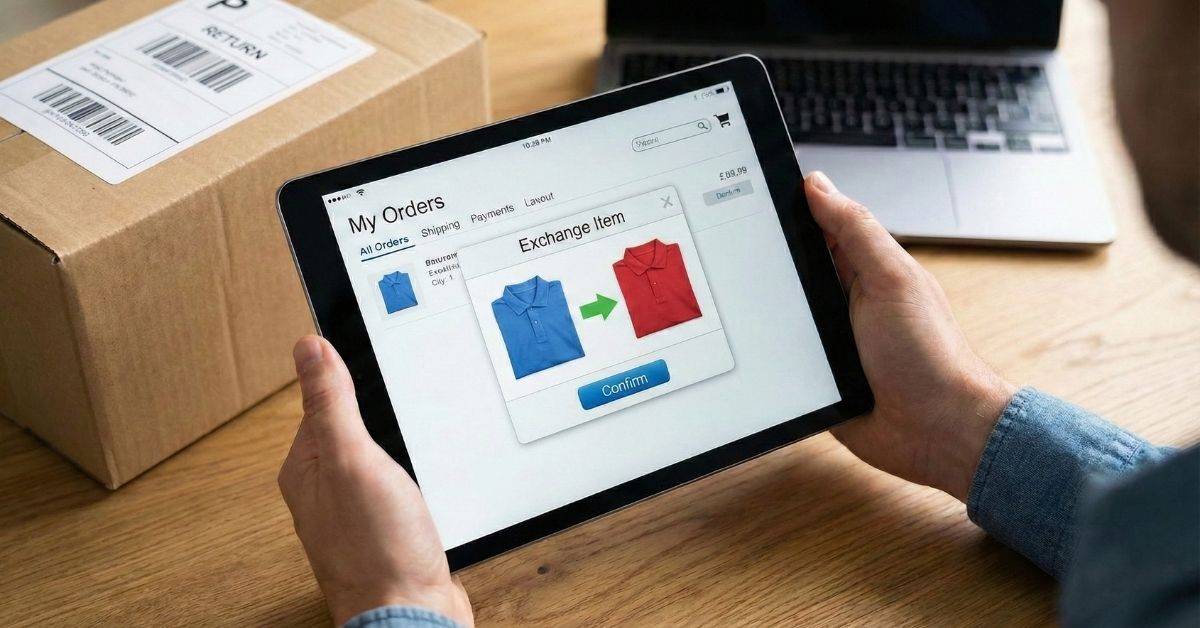
Your return policy is the most effective lever in your ecommerce returns management strategies to mitigate revenue loss. You must shift consumer behavior from seeking refunds to retaining value through an active exchange strategy.
Why should I prioritize exchanges over refunds?
Exchanges are better than refunds because they keep the customer relationship alive. Refunds end the transaction, while exchanges preserve the customer relationship and create another chance to deliver the right outcome.
- Keeping the customer in your ecosystem protects the marketing dollars you spent to acquire them.
- Fixing a product issue builds deeper trust than simply giving money back.
- Recommendations during the exchange process can turn a return into a larger net sale.
Are exchanges more profitable than refunds?
Implementing strategies to increase exchange rates allows your brand to retain the original transaction value. Promoting these options clearly can double adoption rates compared to hiding them in fine print.
The Financial Value of Exchanges
| Scenario | The Math | Net Impact |
|---|---|---|
|
Refund |
Lose $100 revenue and pay $20 in costs. |
-$120 Negative Impact |
|
Exchange |
Keep $100 revenue and pay $15 in costs. |
+$85 Positive Impact |
What is the best way to incentivize exchanges?
You must engineer policies that make exchanges the easiest path for the customer. Offering a “Shop Now” bonus is a powerful psychological tool to drive this behavior.
Offering $110 in credit for a $100 return creates a perception of free money. This bonus is mathematically cheaper for you than the cost of processing a full refund.
- The cash remains within your brand’s ecosystem.
- Customers browse higher-priced items to use the free bonus.
Should I charge for return shipping?
Many profitable brands now use “strategic friction” to protect their margins. This means charging a fee for refunds while keeping exchanges completely free.
- Present a deduction for the shipping label if the customer selects a refund.
- Waive the fee immediately if they select an exchange instead.
- Cost-conscious consumers will choose the exchange option to avoid the extra charge.
- Customers who truly want a refund will pay the fee and recoup your logistics costs.
What is instant exchange technology?
Traditional exchanges cause frustration because the customer has to wait days for the warehouse to receive the old item. Instant exchange technology solves this by shipping the replacement as soon as the carrier scans the return.
You place a temporary hold on the customer’s credit card to reduce risk. This speed mimics the initial purchase experience and improves customer satisfaction scores.
Strategy 3 - Structure A Tech Stack for Retention
What software do I need for returns?
Managing a 45% post-holiday spike is impossible if you rely on manual spreadsheets. You need a robust tech stack, and a specialized Shopify agency can help you execute these strategies effectively.
What are the best returns portals?
Platforms like Loop Returns and ReturnLogic integrate directly with your site to automate approvals. These tools are essential for implementing strategies to increase exchange rates automatically.
Key Capabilities of Returns Portals
| Feature | Function | Benefit |
|---|---|---|
|
Self-Service Workflows |
Allows customers to enter order numbers and select items. |
Reduces support tickets by letting users handle the process alone. |
|
Smart Exchanges |
Suggests the next size up if an item is too small. |
Facilitates seamless one-click exchanges without browsing. |
|
Inventory Visibility |
Checks real-time stock levels before confirming the swap. |
Proper Shopify management prevents the disappointment of cancelling an exchange order later. |
When should I offer returnless refunds?
You can use algorithms to let customers keep items when shipping costs exceed the product value. It is often cheaper to refund the customer than to pay for logistics and restocking fees.
- Trigger this for cheap items under $15 or expensive shipping zones.
- Offer this to VIP customers as a gesture to build long-term loyalty.
- Reduce your carbon footprint by not shipping low-value waste back to the warehouse.
- Keep this option hidden in the background to prevent customers from abusing it.
How can I prevent abusive return requests?
Advanced platforms use AI to analyze return reasons and spot suspicious patterns. This technology helps you block abusive requests before they damage your bottom line.
- Flag accounts with return rates over 40% for manual review.
- Identify orders with multiple sizes to catch bracketing behavior.
- Inspect flagged returns strictly to ensure items have not been worn.
Strategy 4 - Save the Sale with Lifecycle Marketing
How do I write return emails?
You must fight for retention in the inbox once your technical rails are established. Any experienced ecom agency knows that effective strategies treat every transactional email as a high-value marketing asset.
Standard notifications often miss the chance to trigger psychological buy-in from the customer. The table below outlines a high-conversion flow to turn a breakup into a make-up opportunity.
The High-Conversion Exchange Email Flow
| Email Type | Trigger Event | Strategy |
|---|---|---|
|
The Acknowledgment |
Immediately upon RMA creation.
|
Be empathetic and offer clear upsell options if they have not selected one yet. |
|
The In-Transit Nudge |
When the carrier scans the label. |
Offer a “Bonus Credit” to switch to store credit before the refund processes. |
|
The Win-Back |
Upon refund completion. |
Acknowledge the friction and offer a discount code to lower the barrier to re-entry. |
What are the best SMS scripts for returns?
Text messaging gets open rates as high as 98% compared to just 20% for email. This makes it the ideal channel for strategies to increase exchange rates that require immediate attention.
SMS Scripts for Retention
| Scenario | Script Strategy |
|---|---|
|
Instant Exchange |
Ask the user to reply SWAP to exchange instantly before their size sells out. |
|
Store Credit |
Tell the user to reply CREDIT to swap their refund for extra store credit. |
|
Status Update |
Notify the user that their exchange has shipped and provide a tracking link. |
How can I re-engage shoppers who requested a refund?
You need a dedicated flow for customers who ultimately chose a refund in January. Generic emails fail here so you must personalize messages based on the specific return data.
If a customer returned an item because it was too small you should promote products with a relaxed fit. This approach rebuilds trust by showing you understand their specific problem.
- Send a gentle check-in after 30 days to see if they are still thinking about you.
- Highlight new arrivals and value propositions at the 60-day mark.
- Offer a 20% discount code after 90 days to incentivize them to come back.
Turn refund requests into retained revenue with our proven lifecycle flows.
Strategy 5 - Implement Performance Marketing For Retention
How does paid media support retention?
Lifecycle marketing handles your owned channels, but meta advertising is critical for winning back disengaged customers. Brands must collaborate with their ecommerce agency to integrate return data into their acquisition and retargeting strategies.
Syncing this data prevents you from wasting money on the wrong people. The table below outlines how to segment your audiences based on return behavior.
Ad Audience Segmentation for Returns
| Audience Segment | Action Required | Business Goal |
|---|---|---|
|
Serial Returners |
Exclude users with return rates over 40% from all campaigns. |
Stop spending ad dollars to re-acquire customers who destroy your margin.
|
|
Valid Returners |
Retarget customers who returned for fit or style with dynamic product ads. |
Drive a second purchase by showing alternative styles or accessories. |
|
High-LTV Keepers |
Build lookalike audiences based on customers who rarely return items. |
Signal the algorithm to find users who actually keep what they buy. |
How do I retarget customers who returned items?
Customers who return items for valid reasons like fit or style are still high-intent prospects. They liked your brand enough to buy once and just need the right product match.
You should target this group with ads that feature alternative styles or accessories. Offering free shipping on the next order removes the risk and acts as one of the best strategies to increase exchange rates and repeat purchases.
- Create a custom audience of recent returners based on reason codes like fit.
- Show them dynamic ads that highlight different cuts or collections.
- Provide an incentive that lowers the barrier to re-entry.
How do I improve my lookalike audiences?
High return rates often happen when ads target the wrong type of shopper from the start. Agencies make a mistake when they build audiences based solely on revenue or purchase volume.
You need to build your lookalike models based on customers who have a low return rate. This tells the ad platform to find users who share characteristics with people who keep what they buy.
- Stop building audiences based only on top-line revenue.
- Filter for High-LTV customers who also have low return rates.
- Use this data to improve the quality of your new customer acquisition.
Strategy 6 - Prevent Returns Before They Happen
How can I stop returns at the source?
The most profitable return for your business is the one that never happens. You must focus on the customer experience before the purchase as part of your proactive ecommerce returns management strategies.
How can I improve product visuals?
Inaccurate product descriptions and low-quality images account for a massive portion of customer returns. A Shopify CRO agency would advise investing in high-resolution zoom and video content to show exactly how the product moves.
- Use 360-degree views to help consumers gauge fabric texture and scale.
- Display items on models of various body types to help customers visualize the fit.
What tools help with sizing issues?
Sizing issues are the number one driver of apparel returns and account for roughly 55% of your volume. Solving this friction early reduces the pressure on your backend strategies to increase exchange rates.
Data-Driven Sizing Solutions
| Solution Type | Function | Benefit |
|---|---|---|
|
AI Sizing Tools |
Uses machine learning to predict fit probability based on other brands. |
Helps customers select the right size without guessing. |
|
Fit Badges |
Displays tags like “Runs Small” or “True to Size” on the product page. |
Manages customer expectations immediately before they buy. |
|
User Photos |
Encourages customers to upload images with their reviews. |
Provides social proof on real body types to confirm the sale. |
How do I use feedback to stop returns?
Returns data should not die in the warehouse but must go back to your product teams. This closed-loop system prevents future cohorts of customers from experiencing the same disappointment.
- Investigate manufacturing defects if a SKU has a high return rate for quality.
- Reshoot product photography if customers say the item looks different than the website.
Strategy 7 - Speed Up Your Reverse Logistics
How fast should I process returns?
Operational speed is a critical part of your ecommerce returns management strategies to unlock inventory. The longer an item sits in a pile the higher the risk of missing its seasonal selling window.
Your goal is to reduce the time to resale to under 72 hours from the carrier scan. Dedicating specific warehouse zones to returns processing helps you hit this target during January.
- Prioritize unopened Grade A returns for immediate restocking.
- Dedicate staff shifts solely to processing returns during peak times.
How do I manage my 3PL during January?
Brands using third-party logistics providers need tight collaboration during the post-holiday rush. Efficient processing is essential to support your strategies to increase exchange rates and keep customers happy.
Ensure your contract has specific service level agreements for returns processing during the peak season. You must also provide clear visual grading guides to staff to ensure consistency.
- Ambiguous grading leads to sellable items being discarded as loss.
- Poor inspection results in damaged items being restocked for future customers.
Strategy 8 - Tailor Return Tactics Specific To Your Industry
How do I handle returns for my specific industry?
Different product verticals face unique challenges that require tailored solutions to protect profit margins. You need specific ecommerce returns management strategies to handle issues ranging from fit problems to high-value fraud.
The table below outlines specific tactics for key industries like apparel and electronics. These methods include strategies to increase exchange rates and strict protocols to prevent expensive abuse.
Return Strategies by Industry
| Industry | Primary Challenge | Recommended Solution |
|---|---|---|
|
Apparel & Footwear |
High rates of bracketing and fit issues. |
Use AI sizing and Shark Tags to prevent wardrobing. |
|
Beauty & Cosmetics |
Items are often hazardous and cannot be resold. |
Use returnless refunds for low-value items to save shipping costs. |
|
Electronics |
High value items carry a high risk of fraud. |
Enforce strict serial number tracking and mandatory inspections. |
Common Questions About Ecommerce Returns
How do I handle serial returners?
Transparency is key when dealing with abusive accounts in your ecommerce returns management strategies. You should update your terms to state that you reserve the right to refuse service for abuse.
Use internal data to flag these users and remove them from free return eligibility. This makes their behavior unprofitable and causes them to naturally stop buying from you.
Is a returnless refund actually profitable?
It is mathematically better to refund the customer if shipping costs exceed the item value. You save money on operational expenses like processing and restocking fees.
Keep this tactic hidden so customers do not realize they can get free products. It should work as a surprise rather than a public policy.
How do I forecast cash flow in January?
Move to a rolling forecast model instead of relying on a static annual budget. You should re-forecast around January 15th once the initial wave of returns has cleared.
Maintain a liquidity buffer in Q4 to cover fixed costs while revenue reverses. This accounts for the cash flow gap where expenses remain constant.
Should I extend my return window?
Extending the window actually reduces return rates because it removes the urgency to act. Customers get used to having the item in their house and the urge to return it fades.
What is the most impactful change I can make?
The single best move is shifting your focus from refunds to exchanges. Implementing strategies to increase exchange rates from 10% to 30% saves nearly a third of your returned revenue.
Ready to Turn Returns Into Revenue?
The “Returnuary” spike is inevitable for modern stores but profit destruction is not. You can protect your bottom line by adopting proactive ecommerce returns management strategies immediately.
Data shows that customers who have a positive return experience are actually more likely to buy from you again. Your returns portal is not a loss but serves as a second checkout counter for revenue.
Brands that win in 2026 will staff this second counter with the same care they give their front page. You may need a digital marketing agency for ecommerce retention to ensure this process builds a long-term relationship.
Stop returns at the source by optimizing your sizing guides and product descriptions.